Putin in India: Strategy, Signals, and Global South Assertions
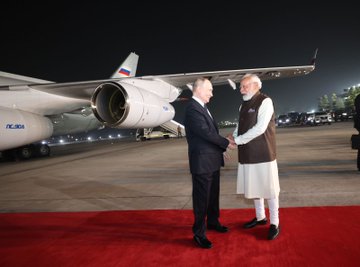
Prime Minister Narendra Modi welcomes Russian President Vladimir Putin at New Delhi airport (Image Modi on X)
Former Prime Minister of the Kyrgyz Republic Djoomart Otorbaev argues that “Putin’s visit to India was not just another diplomatic ritual. It was a carefully engineered geopolitical performance.”
By TRH Foreign Affairs Desk
New Delhi, December 7, 2025 — The visit of Russian President Vladimir Putin and his parleys with Prime Minister Narendra Modi is inviting global scrutiny, with an admission that the Global South is seeking to write rules of geopolitics. The two-hour-long one-on-one meeting of Putin with Modi at the 7, Lok Kalyan Marg where no aides were present is emerging as a subject of keen interest among geopolitical analysts.
In a post headlined “Putin in India: A Visit Wrapped in Silk, Sealed in Strategy, and Full of Inconvenient Signals for the West” on LnkedIn, former Prime Minister of the Kyrgyz Republic Djoomart Otorbaev argues that “Putin’s visit to India was not just another diplomatic ritual. It was a carefully engineered geopolitical performance where every inconspicuous detail said more than any of the 29 signed documents.”
He argued that Modi has sent a firm message to the West and US President Donald Trump in particular that India would chart own path in her foreign policy.
“…the real outcomes of this visit are hiding in plain sight,” he said, while spotlighting “Modi personally greeting Putin on the tarmac—on a red carpet.” He stressed that this was “a gesture far outside protocol. Foreign leaders are usually received by ministers. But this time, the Indian Prime Minister himself stood at the aircraft door.”
Otorbaev accorded “Modi and Putin driving together straight to an informal dinner” as cue of intense significance. Modi and Putin had driven together in a car in China also after the leaders’ summit of the Shanghai Cooperation Organisation (SCO) in September this year.
“Two hours of face-to-face conversation, without aides, without cameras, without leaks. That is where the real decisions were made. Everything else was theatre,” Otorbaev wrote, while spotlight the meeting between the two leaders at the 7, LKM.
He stated that “this is precisely what an Oriental-style visit looks like: documents signed publicly (29), but the main deals and strategic course set quietly, away from microphones. The West still doesn’t understand this style.” He added that India and Russia have mastered this art of geopolitics.
“The message is unmistakable: despite US pressure, New Delhi is not switching fuel or partners,” he said, adding: “The official results alone are monumental. Over 90% of bilateral trade is now conducted in national and alternative currencies, bypassing the US dollar. Trade has increased sixfold since 2022, reaching $70 billion, making Russia India’s fourth-largest trading partner.”
Otorbaev argued that “the most sensitive topics—Su-57 fighters, S-400 deliveries, potential S-500 cooperation—were deliberately left unannounced. That silence tells you more than any briefing.”
He asserted that “their (Russia and India) political trajectories are converging, not diverging. Both leaders made it clear that relations will be protected from external interference.”
“In polite diplomatic language, that means one thing: Washington is losing influence over this vector. All of the above shows that the leaders of the Global South are quietly rewriting the rules, while the Global West watches from the sidelines.”
From Stuck Rupees to a New Trade Play: Sberbank’s Nifty50 Bet
Follow The Raisina Hills on WhatsApp, Instagram, YouTube, Facebook, and LinkedIn




About The Author