Pentagon’s Warning: Is Arunachal Now Beijing’s ‘Core Issue’?
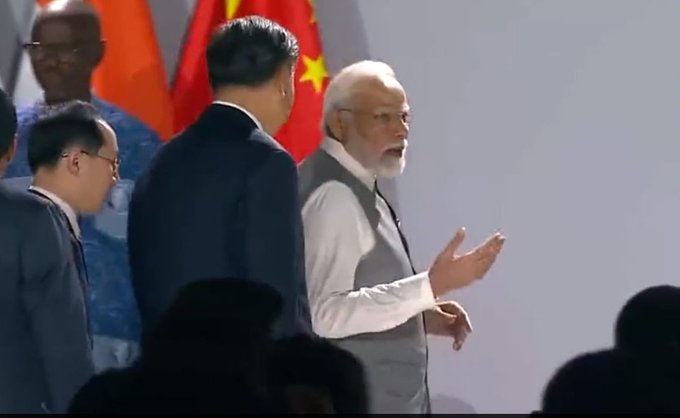
PM Narendra Modi with Chinese President Xi Jinping on the sidelines of BRICS Summit in Johannesburg.
Manish Anand decodes the Trump administration’s first Pentagon report on China — and the strategic warning it carries on Arunachal Pradesh for India
By TRH Foreign Affairs Desk
New Delhi, December 25, 2025 —Washington’s first China-specific Pentagon report under the Donald Trump administration warrants a wise reading from New Delhi. It is not a routine defence paperwork, but a carefully calibrated strategic message. Buried in its dense military language is a pointed warning — one that directly concerns India, Arunachal Pradesh, and the future trajectory of India–China relations.
Decoding the document, Manish Anand, a geopolitics analyst, in an analysis for the YouTube channel of The Raisina Hills said: “The report reiterates what is already well known: China–US rivalry is structural, long-term, and intensifying. But what makes this document significant for India is its explicit reference to Arunachal Pradesh as a Chinese ‘core issue’, placing it in the same strategic bracket as Taiwan and Tibet.”
“This is a serious assertion. Beijing has long avoided formally declaring Arunachal Pradesh as a core interest, even while routinely objecting to Indian activities there,” added Anand. He further argued that “the Pentagon’s assessment suggests that China’s internal strategic calculus may have hardened — even if its public diplomacy has not.”
“In Chinese strategic doctrine, a core issue is non-negotiable. Countries that challenge Beijing on Taiwan have faced severe diplomatic retaliation, economic coercion, and sustained intimidation,” noted Anand in his analysis.
He reasoned that “if Arunachal Pradesh is now viewed through that same prism, the implications for India are profound. It raises the risk threshold for future border confrontations and narrows the space for diplomatic compromise.”
“Equally striking is the report’s blunt allegation that China is actively working to prevent a deeper India–US strategic partnership. According to the Pentagon, Beijing is pursuing a dual-track approach — projecting normalisation with India while quietly undermining trust between New Delhi and Washington,” added Anand, as he quoted from the Pentagon report.
This assessment aligns with post-2020 developments, where military disengagement after the Galwan clash coincided with rapid restoration of flights, trade channels, and diplomatic signalling.
“The report also implicitly questions China’s sincerity on border negotiations. Despite 25 rounds of Special Representative-level talks since 2005, there has been no forward movement. Former foreign secretary Shyam Saran has publicly noted that China has abandoned its earlier ‘give-and-take’ approach,” noted Anand.
He also stated that “while Beijing once accepted Sikkim as part of India, it now appears unwilling to reciprocate flexibility in the eastern sector. The Pentagon’s message to Prime Minister Narendra Modi is unmistakable: normalcy with China may be tactical, not strategic.”
“Arunachal Pradesh remains a pressure point, and India’s choices — between accommodation, deterrence, and alignment — will shape the balance of power in Asia,” argued Anand.
He stated that “this is not alarmism. It is strategic realism.”
Follow The Raisina Hills on WhatsApp, Instagram, YouTube, Facebook, and LinkedIn




About The Author