Pakistani Analyst Reads Germany Signaling India Pivot for Europe
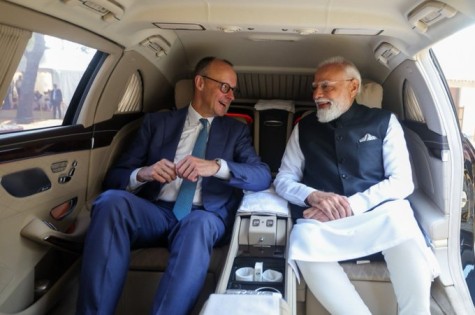
PM Modi hosts Chancellor Friedrich Merz (Image Modi on X)
From Olaf Scholz’s “Focus India” doctrine to Friedrich Merz’s deepened outreach, Berlin sends message—India is the pivot in Indo Pacific.
By TRH Foreign Affairs Desk
New Delhi, January 23, 2026 — Former German Chancellor Olaf Scholz scripted “Focus India” foreign policy shift. His successor, Friedrich Merz, during his India visit this month, accorded depth to Germany’s India pivot. In between the two German chancellors, US President Donald Trump sent tremors in Europe by eroding trust and reliability.
Germany’s India pivot has caught attention of commentators in Pakistan. They note that India has asserted strategic autonomy with Indo-Pacific leverage. Germany, for them, is an exemplar in Europe’s India tilt amid Trumpian geopolitics rupture.
“India has played its hand skillfully, securing technology, legitimacy and access while retaining freedom of maneuver across sanctions, energy and regional policy. Germany, confronting global uncertainty, has opted for pragmatism over pressure,” wrote Saima Afzal, who holds MPhil from National Defence University in Lahore, in Asia Times.
She argued that “the Indo-Pacific has become the principal arena in which economic security, military power and political norms intersect.” Western world has been partnering with India to assert freedom of navigation and rules-based maritime order in the Indo Pacific. India’s growing security partnerships with east Asian nations and naval domination in the Indian Ocean are known to be key enablers of the Indian pivot in the Indo Pacific.
“German Chancellor Friedrich Merz’s January visit to India should be assessed not merely as a bilateral engagement,” argued Afzal, who stressed that the visit illustrates “how middle powers are responding to strategic competition while quietly relaxing normative consistency.”
With “Focus India” strategic paper, Germany had two years ago already signalled the shift. The paper had come after Scholz’s visit to China failed to gain concessions from Beijing for market access.
“India — large, fast-growing, strategically positioned and politically non-aligned — has become central to this recalibration. The Pakistani commentator argued that Merz in his visit showed “Germany’s intent to embed India more firmly within its Indo-Pacific strategy through defence cooperation, technology partnerships and supply-chain resilience.”
“Such flexibility is rarely afforded to smaller states. India’s strategic weight and Indo-Pacific utility have effectively insulated it from the conditionality that often accompanies Western partnerships,” added Afzal. She sought to suggest that the western powers are now overlooking issues which caused discomforts to New Delhi.
Afzal also stressed that Germany’s agreement with India in Defence-industrial cooperation “lies at the heart of the Indo-German relationship and reveals its asymmetry.” “Negotiations over submarine construction involving Thyssenkrupp Marine Systems and India’s Mazagon Dock, alongside collaboration on UAVs, counter-drone systems and advanced platforms, promise India sustained access to high-end dual-use technologies… For Germany, the gains are narrower: commercial access and a foothold in Indo-Pacific security networks,” Afzal wrote.
She noted that the “imbalance lies in leverage.” “German firms will commit capital and intellectual property within procurement frameworks that privilege local control, export discretion and long project horizons. Once embedded, such arrangements are costly to unwind,” argued Afzal.
India-Germany annual trade crossed $50 billion last fiscal. The two nations have set target to double the trade. The India-EU trade deal, set for signing next week, is also set to further enhance Europe’s bet on India.
Afzal claimed that “India has become adept at deliberate strategic bargaining.” She spotlighted India’s leverage of “democracy as strategic credential.”
“The normative dimension of the partnership is more consequential. Both leaders (Modi and Merz) invoked shared democratic values and commitment to a rules-based order,” added Afzal.
She rued “Germany’s public reticence regarding India’s internal trajectory.” “None of this negates the logic of engagement. India matters, and Europe cannot afford strategic absence in the Indo-Pacific,” she added.
Starmer vs Trump: When Alliance Meets Insult Over Britain’s Dead
Follow The Raisina Hills on WhatsApp, Instagram, YouTube, Facebook, and LinkedIn




About The Author