Operation Sindoor: The Strike That Reset India’s Military Doctrine
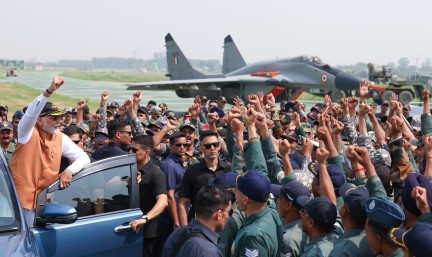
PM Narendra Modi at IAF Airbase in Adampur on Tuesday (Image credit PMO)
From downing 600 drones to strengthening the nuclear triad, Operation Sindoor marked a watershed in India’s security posture—forcing Pakistan to blink and Beijing to defend its weapons
By NIRENDRA DEV
New Delhi, December 31, 2025 —Operation Sindoor was not just retaliation—it was a watershed. For Pakistan, it delivered a brutal lesson. For China, it triggered strategic and commercial discomfort. And for India, it marked the transition from reactive defence to calibrated, tech-driven deterrence.
Defence Minister Rajnath Singh’s blunt assessment captured the moment: Pakistan, he said, has now realised “the heavy cost of running the business of terrorism.” During the operation, Indian air defence units downed or repelled over 600 Pakistani drones, mobilising more than 1,000 gun systems and 750 short- and medium-range SAM platforms in record time.
The Indian Air Force deployed drones and loitering munitions to neutralise enemy air defences, while the Integrated Air Command and Control System (IACCS) fused inputs across services—detecting threats, sharing data in real time, and enabling ground commanders to act decisively. Secure Software Defined Radios and standoff weapon launch detection systems ensured redundancy, speed, and survivability.
The message was not subtle. As Air Marshal A.K. Bharti quoted Ramdhari Singh Dinkar: “There is no love without fear.” It echoed Prime Minister Narendra Modi’s earlier articulation—deterrence, not provocation.
Launched on the night of May 6–7 after the Pahalgam terror attack, Operation Sindoor targeted Jaish-e-Mohammed, Lashkar-e-Taiba, and Hizbul Mujahideen camps, eliminating over 100 terrorists. When Pakistan retaliated with shelling and drone attacks, India expanded strikes to radar sites, communication hubs, and air bases across 11 Pakistani installations. A ceasefire followed on May 10—on India’s terms.
The aftershocks went beyond Rawalpindi. Pakistan’s use of Chinese-origin J-10 jets and PL-15 missiles led Beijing to unleash “tutored experts” to defend the credibility of its weapons systems—aimed as much at global arms buyers as domestic audiences. Pakistan’s battlefield failure was not just a strategic setback for China, but a commercial one.
Meanwhile, India accelerated reform. 2025 was declared the “Year of Defence Reforms”, pushing jointness, AI, drones, cyber and space warfare, and integrated theatre commands. The Navy adopted a ‘no war, no peace’ doctrine, commissioned Project 17A stealth frigates, and prepared to induct Aridaman, the third Arihant-class SSBN—further strengthening India’s nuclear triad.
With 97 Tejas jets ordered, BrahMos and S-400 deployments operational, and a new India–US 10-year Defence Framework, India’s military transformation is no longer incremental—it is structural.
Operation Sindoor proved one final point: India can strike deep, strike precisely, and stop before escalation. That balance—not bravado—is the new doctrine of New Bharat.
(This is an opinion piece. Views expressed are personal)
Operation Sindoor: Auditing Role and Efficacy of Indian Embassies
Follow The Raisina Hills on WhatsApp, Instagram, YouTube, Facebook, and LinkedIn




About The Author