Odisha Higher Education Crisis: Syndicate System Wrath Unravels
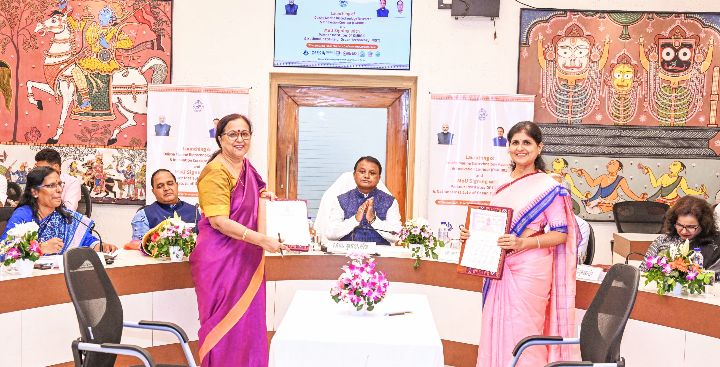
CM Mohan Majhi launches Odisha Marine Biotechnology Research & Innovation Corridor (Image PK Panda)
From VC vacancies to CAG-exposed fund misuse, Odisha’s syndicate system reveals the high cost of political control—and the fragile promise of the 2024 reforms
By PRADEEP KUMAR PANDA
Bhubaneswar, February 8, 2026 — Higher education in Odisha has undergone significant scrutiny and reform between 2024 and 2026, particularly concerning the syndicate system and vice-chancellor (VC) recruitment processes. The Odisha Universities (Amendment) Act, 2020, which abolished the senate and restructured the syndicate, was criticized for centralizing power with the state government, thereby eroding institutional autonomy. This led to administrative vacancies, financial mismanagement, low research output, and poor national rankings.
Legal challenges culminated in the Supreme Court’s intervention, paving the way for the 2024 Amendment Act, which revived the senate, reduced government interference, and facilitated faster recruitments. Despite these reforms, persistent vacancies and past irregularities continue to hinder progress.
Odisha’s higher education landscape, encompassing 17 public universities, has been marked by governance challenges that reflect broader systemic issues in Indian state-run institutions. The syndicate, as the executive body responsible for administrative and financial decisions, and the senate, as an advisory entity on academics and research, form the core of university governance.
However, the Odisha Universities (Amendment) Act, 2020, enacted under the previous Biju Janata Dal (BJD) government, dismantled the senate and reorganized the syndicate in a manner that critics argued enhanced state control at the expense of autonomy. This centralization exacerbated problems such as staff shortages, financial irregularities, and recruitment delays, particularly for VCs.
By early 2026, these issues had prompted reforms via the 2024 Amendment Act, aiming to align with University Grants Commission (UGC) guidelines and the National Education Policy (NEP). This article examines these challenges, drawing on Comptroller and Auditor General (CAG) reports, National Institutional Ranking Framework (NIRF) data, and legislative developments.
The Syndicate System and Governance Issues (2024–2026): The syndicate system’s restructuring under the 2020 Act was a focal point of criticism, as it allegedly prioritized political oversight over academic independence.
Loss of Autonomy and Government Interference: The 2020 amendments allowed the state to nominate members to VC and faculty selection committees, violating UGC Regulations, 2018. This led to “autonomy curbs,” including mandatory Department of Higher Education (DHE) vetting of syndicate decisions and event invitations in 2024. Consequently, academic and administrative functions stalled, contributing to low research output and Odisha’s absence from the top 100 NIRF university rankings as of late 2024–2025. Utkal University, the state’s flagship institution, ranked 48th among state public universities in NIRF 2025, while no public university featured in the overall top 100.
Massive Administrative and Teaching Vacancies: Public universities faced crippling staff shortages. As of March 2025, out of 2,027 sanctioned teaching posts across 17 universities, only 674 were filled, leaving 1,353 vacancies (including 245 professors, 1,155 associate professors, and 666 assistant professors) and over 2,081 non-teaching posts vacant. Overall, more than 3,400 posts remained unfilled, forcing reliance on guest faculty and leading to a “silent collapse” in quality. Institutions struggled to meet UGC norms, such as the 20:1 teacher-student ratio, particularly at the college level.
Financial Mismanagement and Irregularities: A 2025 CAG report exposed lapses in fund utilization. Utkal University misused ₹24.18 crore under Rashtriya Uchchatar Shiksha Abhiyan (RUSA), diverting funds for an administrative building (₹18.7 crore irregularly spent), questionable purchases like diesel generators and VC residence furniture, and leaving equipment idle (e.g., laptops unused for years). Biju Patnaik University of Technology (BPUT) procured 180 computers (₹97.15 lakh) in 2016, with 115 unused for over six years. Rama Devi Women’s University incurred ₹7.45 crore extra due to construction mismanagement. Other issues included ₹11.3 crore wasted on a failed Berhampur cluster university project and diversion of academic funds. These reflected poor prioritization and accountability gaps.
Broader Structural Issues in Odisha Higher Education: Beyond the syndicate, systemic challenges compounded governance woes.
Low Research Output and Completion Rates: Institutions reported only a 16% research project completion rate, worsened by vacancies and interference. This contributed to Odisha’s lag in innovation and national rankings.
Related School-Level Problems: While not directly syndicate-related, school mergers/closures (nearly 10,000 since 2013, impacting tribal areas) and high dropouts (e.g., 18,251 in Rayagada in 2025–26) strained higher education pipelines. Tribal children were hardest hit, with closures fueling educational disparities.
No Public Institutions in Top Rankings: In contrast to private institutions like Siksha ‘O’ Anusandhan (15th in NIRF 2025 universities), public universities highlighted ongoing resource and governance challenges.
Issues with Vice-Chancellor Recruitment: VC appointments were delayed due to legal battles over the 2020 Act’s UGC violations, with a Supreme Court stay in May 2022.
Status as of Late 2025–Early 2026: By late 2025, 14 of 17 universities operated without regular VCs, relying on in-charge officials (e.g., Ravenshaw and Odia University vacancies since August 2025). Over 342 applications were received for 13 positions by mid-2025, but delays stemmed from incomplete syndicates and legal hurdles.
Reforms via Odisha Universities (Amendment) Act, 2024: Passed in April 2025 and effective April 17, 2025, the Act revived the senate (up to 68 members, meeting twice yearly for advisory roles). It reduced interference by having the syndicate nominate to selection committees (UGC nominee, Chancellor’s nominee, syndicate nominee). Universities gained autonomy in faculty recruitment (no OPSC; subject-specific processes). VC age limit increased to 70 years. The Supreme Court lifted stays on May 7, 2025, enabling recruitments. By December 2025, VC selections initiated, with assurances of completion soon. Faculty drives, like OPSC for 312 assistant professors in 2026, commenced.
Issues: These issues fostered administrative paralysis, temporary staffing reliance, financial waste, and stalled progress, indirectly affected by school-level dropouts. The 2024 Act shifts toward autonomy, UGC/NEP alignment, and vacancy resolution. As of early 2026, implementation is ongoing, with VC appointments progressing. However, addressing persistent mismanagement remains crucial for elevating Odisha’s public universities in national rankings.
The period 2024–2026 highlights the tension between state control and institutional autonomy in Odisha’s higher education. While the 2020 Act’s flaws necessitated reforms, the 2024 Act offers a pathway to revitalization. Sustained monitoring, transparent implementations, and stakeholder engagement will be essential to realize these benefits and foster a robust educational ecosystem.
(This is an opinion piece. Views expressed are author’s own.)
Budget 2026–27: Is Odisha Finally Overcoming Historical Neglect?
Follow The Raisina Hills on WhatsApp, Instagram, YouTube, Facebook, and LinkedIn




About The Author