Odisha Budget: ₹3.10L Cr Outlay or ‘Full Menu in Empty Kitchen’?

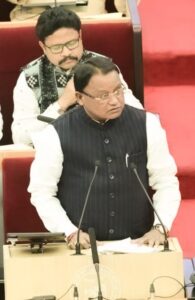
Odisha Chief Minister Mohan Manjhi (Image Odisha CMO)
Odisha Budget 2026-27 sparks fiscal debate as opposition flags rising debt, sectoral cuts and token schemes
By PRADEEP KUMAR PANDA
Bhubaneswar, February 23, 2026 — The Odisha Budget for 2026-27, presented by Chief Minister Mohan Charan Majhi last week, outlines a total outlay of ₹3.10 lakh crore, positioning it as a blueprint for the state’s development under the BJP-led government. While the government hails it as a “people’s budget” with emphasis on infrastructure, agriculture, and social welfare, opposition voices, particularly from the Biju Janata Dal (BJD)-led by former Chief Minister Naveen Patnaik, have lambasted it as “absolutely disappointing” – a “full menu in an empty kitchen” that promises much but delivers little.
This metaphor encapsulates the core critique: an expansive array of announcements lacking substantive funding or strategic focus. Drawing on Keynesian principles and empirical fiscal data, this article critically examines the budget’s shortcomings, connecting its contractionary nature, escalating debt, sectoral cuts, token schemes, unrealistic long-term visions, and failure to address pressing economic issues.
The analysis reveals a budget that prioritizes rhetoric over reality, potentially exacerbating Odisha’s challenges rather than alleviating them.
Fiscal Overview and Growth Concerns
At first glance, the ₹3.10 lakh crore outlay represents a nominal increase from the previous year’s ₹2.90 lakh crore and the 2024-25 figure of ₹2.65 lakh crore. However, when adjusted for inflation – estimated at around 5-6% annually in recent years – this expansion appears contractionary. Critics argue that the BJP government has only managed a cumulative increase of ₹55,000 crore across its three budgets since assuming power, a modest increment compared to the BJD’s last interim budget of ₹2.55 lakh crore in 2023-24. This sluggish growth in budgetary allocation fails to keep pace with Odisha’s economic needs, particularly in a post-pandemic recovery phase where robust fiscal stimulus is essential.
The budget’s capital outlay of ₹72,100 crore (23.3% of the total and 6.5% of GSDP) is touted as a driver for infrastructure, but opposition figures highlight that actual expenditure has been abysmal, with only 57% of allocations utilized in the first 10 months of the current fiscal year. Such under-spending undermines the budget’s potential to stimulate growth, echoing broader concerns about implementation inefficiencies. In essence, the fiscal framework prioritizes nominal figures over effective delivery, risking stagnation in an economy aiming for higher contributions to national GDP (from 3% to 5%, as per the Governor’s address).
Budget 2026–27: Is Odisha Finally Overcoming Historical Neglect?
Escalating Debt Burden
A pivotal concern is the budget’s impact on Odisha’s debt profile. The 2026-27 estimates project an additional borrowing of ₹47,800 crore, pushing the public debt stock to ₹1,55,710 crore. This escalation has driven the debt-to-GSDP ratio from 11.7% in 2023-24 to 14.1% in 2026-27, signaling a worrying trend toward fiscal vulnerability. Over the BJP’s three budgets, the cumulative public debt addition stands at ₹1.38 lakh crore – a stark contrast to the BJD’s ₹78,000 crore over 24 years of governance.
This rapid debt accumulation raises questions about sustainability, especially without corresponding revenue enhancements or growth dividends. Critics, including the Congress, label it an “elephant-sized budget with ant-like spending,” where borrowings fund underutilized schemes, burdening future generations. In a Keynesian lens, while deficit financing can be expansionary, Odisha’s approach risks crowding out private investment and inflating interest payments, diverting resources from productive sectors.
Sectoral Allocations and Cuts
The budget’s sectoral priorities reveal a pattern of reductions in critical areas, contradicting claims of inclusive growth. Health allocation has been slashed by ₹453 crore, from ₹23,635 crore in 2025-26 to ₹23,182 crore – a cut that could strain public healthcare amid ongoing challenges like malnutrition and anaemia. Similarly, percentage declines are evident in agriculture, education, rural development, Panchayati Raj, women and child development, and Mission Shakti programs.
Agriculture, a cornerstone of Odisha’s economy, receives ₹42,492 crore, but critics argue this represents a relative cut when inflation and population growth are factored in. Absent are dedicated schemes for employment generation, price rise control, or structured supply chain management – omissions that exacerbate farmer distress and urban inflation. Education, allocated 13.7% of the budget (about 3.8% of GSDP), faces cuts that could hinder human capital development, particularly in a state targeting higher per capita income by 2047. These reductions, amid no offerings for any population category, underscore a budget that neglects immediate social welfare needs.
Tokenism in Schemes and Announcements
The budget introduces 16 new “token” schemes with allocations ranging from ₹5 crore to ₹15 crore – amounts deemed “absolutely abysmal” for meaningful impact. Furthermore, announcements of four new universities, two engineering colleges, and three agriculture colleges lack any budgetary provision, rendering them hollow promises. This pattern of underfunded or unfunded initiatives exemplifies tokenism, where political optics trump practical execution.
Such approaches erode public trust and fiscal credibility, as seen in national critiques of similar budgets that prioritize announcements over outcomes. In Odisha’s context, they fail to address core issues like unemployment and infrastructure gaps, perpetuating a cycle of unfulfilled expectations.
Long-term Visions Amid Short-term Crises
The budget’s emphasis on futuristic goals – such as establishing five World Skill Centres by 2036 and seven by 2047 – is dismissed as “absolutely ridiculous” by critics. Invoking Lord John Maynard Keynes’ famous quip, “In the long run, we are all dead,” the opposition argues that budgets should prioritize current-year plans over rosy projections for distant horizons. This long-termism distracts from immediate crises, including youth unemployment and economic disparities.
The vision of a “Viksit Odisha” with a USD 500 billion economy by 2036 demands a 9.1% annual GSDP growth rate, per the state’s vision document. Yet, actual performance under BJP – 7.2% in the first year and 7.9% in the second – falls short, making the target unattainable at current trajectories. This disconnect highlights a budget that paints aspirational pictures without grounding in feasible strategies.
Odisha’s 2026-27 Budget, while ambitious in scale, emerges as a document riddled with contradictions: nominal expansions masking contractionary effects, debt escalations without safeguards, sectoral cuts undermining welfare, token schemes lacking substance, and long-term dreams ignoring short-term realities. It fails comprehensively to address current economic issues – from employment and inflation to inclusive growth – offering little to farmers, youth, women, or rural communities. As Naveen Patnaik aptly summarizes, it is a “full menu in an empty kitchen,” big on paper but weak on delivery. For Odisha to realize its potential, future budgets must shift from rhetoric to rigorous, evidence-based policymaking, ensuring fiscal prudence aligns with equitable development.
(This is an opinion piece. Views expressed are author’s own.)
Odisha Higher Education Crisis: Syndicate System Wrath Unravels
Follow The Raisina Hills on WhatsApp, Instagram, YouTube, Facebook, and LinkedIn




About The Author