Northeast: Tracks of Change: Mizoram to Barak Valley by Rail
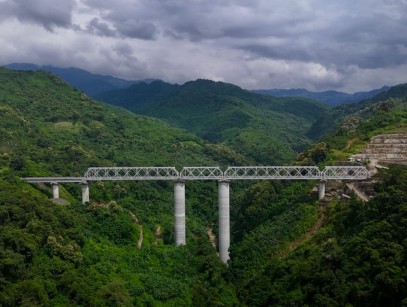
Mizoram Rail line inaugurated by PM Narendra Modi ! (Image Railways)
From Dust, Dizziness and Delay to Steel Tracks of Transformation in Northeast as Railways Push Ahead
By NIRENDRA DEV
Aizwal, February 2, 2026 — Travel between Silchar in Assam’s Barak Valley and Mizoram’s Aizawl or Lunglei was once a nightmare. I know this not from statistics, but from lived experience. Since the 1980s, journeys meant heat, dust, dizziness—and often vomiting—on treacherous hill roads that tested both body and patience.
Even as late as 2018, while covering Mizoram’s state elections, flying seemed the only viable option. Yet even that came with its own absurdities. On my return, Jet Airways withheld luggage—mine and many others’—due to weight restrictions. We received our bags two days later. Connectivity existed, but reliability did not.
By 2026, it is a different world.
The story of Indian Railways in the Northeast is one of persistence finally meeting political will. In just over a decade, century-old metre-gauge lines have been upgraded, long-stalled projects revived, and capital cities like Aizawl and Imphal placed firmly on India’s railway map.
On January 28, 2026, I travelled from Sairang, near Aizawl, to Katakhal in Assam. It was an eventful evening. Minutes after I deboarded, Assam Police arrested a passenger at Badarpur carrying gold biscuits—an episode that quietly reminded us how border economies, connectivity, and informal trade often intersect in the Northeast.
Among northeastern states, Assam has emerged as the railway backbone, with rapid electrification and doubling of tracks. Frontier states—Mizoram, Nagaland, and Arunachal Pradesh—are now pushing lines toward borders and future trade gateways. Tripura has already reached Bangladesh by rail, while Meghalaya and Sikkim await their turn.
Together, these milestones represent more than engineering feats. They mark the Northeast’s slow but steady transition from isolation to integration.
The centrepiece of this shift is the 51-km Bairabi–Sairang railway line, inaugurated in September 2025. With 48 tunnels and 55 major bridges—including Bridge No. 196 rising 104 metres—it connects Mizoram’s capital region directly to Guwahati and the national rail grid. Travel that once took punishing hours by road is now faster, cheaper, and safer.
The daily Sairang–Guwahati Express has transformed mobility, with fares ranging from about ₹300 (sleeper) to ₹1,130 (2AC). Other key services include the Sairang–Kolkata Express and the Sairang–Anand Vihar Rajdhani. Passenger response has been overwhelming, with occupancy exceeding 100 per cent since late 2025.
On December 14, 2025, another milestone followed: 119 Maruti cars reached Sairang by rail for the first time, reducing dependence on long-haul road transport and strengthening Mizoram’s automobile ecosystem.
Since 2014, railway allocations to the Northeast have increased fivefold, touching ₹62,477 crore. In the mist-clad hills and deep valleys of the region, a quiet revolution is unfolding—one steel track at a time.
What was once a test of endurance has become a journey of possibility.
Follow The Raisina Hills on WhatsApp, Instagram, YouTube, Facebook, and LinkedIn




About The Author