Noida Death: Not killed in Accident but Lynched by System
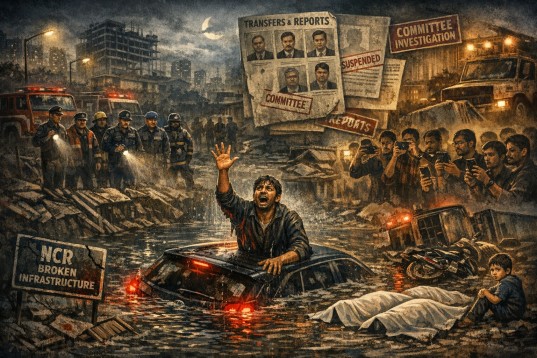
A representative image of Noida drowning case. (Image TRH)
The Noida death exposes systemic failure in India’s cities, where apathy, broken infrastructure, and state inaction cost human lives.
By SIDHARTH MISHRA
New Delhi, January 20, 2026 — What happened in Noida’s Sector 150 was not an accident. It was a systemic failure so grotesque that it amounts to a slow, public execution. When a 27-year-old man clung to the roof of his submerged car for two hours, screaming for help, it was not just water that drowned him, it was indifference, incompetence and apathy.
Yuvraj Mehta did everything a responsible citizen is expected to do. He studied, worked, contributed to the economy and tried to build a life in the National Capital Region (NCR). Yet, when he needed the state the most, the state failed him.
The police, fire department and SDRF, institutions meant to protect life stood by as spectators. They did not battle the water, instead they surrendered to it. They did not rescue the man, they waited for his death. That image should haunt us far more than the waterlogged pit that swallowed him.
This tragedy is not an aberration. It is the predictable outcome of an urban model that prioritizes real estate over safety, speed over planning, and optics over accountability. NCR was once sold as a visionary solution to decongest Delhi. Today, it feels more like a labyrinth of neglect, broken roads, collapsing infrastructure, dysfunctional transport and a perpetual battle for basic amenities.
Why was Yuvraj driving 70 kilometres that night? Because public transport in this region is non-existent. Poor lighting, missing signage, and lethal potholes turn every commute into a gamble with death. Even mobile networks abandon citizens in these zones, leaving them isolated at the very moment they need help.
Yuvraj wanted to leave India for the UK in search of a more humane life. Ironically, he was denied even that chance, not by immigration rules, but by a pothole filled with rainwater.
And before we could even mourn him, another family was destroyed in Loni. A bike slipped into a pit, a truck followed and three lives vanished in seconds. A child survives, orphaned by infrastructure failure. These are not statistics, they are human catastrophes engineered by negligence.
We boast about becoming “Vishwaguru,” yet we cannot keep our roads safe. We remain silent when taxpayers are crushed on those very roads. We are quick to debate nationalism, but reluctant to demand accountability.
Perhaps the most chilling part of Yuvraj’s death was the presence of nearly 80 onlookers who recorded videos but offered no help. The callous spectators include not just those people by the pit but it is all of us, watching headlines, expressing momentary outrage, and then moving on.
The government claims it has acted. The top-ranking CEO of Noida development authority has been shifted. More transfers will happen. Committees have been formed. Reports will be written. A few officials may be suspended. But don’t be mistaken, life and death will continue as before.
Unless citizens demand real accountability from local authorities, unless infrastructure safety becomes a political priority and unless we refuse to normalize such deaths, Yuvraj will not be the last. Today it was his turn, tomorrow, it could be any of us.
(This is an opinion piece. Views expressed are author’s own)
Follow The Raisina Hills on WhatsApp, Instagram, YouTube, Facebook, and LinkedIn




About The Author