NFRA’s Wake-up Call: Why Boards Can No Longer Stay Silent
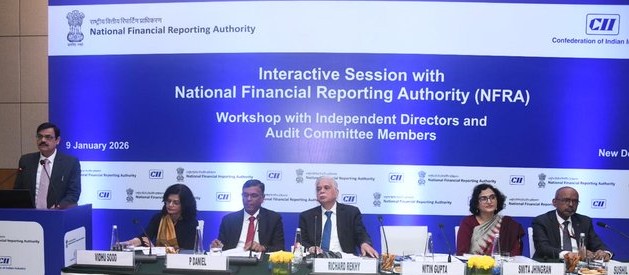
NFRA and CII held an interactive session in New Delhi. (Image NFRA on X)
From auditors alone to boardroom responsibility, NFRA’s TCWG push signals a tectonic shift in Indian corporate governance
By P. SESH KUMAR
New Delhi, January 26, 2026 — The NFRA Circular of January 7, 2026 is not a routine advisory dressed up as reform. It is a deliberate attempt to shake Indian corporate governance out of a long-standing comfort zone where statutory audit is treated as a private conversation between auditors and the finance department, while boards and independent directors remain politely disengaged. By foregrounding the role of ‘Those Charged With Governance (TCWG),’ NFRA seeks to redistribute financial accountability across the boardroom.
What Is Actually New in the 7 January 2026 Circular?
What makes this circular stand out is not its language but its target. For the first time, NFRA moves beyond auditors and squarely addresses the governance ecosystem surrounding financial statements. The circular systematically emphasises structured, documented, and meaningful engagement between statutory auditors and TCWG, going well beyond the perfunctory Audit Committee meeting that signs off accounts after the fact.
The novelty lies in NFRA’s insistence that audit findings, significant judgments, internal control weaknesses, and auditor concerns must be actively owned, discussed, and responded to at the governance level, not merely “noted” by finance executives. In effect, NFRA is saying: if you sit at the board table, you do not get to outsource your fiduciary discomfort to the CFO.
This is a quiet but profound shift-from audit as a compliance ritual to audit as a governance dialogue.
Why Now? The Provocation Behind the Circular
The timing is no accident. NFRA’s recent enforcement orders reveal a recurring and troubling pattern: auditors penalised for failures that were structural and systemic, not merely individual. Time and again, inspection findings have shown weak challenge by audit committees, passive independent directors, boiler-plate minutes, and near-total reliance on management representations.
In parallel, the regulator has faced sustained criticism-from audit firms, professional bodies, and even former regulators-that NFRA has been disproportionately harsh on auditors while letting boards escape scrutiny. The January 2026 circular appears to be a calibrated response to that criticism. It implicitly acknowledges that audit quality cannot improve in a vacuum and that holding auditors alone to account, while boards remain disengaged spectators, is neither fair nor effective.
In that sense, the circular is as much self-correction as it is regulatory assertion.
Will This Change the Deep-Rooted Belief That Audit Is “Finance’s Problem”?
Here lies the real test. Indian corporate practice-especially in large PIEs-has long treated statutory audit as a technical exercise managed by the CFO, with the Audit Committee stepping in only at the approval stage. Independent directors often focus on strategy, remuneration, or ESG optics, viewing audit issues as someone else’s headache.
NFRA’s circular challenges this culture head-on by signalling that ignorance is no longer a defensible position. If taken seriously, it would require non-executive and independent directors to ask uncomfortable questions, demand clarity on estimates and judgments, and engage directly with auditors without management acting as an interpreter.
But cultural inertia is powerful. Unless reinforced by enforcement actions, judicial recognition, or board-level accountability norms, many corporates may comply in form—expanded agendas, longer minutes—while resisting the spirit. The circular opens the door; it does not guarantee that boards will walk through it.
Is “TCWG” a Statutory Concept or an NFRA Invention?
This is a crucial legal question. The acronym TCWG does not appear in the Companies Act, 2013. It originates in international auditing standards, particularly ISA 260, and has been imported into Indian auditing practice through SA 260 issued by ICAI.
NFRA has not invented TCWG, but it has borrowed and elevated it. Statutorily, Indian law speaks of the Board of Directors, Audit Committee, and officers in default-not TCWG as a defined legal entity. Consequently, NFRA circulars are directly binding on auditors, who are within NFRA’s regulatory jurisdiction, but only indirectly influential on TCWG.
In other words, the circular compels auditors to engage with TCWG in a particular manner; it does not, by itself, impose new statutory obligations on directors. This distinction matters greatly if enforcement ever reaches the courtroom.
NFRA at a Crossroads: Can India’s Audit Regulator Regain Trust?
Is This NFRA Softening Its Stance Towards Auditors?
In substance, yes—though NFRA would never phrase it that way. By emphasising governance engagement, NFRA is implicitly conceding that audit failures often reflect governance failures, not merely documentation lapses or procedural errors by audit firms.
The circular can be read as an olive branch: a recognition that auditors operate within constraints set by management behaviour and board culture. If auditors can demonstrate robust communication with TCWG, NFRA’s own enforcement framework may evolve to assess responsibility more holistically rather than in isolation.
That said, this is not leniency-it is rebalancing.
Is NFRA Quietly Expanding Financial Accountability Without Statutory Backing?
Undeniably, NFRA is pushing the envelope. By foregrounding TCWG, it is attempting to extend the moral and functional perimeter of accountability beyond the CFO’s desk to the entire boardroom. Whether this expansion will withstand legal scrutiny depends on how it is operationalised.
If NFRA uses the circular merely to assess audit quality and auditor conduct, it remains on firm ground. If, however, it seeks to treat TCWG failures as quasi-statutory breaches without legislative amendment, resistance is inevitable.
Corporate India may initially treat this as another compliance circular. But over time-especially if SEBI, courts, or Parliament echo the same expectations-this could reshape how directors perceive their role in financial reporting.
From Advisory to Architecture
For the circular to matter, three things must follow. First, auditors must use it proactively, not defensively, to insist on deeper board engagement. Second, boards must internalise that audit literacy is a fiduciary duty, not an optional skill. Third, policymakers must consider whether governance concepts like TCWG deserve explicit statutory recognition to avoid ambiguity.
If that happens, the January 2026 circular may be remembered not as another NFRA communication, but as the moment Indian corporate governance was told-politely but firmly-that financial accountability begins in the boardroom, not in the balance sheet.
(This is an opinion piece. Views expressed are author’s own.)
A Quiet Court Order Just Shook India’s Audit and NFRA Regime
Follow The Raisina Hills on WhatsApp, Instagram, YouTube, Facebook, and LinkedIn




About The Author