Netaji Death Mystery: India’s Unsettled Freedom Struggle Enigma
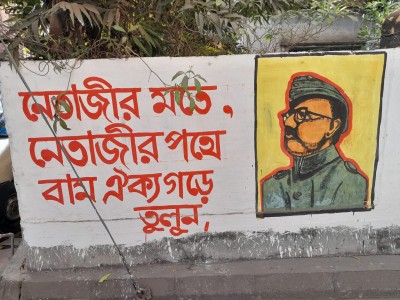
A poster on Netaji Subhash Chandra Bose seen in Kolkata (Image Nirendra Dev)
Why the ‘death’ of Netaji Subhas Chandra Bose was never convincingly explained—and how political rivalries reshaped India after his disappearance
By NIRENDRA DEV
New Delhi, January 23, 2026 — The alleged death of Netaji Subhas Chandra Bose has never been convincingly explained. No serious observer claims Bose was immortal. Yet, the mystery surrounding his disappearance remains one of the greatest unresolved enigmas of modern India.
Records of the Khosla Commission reveal troubling inconsistencies, including contradictory testimony by Dr Yoshimi, the so-called eyewitness, on the timing and circumstances of Bose’s death. Such gaps leave the official narrative deeply unconvincing.
This unresolved mystery inevitably leads to a larger and more uncomfortable question: was one of India’s greatest freedom fighters politically outmanoeuvred by his contemporaries?
By the late 1930s, intense power games were underway within the national movement. Jawaharlal Nehru, cultivating close ties with British leaders and projecting himself as Mahatma Gandhi’s political heir, emerged as a dominant figure. In 1937, his refusal to induct even two Muslim League members into the United Provinces government proved disastrous.
As Congress president in 1938, Bose attempted a fresh dialogue with Mohammed Ali Jinnah to resolve the Hindu–Muslim question. He soon discovered that Nehru was reluctant—and that negotiations had already been complicated. Nehru famously dismissed the Muslim League’s relevance, asserting that India had only two parties: the British and the Congress. Was this democratic confidence—or political arrogance?
Bose envisioned independence without one-party domination. His leadership of the Indian National Army transcended caste, religion, and regional identity—something independent India failed to replicate.
India, a civilization and a continent in itself, continues to struggle with unresolved fault lines: communalism, casteism, inequality, and uneven modernization. One cannot help but wonder whether Netaji’s presence might have altered this trajectory.
In 2016, Narendra Modi declassified long-sealed files on Bose, reigniting public debate. Yet the central mystery endures.
On Netaji’s birth anniversary, headlines will return—but closure will not. Until India confronts both the truth about Bose’s disappearance and the political culture that sidelined him, the question will persist: did independent India truly inherit the best of its freedom struggle?
(This is an opinion piece. Views expressed are author’s own)
Follow The Raisina Hills on WhatsApp, Instagram, YouTube, Facebook, and LinkedIn




About The Author