Narasimha Rao Revived Congress After Rajiv — A Forgotten Truth
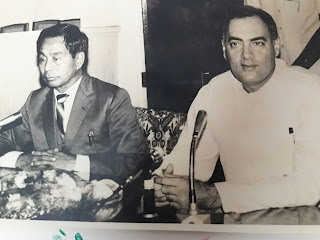
Former Nagaland CM Hokishe Sema with Rajiv Gandhi (Image Nirendra Dev)
Veteran Naga leader Hokishe Sema’s blunt diagnosis exposes how sycophancy, mismanagement, and missed opportunities hollowed the Congress—and how P V Narasimha Rao rebuilt it from the ground up
By NIRENDRA DEV
New Delhi, January 15, 2026 — It is time to change the narrative around the Congress party’s most turbulent transition. The dominant story often romanticises Rajiv Gandhi’s intent while downplaying his failures. But a candid assessment by Hokishe Sema, former Nagaland Chief Minister and ex-Governor of Himachal Pradesh, tells a far more uncomfortable truth: the Congress revived under P V Narasimha Rao precisely because Rajiv Gandhi had failed—politically, organisationally, and economically.
In a long interview I conducted in 1991, soon after Rajiv Gandhi’s assassination, Hokishe was unsparing. When asked whether sycophancy had become Congress culture under Rajiv Gandhi, his response was blunt: yes, it had—but not because Rajiv demanded it. “It was the coterie culture,” he said, adding that inner-circle politics ultimately brought Rajiv down. Rajiv trusted friends, gave them unchecked power, and struggled with man-management—fatal flaws for a Prime Minister thrust into office too early and too suddenly.
Hokishe was equally critical of the Congress’s political immaturity in bringing down the Chandrashekhar government after pledging support. “Politics is much beyond suspicion and paranoia,” he said, lamenting how the party squandered credibility during a period of national instability, Ayodhya-related violence, and economic freefall.
Against this backdrop, Hokishe welcomed the return of the Congress “old guard” under P V Narasimha Rao. He saw Rao as a leader who understood institutions, federal balance, and political patience. Rao’s decision to announce organisational elections—unheard of since 1972—was, in Hokishe’s view, revolutionary. It signalled that the Congress was finally thinking beyond the Nehru-Gandhi family, especially when Sonia Gandhi was unwilling to enter politics.
Most importantly, Hokishe believed Rao revived the party by decentralising power. Leaders like Digvijaya Singh, S M Krishna, and Sharad Pawar were encouraged to build the Congress in their states with autonomy and merit. “This change is refreshing,” Hokishe observed, noting that the revival was happening “on the ground,” even though Rao led a minority government.
On the economy, Hokishe—no economist himself—offered a strikingly accurate political diagnosis: the 1991 collapse was the result of India’s own failures, and liberalisation was unavoidable. Rajiv Gandhi’s economic governance, he said, had been weak; Rao’s willingness to dismantle the licence raj and open India to foreign investment was both necessary and courageous.
The conclusion Hokishe Sema reached three decades ago still unsettles the Congress today: Rajiv Gandhi inherited power; Narasimha Rao earned legitimacy. One failed to institutionalise leadership. The other rebuilt a party—and an economy—from ruins.
Follow The Raisina Hills on WhatsApp, Instagram, YouTube, Facebook, and LinkedIn




About The Author