


By TRH World Desk
As Myanmar’s military ruler Min Aung Hlaing begins a landmark visit to India in Bodh Gaya, New Delhi faces a delicate strategic challenge: balancing security interests, Chinese influence, Northeast insurgency concerns, and its long-standing support for democratic values in Myanmar.
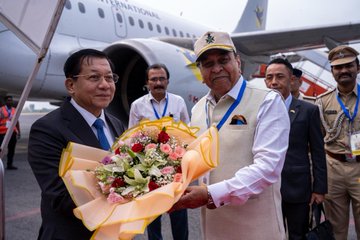
New Delhi, May 30, 2026 — There is a certain symbolism — almost too deliberate to be accidental — in Myanmar’s President U Min Aung Hlaing choosing to begin his India visit at Bodh Gaya, the seat of Buddhist enlightenment. For a military strongman whose forces have been accused of devastating the very people of his country, the spiritual optics are rich with irony. Yet, for New Delhi, the welcome mat rolled out for this visit reflects not naivety, but the cold, pragmatic logic of geopolitics.
Ministry of External Affairs announced that Min Aung Hlaing — on his first visit to India in his current capacity as President — would travel to Bodh Gaya on May 30, hold bilateral talks with Prime Minister Narendra Modi in New Delhi on June 1, and meet India’s business community in Mumbai on June 2. The MEA’s spokesperson Randhir Jaiswal framed the agenda in carefully calibrated language: “Regarding border security, connectivity, and other issues, all matters that form part of the gamut of relations between Myanmar and India will come up for discussion. Our idea is to take our friendly, civilizational ties forward.”
The word “civilizational” is doing a lot of heavy lifting here. It allows India to sidestep the uncomfortable question that hangs over the entire visit: How does the world’s largest democracy host, honour, and hold talks with a leader who came to power through a coup in 2021, whose military junta has waged war against its own citizens, and whose elections — contested or otherwise — have sidelined democratic icon Aung San Suu Kyi?
The answer, if one is honest, lies in three interlocking fears.
The China Factor: The most pressing concern is Beijing. Myanmar’s military junta relies on China for economic lifelines. Myanmar owes roughly 40 per cent of its foreign debt to China. Ethnic armies closely linked to Beijing — chief among them the Myanmar National Democratic Alliance Army in the Kokang region — control large swathes of territory in northern Shan state. To push the junta away would be to gift China an even deeper chokehold over what India considers its own strategic backyard.
India’s pivot toward Myanmar’s generals, as documented in The Diplomat (February 2025), is not new — New Delhi shifted away from supporting pro-democracy movements in Myanmar during the 1980s precisely as China deepened its economic and military cooperation with the regime. History has only made this calculus more acute in 2026.
The Northeast Insurgency Imperative: India’s second fear is more immediate and visceral. The two countries share a 1,643-kilometre border. For decades, New Delhi has relied on cooperation with the Myanmar military to manage insurgencies in India’s Northeast.
The collapse of central authority in Myanmar has made the border more, not less, dangerous. If relations sour, according to security analysts, Indian insurgents could find a safe haven in Myanmar with junta support. Groups like the ULFA and the People’s Liberation Army of Manipur have long used Sagaing as operational territory, the stress, adding: “India cannot afford to lose its interlocutor.”
The Democracy Dilemma: And yet, none of this erases what haunts Indian foreign policy — the democratic dilemma. India presents itself to the world as a responsible democracy and a champion of rules-based order. Every handshake with a junta leader, every “civilizational” communiqué, is noted in capitals from Washington to Brussels. As the Daniel K. Inouye Asia-Pacific Center for Security Studies argued in March 2025, India has a strategic moment — and a strategic responsibility — to engage more robustly with pro-democracy forces and ethnic resistance groups rather than legitimising the military regime alone.
The visit’s itinerary — Bodh Gaya for optics, New Delhi for substance, Mumbai for money — tells us everything about how India has chosen to answer this dilemma, at least for now. Pragmatism wins. Principle waits.
India’s approach is not indefensible. Disengagement from Myanmar would leave a vacuum that China would fill within weeks. The Kaladan Multi-Modal Transit Transport Project and the India-Myanmar-Thailand Trilateral Highway — both critical to India’s Act East connectivity ambitions — need a functioning partner in Naypyidaw. Over 90,000 refugees reportedly have already crossed into Mizoram and Manipur; destabilising the Myanmar government further would compound this crisis.
As the Buddhist bells ring in Bodh Gaya today for Myanmar’s President, India’s foreign policy establishment will be praying for something more elusive than enlightenment: a stable Myanmar, a contained China, a quiet Northeast, and a clear conscience. History suggests it is unlikely to get all four.
Myanmar drone case explained: Foreign interference in Northeast
Follow The Raisina Hills on WhatsApp, Instagram, YouTube, Facebook, and LinkedIn




