Munich Drama to Modi–Macron Reset: Game-Changing Alliances?
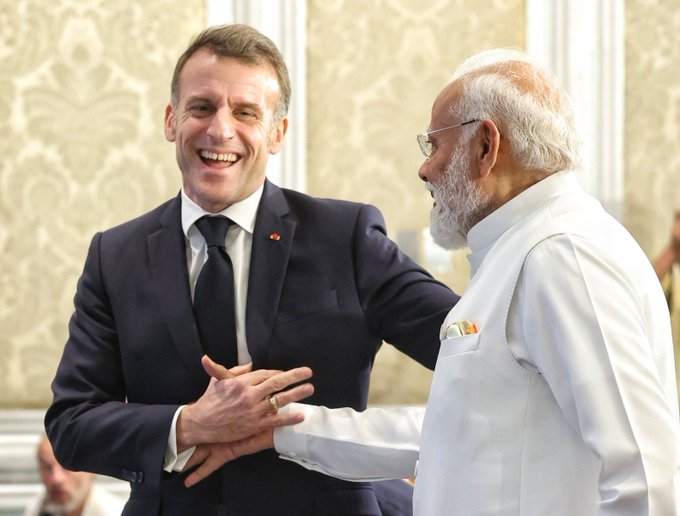
Prime Minister Narendra Modi with French President Emmanuel Macron in New Delhi. (Image Modi on X)
After a heated Lindsey Graham episode at Munich, France and India deepen strategic ties as Trump-era tremors reshape global power equations
By TRH World Desk
New Delhi, February 18, 2026 — In a special monologue on The Raisina Hills YouTube channel, Manish Anand connects two seemingly separate global moments — a diplomatic flare-up in Munich and French President Emmanuel Macron’s high-profile India visit — to argue that a new multipolar world order may be crystallising.
The Munich Flashpoint
At the sidelines of the Munich Security Conference, a closed-door meeting reportedly turned tense when US Senator Lindsey Graham clashed with Danish Prime Minister Mette Frederiksen and Greenland Premier Jens-Frederik Nielsen.
According to accounts cited in the monologue, Graham’s language shocked European participants, with even a Democratic US lawmaker reportedly walking out.
Anand frames the episode as symptomatic of what he calls a revived “New Monroe Doctrine” under President Donald Trump — a muscular, influence-driven American posture toward allies.
“When allies are spoken to as subordinates, Europe begins to rethink its future,” Manish Anand says in his monologue.
Why Macron’s India Visit Matters
Against this backdrop, Macron’s fourth India visit in eight years — and his meetings with Prime Minister Narendra Modi — take on larger geopolitical meaning.
France has long advocated strategic autonomy within Europe and supported a multipolar balance of power. Unlike a binary US–China order, Paris has consistently argued for diversified global centers of influence.
India, too, historically rooted in non-alignment since Jawaharlal Nehru, champions multipolarity. But Anand argues that France preceded even India and China in articulating resistance to rigid bipolar dominance.
The Rafale Signal
India’s continued defence partnership with France — including procurement of Rafale Marine fighter jets — sends what Anand calls a “strategic message.”
Despite American pressure narratives and controversy, New Delhi has reinforced Paris as a trusted defence partner, especially in co-development and technology sharing.
AI, Europe and the Balance of Power
With artificial intelligence emerging as a US–China duopoly battleground, Anand sees India–France collaboration as crucial to shaping rule-based tech governance.
“Multipolarity is no longer just geopolitical,” he argues. “It is technological, financial and regulatory.”
As Europe debates regulating American tech giants and asserting digital sovereignty, India becomes a pivotal partner.
The Larger Question
If Washington recalibrates alliances under Trump-era assertiveness, and Europe seeks autonomy, India stands uniquely positioned — balancing Washington, Moscow, Beijing and Paris.
The Munich episode may have been a diplomatic tremor. But Macron’s India visit signals something larger: a search for equilibrium in an unstable world.
Follow The Raisina Hills on WhatsApp, Instagram, YouTube, Facebook, and LinkedIn




About The Author