Mukul Roy Dies at 71: Bengal’s ‘Chanakya’ Who Snubbed a PM

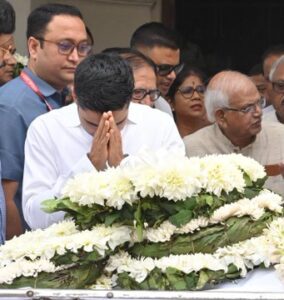
People pay their respects to mortal remains of Mukul Roy in Kolkata on Monday. (Image TMC on X)
Mukul Roy death marks end of an era in West Bengal politics as leaders across parties pay tribute
By NIRENDRA DEV
New Delhi, February 23, 2026 — Former Union minister and veteran political strategist Mukul Roy passed away early Monday at a private hospital in Salt Lake. He was 71.
Roy, once regarded as West Bengal Chief Minister Mamata Banerjee’s most trusted lieutenant and the principal architect of the All India Trinamool Congress (TMC)’s organisational rise, died of cardiac arrest around 1:30 am, according to his son Subhranshu Roy.
He had been battling multiple ailments over the past two years and was reportedly suffering from dementia before slipping into a coma.
The Founding Pillar Before Mamata
Paradoxically, Roy was technically the founding president of the Trinamool Congress when it was launched in 1997 after Mamata Banerjee broke away from the Congress. Banerjee later took formal charge of the outfit, but Roy emerged as its chief backroom strategist.
Often described as the “Chanakya” of Bengal politics, Roy built the party’s grassroots machinery and managed defections that helped TMC end the 34-year Left Front rule in 2011.
The Man Who Snubbed a Prime Minister
In 2012, during UPA-2, Roy — then serving as railway minister — reportedly declined then Prime Minister Manmohan Singh’s suggestion to visit a train derailment site in Assam following a blast.
Asked about his absence, Roy had said: “I have nothing to say. I suggest you contact the General Manager of the NF Railway.”
The episode reinforced his image as a fiercely autonomous regional power broker. He had replaced Dinesh Trivedi as Railway Minister after a fare hike controversy that angered the TMC leadership.
From TMC Strategist to BJP Architect
Roy’s career was marked by dramatic political shifts. After falling out with the TMC leadership in 2017, he joined the Bharatiya Janata Party (BJP). His move significantly altered Bengal’s political landscape. Party insiders credited him with engineering defections that boosted the BJP’s tally to 18 Lok Sabha seats in 2019.
However, after the BJP failed to capture power in the 2021 Assembly elections, Roy returned to the TMC — only to be later disqualified as an MLA under anti-defection provisions. Though he rejoined the party, he never regained his former centrality.
Shadow of Controversy
Roy’s political journey was not without turbulence. His name surfaced in the Saradha chit fund scam and the Narada sting operation — episodes that cast a long shadow over his career. Analysts argue that how he navigated those investigations shaped his later political repositioning.
Tributes Pour In
Chief Minister Mamata Banerjee said she was “shocked and saddened,” recalling Roy as a long-time colleague and “comrade-in-arms in many struggles.”
Prime Minister Narendra Modi condoled his death, saying Roy would be remembered for his political experience and efforts to serve society.
Leader of Opposition in the West Bengal Assembly Suvendu Adhikari described his demise as “deeply disheartening.” TMC national general secretary Abhishek Banerjee said Roy’s passing marked “the end of an era” in Bengal’s political journey.
A Transactional Strategist in Turbulent Times
Roy’s four-decade career spanned Congress, TMC and BJP. More strategist than ideologue, he mastered organisational arithmetic in a state defined by intense political rivalry.
His rise, fall and return symbolised the volatility of West Bengal’s political theatre. With Mukul Roy’s death, Bengal loses one of its most enigmatic power players — a man who operated as kingmaker, tactician and, at times, disruptor.
(This is an opinion piece. Views expressed are author’s own.)
West Bengal: Power, Violence and the Cold Arithmetic of 2026
Follow The Raisina Hills on WhatsApp, Instagram, YouTube, Facebook, and LinkedIn




About The Author