Modi vs Trump: When Base Politics Takes Different Turns
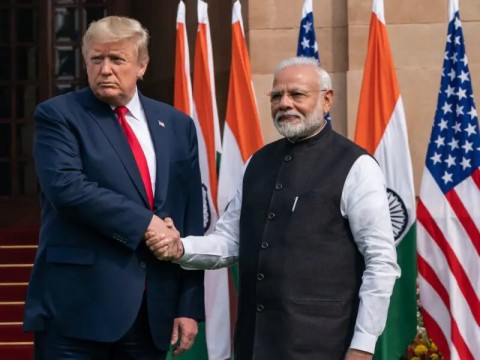
US President Donald Trump & India PM Narendra Modi (Image credit X.com, File)
As Narendra Modi backs caste enumeration ahead of Census, comparisons with Donald Trump’s aggressive defence of his base sharpen political fault lines.
By RAVI SHANKER KAPOOR
New Delhi, February 24, 2026 — Political commentators frequently compare Prime Minister Narendra Modi with US President Donald Trump. Both are charismatic, nationalist leaders who have reshaped their respective political landscapes. Yet beneath surface similarities lie fundamental differences — particularly in how they treat their core constituencies.
For Modi, critics argue, the Indian middle class — where upper castes have significant representation — has remained a loyal but often taken-for-granted support base. For Trump, by contrast, white voters remain central to his political messaging and policy priorities.
Two recent developments have reignited the Modi vs Trump debate.
Caste Census and Ideological Trade-Offs
The Modi government’s decision to allow caste enumeration in the upcoming Census has triggered sharp political discussion. The move follows the Rashtriya Swayamsevak Sangh (RSS) signalling acceptance of caste data collection.
Critics within conservative circles argue that caste enumeration sits uneasily with the ideological premise of Hindu unity long associated with the broader Sangh Parivar ecosystem. Supporters, however, view it as a pragmatic political step, especially with Bihar’s Assembly elections on the horizon.
The development also underscores the influence of Modi and Home Minister Amit Shah within the BJP’s decision-making structure. While internal discussions continue over party leadership roles, the current central leadership retains substantial authority.
Political observers link the caste census decision to short-term electoral calculations. The long-term ideological and economic implications, however, remain part of a broader and evolving debate.
Trump’s Direct Messaging to His Base
In contrast, Trump has made clear moves to dismantle Diversity, Equity and Inclusion (DEI) frameworks. Early in his second term, he issued directives targeting DEI initiatives across federal agencies and the Foreign Service.
Trump has also publicly raised concerns about the treatment of white farmers in South Africa during his meeting with President Cyril Ramaphosa, drawing global media attention. The US administration granted asylum to a group of South African whites — an action that reinforced his message to supporters.
Despite criticism from mainstream media and civil rights groups, Trump has remained unapologetic. His stance reflects a broader political strategy: retaining and energising a loyal base even amid controversy.
Mandal Legacy and BJP’s Position
India’s caste politics have long been shaped by the Mandal Commission recommendations. While leaders such as Rajiv Gandhi voiced opposition at the time, the BJP historically adopted a calibrated approach rather than outright rejection.
Debates over “social justice” policies continue to influence India’s electoral discourse. The Scheduled Castes and Scheduled Tribes (Prevention of Atrocities) Act remains another politically sensitive issue, especially after judicial scrutiny and subsequent legislative amendments.
A Broader Civilisational Contrast?
Supporters of Trump argue he frames his politics around individual liberty, equality before law, and limited government. Critics counter that such framing often polarises American society.
In India, Modi’s approach blends welfare expansion, Hindu cultural assertion, and electoral pragmatism. The caste census decision reflects that balancing act — ideology intersecting with arithmetic.
The Modi vs Trump comparison ultimately highlights differing political ecosystems. Trump governs in a hyper-polarised two-party system where base consolidation is paramount. Modi operates within a multi-layered social structure shaped by caste, region, and coalition politics.
Whether caste enumeration strengthens or complicates BJP’s long-term ideological positioning remains to be seen. What is clear is this: strong leaders may share stylistic similarities, but their strategies for managing core constituencies can diverge sharply.
(This is an opinion piece. Views expressed are author’s own. The article is brought in collaboration with The Hindu Chronicle.)
Follow The Raisina Hills on WhatsApp, Instagram, YouTube, Facebook, and LinkedIn




About The Author