Modi vs Trump Tariffs: How India Quietly Recalibrated Strategy
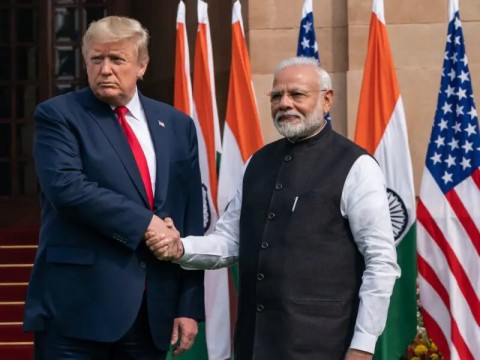
US President Donald Trump & India PM Narendra Modi (Image credit X.com, File)
From Trump-era tariffs to governance reforms, why global economists—from The Economist to American thinkers—are reassessing India under Narendra Modi
By TRH World Desk
New Delhi, January 23, 2026 — The age of tariffs, protectionism, and hard-nosed geopolitics is back. Yet amid the disruption unleashed by US President Donald Trump, one major global publication has offered an unexpected assessment of India.
The Economist, known more for its scepticism than praise, recently highlighted how Prime Minister Narendra Modi responded to Trump’s tariff shocks not with panic—but with governance reform.
According to the magazine, despite external pressure from American trade actions, India chose balance over brinkmanship: sustaining macro stability, pushing reforms, and sharpening governance. For a publication that has often been critical of Modi, this acknowledgment is significant.
American economist Jeffrey Sachs offers a complementary argument. He believes India’s best defence against Trump-era trade barriers lies in diversifying its export basket—deepening economic ties within Asia, East Asia, and beyond China. In short: reduce overdependence on any single market.
At the World Economic Forum in Davos, Trump once again called Modi his “good friend” and promised a “very big” trade deal with India. “Yet repetition has diluted seriousness. What matters more is action—and here, diplomatic signals have quietly shifted,” said Manish Anand in his monologue for The Raisina Hills – YouTube Special.
Anand noted that “the arrival of the new US ambassador in New Delhi, a trusted figure from Trump’s inner circle, Sergio Gor, has injected cautious optimism into India–US ties.” “Washington now describes relations with New Delhi as the most consequential partnership—a phrase not used lightly,” he added.
But optimism alone does not pass economic tests, Anand stressed.
Six months into the renewed tariff turbulence, India’s GDP growth remains resilient, with international agencies projecting growth above 7 percent. “Consumption has picked up after GST rate cuts before Diwali—acknowledging India’s core reality as a consumption-driven economy. Yet warning signs persist: delayed income-tax refunds, fiscal strain from election-year populism, and anxieties over labour reforms,” added Anand.
The upcoming Union Budget will therefore be critical, he said, adding: “Can the government balance welfare pressures with fiscal discipline? Can it protect jobs while enforcing long-pending labour reforms?”
Strategically, India has moved faster where it matters most—trade diversification. Agreements with the UAE, Australia, Japan, the UK, and negotiations with the European Union signal a structural shift. As EU leaders call the proposed pact the “mother of all trade deals,” India is clearly hedging against American disruption.
“China did this in the 1990s. India is doing it now—later than ideal, but decisively,” stressed Anand.
The question is no longer whether Trump’s tariffs hurt. They do. “The real question is whether India has learned to absorb the shock—and turn disruption into leverage. For now, the answer appears cautiously affirmative,” argued Anand.
(Manish Anand hosts discussions on geopolitics on the YouTube channel of The Raisina Hills)
Trump’s Dictator Rhetoric: A 2026 Test for Modi’s Foreign Policy
Follow The Raisina Hills on WhatsApp, Instagram, YouTube, Facebook, and LinkedIn




About The Author