Modi Tightens Grip on Bureaucracy: Pushes ‘Swadeshi Learning’
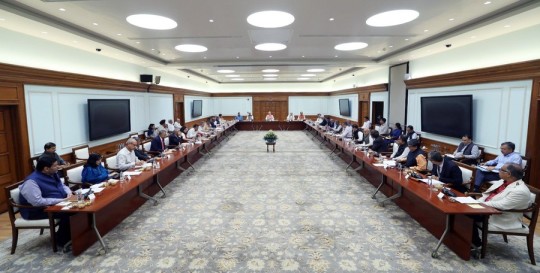
Prime Minister Narendra Modi chaired a meeting to discuss the roadmap for Next-Generation Reforms! (Image Narendra Modi, X)
Ending a decades-old privilege, Prime Minister Narendra Modi has directed senior bureaucrats to pursue executive training within Indian institutes instead of elite global universities, showing a major shift toward “Atmanirbhar” governance learning.
By MANISH ANAND
New Delhi, November 2, 2025 — Prime Minister Narendra Modi has tightened his control over the country’s powerful bureaucracy, curbing a long-standing privilege that allowed senior civil servants to attend training programs at elite foreign universities. The new directive requires officers to undertake all executive education courses within India, marking a decisive turn toward the government’s “Swadeshi Learning” policy.
For decades, officers of the Indian Administrative Service (IAS), Indian Police Service (IPS), Indian Foreign Service (IFS), and other central services were routinely deputed to attend short-term executive programs at universities such as Harvard, Oxford, and Cambridge—often at government expense. These programs, lasting from a few weeks to a month, were seen as a badge of prestige within bureaucratic circles.
However, the Modi government has now replaced that system with domestic training options at premier institutions such as the Indian Institutes of Management (IIMs) in Ahmedabad, Bangalore, and Lucknow, and the Management Development Institute (MDI) in Gurugram.
“Officers must now learn within India, where our management schools can offer the same level of global excellence,” a senior official in the Department of Personnel and Training (DoPT) said, adding that the shift aligns with Modi’s larger emphasis on “Atmanirbhar Bharat.”
Sources within the civil services told The Raisina Hills that the change has stunned many mid-career officers accustomed to foreign travel. “Until now, these foreign courses were seen as perks—more tourism than training,” one joint secretary admitted, adding: “But at IIMs, we’re actually attending lectures from morning to evening and realizing how much the world has changed.”
The move mirrors a broader pattern in Modi’s governance style: reducing bureaucratic privileges and centralizing control. In 2014, soon after taking office, the Prime Minister ended another long-standing practice—allowing journalists to accompany him on foreign visits. Now, with this new order, senior civil servants find themselves subject to the same discipline.
Observers say the decision is also symbolic of India’s shifting trade and geopolitical posture. Amid rising tensions with the US over tariffs and technology partnerships, Modi’s call to “buy Indian, learn Indian” reinforces the government’s self-reliance agenda across sectors.
While critics argue that exposure to global institutions broadens bureaucratic perspectives, supporters insist the move will save public money and strengthen Indian academic capacity.
“It’s a bold step,” said a retired IAS officer, who added that “if Indian officers truly engage with Indian institutions, it will create a new kind of administrative mindset—rooted in India, not imported from abroad.”
As officers now sit in classrooms at IIMs instead of Harvard, the Modi government’s message is unmistakable: India’s administrators must learn to manage India, the Indian way.
Follow The Raisina Hills on WhatsApp, Instagram, YouTube, Facebook, and LinkedIn




About The Author