Modi Signals ‘New Beginning’ With Dhaka with BNP Hedge
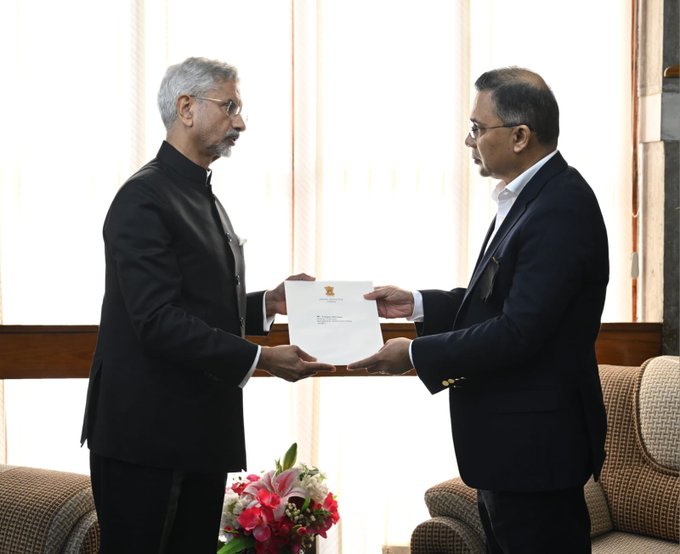
EAM S Jaishankar met BNP acting chairperson Tarique Rehman in Dhaka (Image Jaishankar on X)
PM Modi’s outreach to BNP and Jaishankar’s Dhaka visit signal a recalibration in India–Bangladesh ties as power equations shift ahead of February polls.
By NIRENDRA DEV
New Delhi, January 1, 2026 —Prime Minister Narendra Modi’s expression of hope for a “new beginning” in India–Bangladesh relations is neither rhetorical nor routine. It is a calibrated diplomatic signal—issued at a moment when Dhaka’s political future appears poised for a decisive shift.
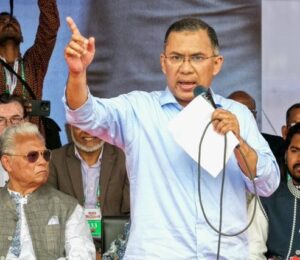
The massive turnout at Khaleda Zia’s funeral in Dhaka—drawing people from all walks of life—has triggered serious political speculation: that the Bangladesh Nationalist Party (BNP) may be heading for a convincing victory in the February 12 elections, provided they are held on schedule and power transitions smoothly.
India’s Neighbourhood First Policy, anchored in civilisational ties and pragmatic diplomacy, has long treated Bangladesh as a priority partner. But New Delhi’s comfort level has clearly frayed in recent months—especially amid signals that sections of Dhaka’s interim establishment are attempting to reopen channels with Pakistan, while appearing to downplay the historical trauma of the 1971 genocide.
It is in this context that India’s decision to send External Affairs Minister S. Jaishankar to Dhaka for a tightly timed four-hour visit—and PM Modi’s personal letter to Tarique Rahman, widely seen as the Prime Minister-in-waiting—assumes significance.
“I am confident that her ideals will be carried forward under your able leadership,” Modi wrote, expressing hope that Khaleda Zia’s legacy would guide a renewed partnership between India and Bangladesh.
The subtext was unmistakable: India is hedging its bets, preparing for a post-Hasina political order.
While elections are formally scheduled for February 12, uncertainty lingers over whether interim leader Muhammad Yunus—widely viewed in Indian strategic circles as aligned with extra-constitutional power centres—will relinquish control smoothly. His recent remark that his role ends only “when a new government takes charge” has raised eyebrows.
New Delhi, however, could not afford strategic inertia. Years of diplomatic investment under Sheikh Hasina—in connectivity, security cooperation, and economic integration—cannot be allowed to dissipate without contingency planning. Hence, outreach to BNP represents what many Indian policymakers privately describe as the “monder bhalo” (lesser evil) option.
The political optics in Dhaka are shifting. The funeral congregation around the Jatiya Sangsad complex transformed grief into a show of political mobilisation. While crowds alone do not win elections, they do reveal momentum—and anxiety now persists only until the ballot boxes speak.
Crucially, Tarique Rahman has so far maintained restraint. Unlike earlier BNP regimes, his public posture has avoided overt anti-India rhetoric. At a moment when Bangladesh faces economic stress, trade disruptions, and deteriorating law and order, confrontation with India offers little electoral or economic dividend.
Indeed, Bangladeshi intellectual circles are showing signs of neo-pragmatism. Criticism of the Yunus regime is growing—over governance failures, eroding India ties, and economic losses, especially in textiles and cross-border trade.
India’s message, implicit but firm, is simple: friends are protected; adversarial posturing carries costs. History shows that PM Modi is willing to go to great lengths to secure the interests of reliable partners.
Yet caution remains warranted. The BNP’s past record—marked by warmer ties with Pakistan and China and strained engagement with India—cannot be wished away. History, geography, and political memory will shape the next phase of bilateral relations.
Still, diplomacy is not about nostalgia—it is about necessity, vision, and realism.
If elections proceed as scheduled and power changes hands peacefully, mid-February 2026 could mark a genuine inflection point in India–Bangladesh relations. Whether this becomes a reset—or a relapse—will depend on choices made in Dhaka as much as signals sent from New Delhi.
For now, India has extended an olive branch. The region will soon know whether it finds a willing hand.
(This is an opinion piece. Views expressed are the author’s own.)
Modi’s Condolence to Khaleda Zia’s Son Signals a Quiet Reset
Follow The Raisina Hills on WhatsApp, Instagram, YouTube, Facebook, and LinkedIn




About The Author