Modi–Putin Bear Hug: Why ‘New Russia’ Is Courting ‘New India’
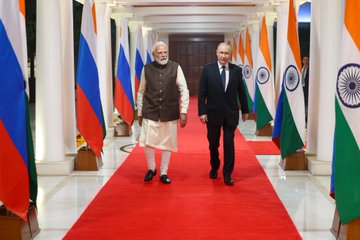
Prime Minister Narendra Modi receives Russian President Vladimir Putin at 7, Lok Kalyan Marg in New Delhi. (Image Modi on X)
From Dugin’s Novorossiya to Hindutva’s civilisational turn, Moscow and Delhi are converging on a worldview where culture, not constitutions, defines the nation.
By NIRENDRA DEV
New Delhi, December 17, 2025 — There is something deeper at work in the Modi–Putin warmth than oil, arms or sanctions-busting diplomacy. Beneath the optics of bear hugs lies a shared civilisational imagination—one that seeks to redefine citizenship, sovereignty and global order itself.
Enter Novorossiya—“New Russia”—a concept popularised by Aleksandr Dugin, the Russian political philosopher whose Neo-Eurasianism imagines Russia as the core of a vast, non-Western civilisational bloc. Dugin is no policymaker, but he is a powerful thought-influencer. His ideas echo disturbingly well with the language now visible in Moscow—and, increasingly, in New Delhi.
Dugin’s worldview rejects Western liberalism and Atlanticism, advocating instead a multipolar order led by “traditional civilisations”: Russia, China, the Islamic world, India and Africa. He has openly praised Hindutva, calling for an ideological alliance between Russia and India against Western modernity. In this framework, nations are not civic constructs bound by constitutions, but ancient cultural entities with historical destinies.
Seen through this lens, Putin’s embrace of India is not merely transactional. It reflects a comfort among like-minded states that see themselves as guardians of besieged civilisations rather than modern nation-states accountable to liberal norms.
In India, Hindutva performs a parallel role. As noted by The Telegraph’s Carol Schaeffer, it recasts India not as a constitutional republic founded in 1947, but as an ancient Hindu civilisation stretching back millennia. Citizenship becomes cultural rather than civic; minority protections are reframed as “appeasement”; dissent is increasingly portrayed as betrayal of the nation’s soul.
Dugin’s intellectual journey— from anti-communist dissident to far-right ideologue—has always revolved around this civilisational absolutism. In the 1990s, he argued that Russia was destined to confront an individualistic, materialistic West. His later writings denied Ukraine any meaningful statehood, framing its existence as a threat to Eurasian unity—a logic that now underpins the war.
The danger is not just about India–Russia ties or the RIC axis. It is about the kind of global order the world’s largest democracy helps legitimise. When citizenship shifts from law to culture, and geopolitics from interests to destiny, the results are rarely peaceful.
(This is an opinion piece, and views are author’s)
Follow The Raisina Hills on WhatsApp, Instagram, YouTube, Facebook, and LinkedIn




About The Author