


By TRH World Desk
Modi’s New Zealand Visit Signals Strategic Shift Beyond Trade as Both Nations Deepen Indo-Pacific Partnership
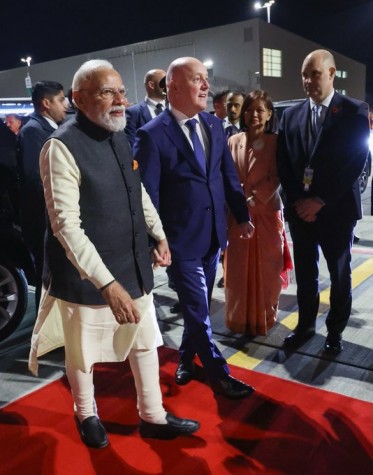
New Delhi, July 11, 2026 — Prime Minister Narendra Modi’s visit to New Zealand has resulted in one of the most comprehensive upgrades in bilateral relations in decades, with both countries elevating their engagement to a Strategic Partnership backed by a detailed Roadmap to 2030. While trade expansion remains an important pillar, the agreements announced on Saturday indicate that the partnership is increasingly being shaped by shared security concerns in the Indo-Pacific.
The visit produced ten bilateral agreements spanning defence, maritime security, disaster management, agriculture, tourism, sports, culture and scientific cooperation, alongside several strategic announcements aimed at strengthening long-term institutional collaboration.
The most significant outcome was the decision to establish an India-New Zealand Strategic Partnership, providing a structured framework for cooperation across ministries over the next four years. The roadmap reflects New Delhi’s broader effort to build a network of like-minded partners in the Indo-Pacific amid intensifying geopolitical competition in the region.
Defence cooperation featured prominently in the outcomes. Both countries signed agreements on maritime cooperation, reciprocal logistics support between their navies, hydrography and nautical cartography, while also agreeing to establish a dedicated Maritime Security Dialogue.
Collectively, these measures move bilateral defence ties beyond goodwill visits towards operational cooperation. The logistics arrangement, in particular, could facilitate easier naval deployments, humanitarian missions and joint exercises across the Indo-Pacific.
Another notable development was the establishment of a Joint Working Group on Counter-Terrorism, showing growing convergence on regional security challenges. Intelligence sharing and coordinated approaches to combating terrorism are expected to become regular features of bilateral engagement.
Economically, India and New Zealand have set an ambitious target of doubling bilateral trade to NZ$7 billion (approximately ₹35,000 crore) by 2030, complementing ongoing discussions surrounding a Free Trade Agreement. The objective reflects both governments’ desire to diversify supply chains and reduce overdependence on traditional trading partners.
Agriculture also emerged as a major area of cooperation. The launch of a Kiwifruit Action Plan, along with the establishment of two Centres of Excellence in Nagaland and Uttarakhand, demonstrates a shift from conventional trade towards technology transfer, research and value-chain development. Agreements covering dairying and food technology further strengthen this agenda.
The partnership also expanded into emerging sectors. New Zealand’s decision to join the Global Biofuels Alliance aligns it more closely with India’s clean energy diplomacy. Meanwhile, collaboration between India’s National Centre for Polar and Ocean Research and New Zealand’s University of Canterbury is expected to deepen Antarctic scientific research.
People-to-people ties also received renewed attention through agreements on tourism, sports and cultural exchanges, while cooperation between disaster management agencies highlights the growing importance of climate resilience and emergency preparedness.
Strategically, New Zealand’s decision to join the Maritime Security pillar of India’s Indo-Pacific Oceans Initiative (IPOI) may prove one of the visit’s most consequential outcomes. The move strengthens cooperation against Illegal, Unreported and Unregulated (IUU) fishing while reinforcing India’s vision of a free, open and rules-based Indo-Pacific.
Taken together, the agreements suggest that India-New Zealand relations are evolving beyond their traditionally modest economic profile into a broader strategic partnership anchored in maritime security, resilient supply chains, defence cooperation and shared regional interests. For New Delhi, the visit represents another step in expanding its Indo-Pacific architecture through trusted democratic partners.
Follow The Raisina Hills on WhatsApp, Instagram, YouTube, Facebook, and LinkedIn




