


By KUMAR VIKRAM
From Jakarta to Melbourne, the crowds may change—but the script remains remarkably consistent.
New Delhi, July 9, 2026 — Prime Minister Narendra Modi has spent this week doing something he has now done for more than a decade: filling a room with the Indian diaspora, and watching the host country’s politicians scramble to be seen next to him.
On July 8, it was Jakarta —the Prime Minister addressed the Indian community in Indonesia, talking up the country’s growth trajectory and asking the diaspora to encourage their Indonesian friends to visit India, in front of a crowd of around 4,000.
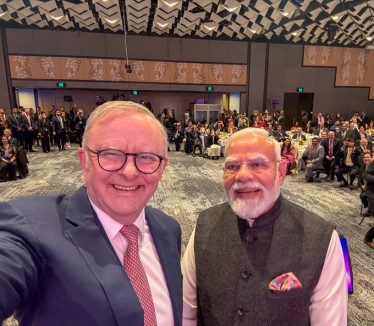
By the time this runs, he’s in Melbourne, where Victorian Premier Jacinta Allan and federal Home Affairs Minister Clare O’Neil will greet him on arrival, before Allan and Opposition Leader Anthony Albanese share a stage with him at the “Melbourne Meets Modi” event at Marvel Stadium — reportedly in front of up to 30,000 people, according to reporting in The Australian.
This isn’t a coincidence of scheduling. It’s a pattern, and it’s worth understanding both halves of it: why Modi keeps doing this, and why local politicians keep queuing up to join him.
The Six-Day Circuit: Jakarta, Melbourne, Auckland
Modi’s current trip is a three-country swing. He is travelling to Indonesia, Australia and New Zealand from July 6 to 11, holding bilateral talks with each country’s leader, reviewing cooperation and addressing the Indian diaspora at each stop.
The Indonesia leg ran July 6–8 at President Prabowo Subianto’s invitation — Modi’s fourth visit to the country. From there he travelled to Melbourne from July 8–10 at Anthony Albanese’s invitation, where he is holding bilateral talks, call on Governor-General Sam Mostyn, addressed the India-Australia CEOs Forum, and meet the diaspora, which the Australian government has described as a key pillar of the bilateral relationship.
He then continues to New Zealand for the first state visit by an Indian PM there in four decades.
The Melbourne stop is notable for one reason in particular: it isn’t Sydney. Modi’s decision to address supporters in Melbourne rather than Sydney, where he held his last mass diaspora event in 2023, reflects the changing geography of Australia’s Indian community, with Victoria now home to one of the country’s largest Indian-born populations.
Nationally, people born in India have overtaken those born in England as Australia’s largest overseas-born population for the first time on record, according to the Australian Bureau of Statistics. That demographic shift is the quiet subtext of every seating chart on that Marvel Stadium stage.
A Pattern Twelve Years in the Making
Modi didn’t invent the diaspora rally, but he has industrialised it. The sequence goes back to his first months in office:
– 2013, Munich — a diaspora reception at the Audi Dome, before he was even Prime Minister.
– 2014, New York — roughly 18,500 people at Madison Square Garden, his first major diaspora event as PM.
– 2014, Sydney — a crowd of similar size at what was then the Allphones Arena.
– 2015, San Jose —around 45,000 people gathered, with 18,500 packed into the SAP Center itself.
– 2015, London —an estimated 60,000 people at Wembley Stadium, with British PM David Cameron sharing the stage.
– 2019, Houston — “Howdy, Modi!”, a rally of 50,000 with Donald Trump as the self-described “warm-up act,” plus US lawmakers and business leaders in attendance.
– 2023, Sydney —roughly 20,000 people at Qudos Bank Arena, where Albanese introduced Modi to chants of his name.
– 2026, Jakarta and Melbourne — the current leg.
Academic analysis of this pattern, written around the Houston event, is blunt about what these gatherings actually are: “Gatherings like Howdy, Modi are effectively campaign rallies, albeit organised abroad and involving people who, for the most part, cannot vote in India’s elections.” The same analysis in Griffith Asia Insight notes a financial dimension too —rallies of this kind are designed partly to thank past donors and solicit future contributions, at a time when Indian election-finance law has made it easier for foreign entities to donate to Indian parties while making the money harder to trace.
And they double as an organising tool for a diaspora that is, by nature, fragmented: “India’s diaspora splits along regional, linguistic, caste and religious lines, and events like these function as a focal point that pulls those smaller groups into a single, visible show of unity.”
Why the Local Politicians Show Up
None of that explains why Anthony Albanese, David Cameron, Jacinta Allan or Donald Trump wanted to be within camera-shot of it. That part is entirely domestic politics.
The Australian case is the clearest illustration, and the Melbourne event sits inside a live contest for the Indian-Australian vote. According to reporting in The Australian, former Labour strategist Kosmos Samaras — now director at RedBridge — says Modi’s brand in Australia is “strongly aligned with Labour,” and that Indian-Australian voters, once seen as a genuine electoral battleground, have increasingly become part of Labour’s base, in electorates where the two-party-preferred vote for people who speak a language other than English at home already sits above 40%.
That’s the mechanism in miniature: a diaspora of more than 673,000 Indian-born residents nationally, concentrated in outer-metropolitan seats that both major parties need, watching which politicians turn up to greet their prime minister and which don’t. Being on stage is a low-cost, high-visibility way to signal you take that community seriously. Being absent is read the other way.
Albanese has form here. At the 2023 Sydney event, he told the 21,000-strong crowd that Modi “gets a rock star reception wherever he goes,” comparing him to Bruce Springsteen and declaring “Prime Minister Modi is The Boss.” The crowd of about 20,000 chanted Modi’s name as the two leaders signed new migration and green hydrogen agreements the following day.
Receptions, Goodwill, and Footages
Strip away the individual stadiums and cities, and the same three things happen every time: Modi gets a rapturous, made-for-television reception from a diaspora that is genuinely large and growing; the host country’s leadership gets a photo opportunity with a foreign leader who commands more domestic goodwill among a swing constituency than almost any other visiting dignitary; and a layer of unresolved criticism — on human rights, on migration policy, on what these events actually cost versus what they buy — sits just below the surface, visible but rarely allowed to interrupt the choreography.
Jakarta this week, Melbourne next — and if the pattern holds, wherever Modi lands next will look much the same.
Follow The Raisina Hills on WhatsApp, Instagram, YouTube, Facebook, and LinkedIn




