Modi in Israel Amid Iran War Clouds: Strategic Autonomy or Signal?
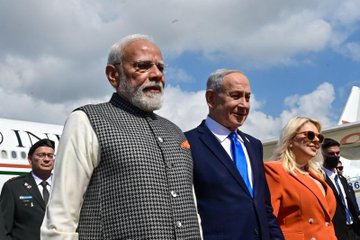
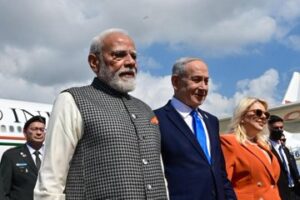
Prime Minister Narendra Modi with Israel PM Benjamin Netanyahu in Tel Aviv on Wednesday (Image Israel PM on X)
Manish Anand on The Raisina Hills: India Deepens Israel Ties as Middle East Tensions Escalate
By TRH Op-Ed Desk
New Delhi, February 25, 2026 — Prime Minister Narendra Modi has landed in Israel at a moment when the Middle East stands on edge.
Welcomed warmly at the airport by Israeli Prime Minister Benjamin Netanyahu and his spouse, Modi’s visit is being watched closely by global geopolitical observers. The optics — the embrace, the symbolism, the timing — are unmistakable.
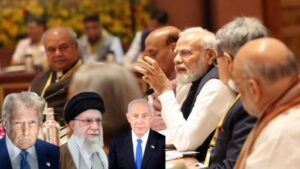
The Modi Israel Visit 2026 comes as war clouds gather over Iran, with speculation intensifying that the United States could consider military options if Tehran advances toward nuclear capability and ballistic missile programme.
Speaking on The Raisina Hills, geopolitics analyst Manish Anand said: “Prime Minister Narendra Modi has arrived in Israel at a time when the Middle East is facing extraordinary uncertainty.”
He further stated that “there were expectations that the United States could move militarily against Iran within days. In his State of the Union address, President Donald Trump reiterated that Iran will not be allowed to develop a nuclear bomb or intercontinental ballistic missiles.”
Against this tense backdrop, Modi’s two-day visit carries deep geopolitical meaning, he added. Anand noted that this is Modi’s first visit to Israel since 2017 — when Netanyahu was also Prime Minister — underscoring the personal rapport between the two leaders.
From I2U2 to Abraham Accords: The Strategic Reset
Anand pointed out that under the Biden administration, the I2U2 Group — comprising India, Israel, the United States, and the UAE — emerged as a new minilateral platform.
However, with Trump back in office, attention has shifted again toward the Abraham Accords, which focus on expanding Israel’s normalization with Arab states.
“Trump’s Middle East strategy is returning to the Abraham framework. His emphasis remains on consolidating pro-West Asian partnerships against radicalism — both Shia and Sunni variants,” Anand said.
Axis of Resistance and Security Calculus
Netanyahu, in a pre-visit cabinet message, indicated that India and Israel would work together against radical forces — an implicit reference to Iran-backed networks. These include: Hamas in Gaza, Hezbollah in Lebanon, and Houthi forces in Yemen. However, India doesn’t specifically associate with any of the mentioned groups for any action.
Often referred to collectively as the “Axis of Resistance,” these groups are seen by Israel as strategic extensions of Iranian influence. Anand observed: “India’s position remains balanced. It supports Israel strongly on counter-terror cooperation, but it also maintains commitment to a two-state solution and strong ties with Gulf nations including the UAE, Oman, Qatar, and Egypt.”
Defence, Intelligence & Iron Dome Technology
Defence cooperation remains the backbone of India–Israel relations. Israel’s advanced air defence systems — particularly the Iron Dome — are central to discussions. While Israel traditionally does not export core defence technologies outright, technology-sharing arrangements could significantly enhance India’s air defence grid.
“If Israel shares advanced air defence technology with India, it could strengthen India’s security architecture — something Prime Minister Modi has emphasized from the Red Fort,” Anand noted.
Intelligence-sharing between the two nations is also expanding, with Israel widely regarded as one of the world’s most sophisticated intelligence powers.
Trade & Free Trade Agreement Momentum
Beyond defence, economic ties are accelerating. Talks on a Free Trade Agreement are reportedly gaining traction. Israel, a global startup hub, could expand manufacturing footprints in India under the “Make in India” initiative.
Indian workforce mobility to Israel — particularly in construction and skilled sectors — is also rising, adding a human dimension to the partnership.
The Pakistan Factor
Anand also flagged Pakistan’s evolving posture on Gaza diplomacy, cautioning that increased Pakistani involvement in certain Middle East peace mechanisms could create friction with Israel.
“The geopolitical chessboard is dynamic. Every move has multiple consequences — regionally and domestically,” he said.
Strategic Autonomy in Action
The broader takeaway? India continues to practice strategic autonomy — engaging Israel deeply while maintaining relations with Iran and the wider Arab world.
As Modi completes this visit and prepares for subsequent high-level engagements, the Modi Israel Visit 2026 could mark a defining moment in India’s Middle East recalibration.
The coming days will reveal whether this visit reshapes defence, economic, and intelligence cooperation — or signals something even larger in the shifting global order.
Modi in Israel: New Delhi Doing What Is Good for India: Analyst
Follow The Raisina Hills on WhatsApp, Instagram, YouTube, Facebook, and LinkedIn




About The Author