Modi Foreign Policy 2025 and India’s Strategic Crossroads
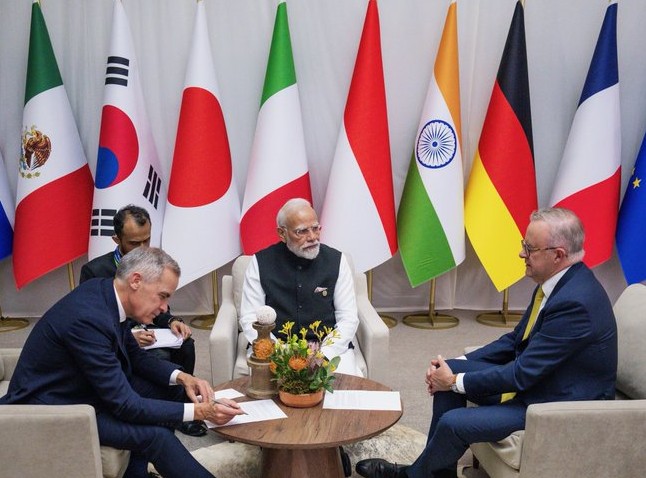
PM Narendra Modi with PMs of Australia and Canada on sidelines of G20 Summit (Image Mark Carney on X)
From the India–Pakistan conflict to strained Trump–Modi ties, China’s leverage, Russia’s embrace and trade diversification — 2025 put Modi foreign policy through its toughest geopolitical examination yet.
By TRH Foreign Affairs Desk
New Delhi, December 28, 2025 — The year 2025 will be remembered as a year of turbulence for global geopolitics—and an intense stress test for Modi foreign policy 2025. It was a year when assumptions were challenged, alliances questioned, and India’s rising global stature put under sharp international scrutiny.
The four-day India–Pakistan military conflict early in the year altered the diplomatic landscape dramatically. “While New Delhi expected unequivocal global backing after Operation Sindoor, the international response was sobering,” said Manish Anand in his year-end analysis of India’s foreign policy for the YouTube channel of The Raisina Hills.
Major powers focused more on de-escalation than endorsement. “This raised uncomfortable but necessary questions: How deep is India’s global influence? Who are India’s reliable friends in moments of crisis,” Anand asked.
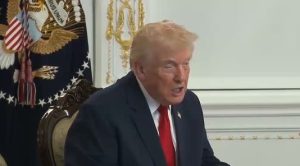
Compounding this challenge was the evolving trajectory of India–US relations. Until recently, strategic convergence between Washington and New Delhi appeared irreversible. However, the return of Donald Trump and his distinctly transactional, isolationist worldview introduced fresh uncertainty. “Trump’s foreign policy—guided by narrow American self-interest—has diluted US leadership globally and complicated partnerships, including with India,” noted Anand.
The postponement of the Quad leaders’ summit under India’s presidency symbolised this strain. “Despite strong interest from Japan and Australia to counterbalance China, American hesitation weakened the grouping’s momentum. Trade negotiations too remain unresolved, with punitive tariffs and pressure tactics clouding bilateral trust,” he added.
Meanwhile, China’s rise continues to dominate global calculations. “Beijing today is not just a geopolitical power but a financial and technological force, wielding leverage through debt diplomacy, critical minerals, semiconductors and currency reserves,” stressed Anand.
US national security and defence documents under the Trump 2.0 administration reflect deep anxiety about China’s expanding footprint. “In this environment, Washington’s dilemma is clear: will it treat India—the likely third-largest economy—as a strategic partner or a future rival,” wondered Anand.
India, anticipating uncertainty, has quietly diversified. Trade agreements with Australia, the UK, New Zealand and the European Union have strengthened India’s economic resilience. Talks with Canada have resumed after a prolonged freeze, aided by leadership change in Ottawa and improved political chemistry. A trilateral technology partnership between India, Canada and Australia marks a significant reset.
Perhaps the most consistent pillar of Modi foreign policy 2025 has been India–Russia relations. “Despite Western unease, President Vladimir Putin’s visit to Delhi reaffirmed a partnership rooted in defence cooperation and technology sharing. For India’s national interest, Moscow remains indispensable—an uncomfortable truth for many in the West,” opined Anand.
Yet, questions persist. As India inches closer to becoming the world’s third-largest economy, will global power structures make room for it at the high table, he asked. Or, said Anand, will India be asked to shoulder responsibilities without commensurate influence?
“As 2026 approaches, Modi foreign policy stands at a crossroads—balancing old friendships, managing volatile partnerships, and asserting strategic autonomy in an increasingly fractured world,” concluded Anand.
(Manish Anand hosts discussions on geopolitics and Indian politics on The Raisina Hills’ channel)
Follow The Raisina Hills on WhatsApp, Instagram, YouTube, Facebook, and LinkedIn




About The Author