Matua Votes, Citizenship Angst and the West Bengal’s Poll Storm
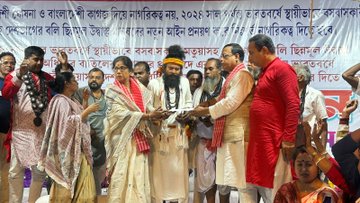
TMC leaders with representatives of the Matua community (Image TMC on X)
West Bengal politics through the Matua vote-base—where voter list revisions, citizenship delays and BJP–TMC cross-currents are reshaping the state’s most volatile electoral contest
By TRH Political Desk
Kolkata, January 2, 2026 — West Bengal is once again on the brink of a political churn—but this time, the storm has a name: the Matua vote base.
As the Election Commission rolls out a Special Intensive Revision (SIR) of electoral rolls and the 2026 Assembly election approaches, the Matua community—largely migrants from Bangladesh who settled in Bengal from the 1990s onwards—has moved from the margins to the centre of the state’s political battlefield.
Estimates vary, but the Matua population is believed to constitute 17–20 per cent of West Bengal’s population, with the capacity to decisively influence outcomes in 40 to 60 Assembly seats. “In a state where margins are tight and emotions sharper, that arithmetic is politically explosive,” said Manish Anand, senior political journalist in his analysis for the YouTube channel of The Raisina Hills.
Why the Matua Factor Matters Now
The immediate trigger is the Special Intensive Revision of voter lists—the first such large-scale exercise since 2002, when electoral rolls were digitised. “For many Matua families who arrived after the 1990s, documentary proof is thin. Land registration papers often exist; birth certificates, legacy records and citizenship documents often do not,” added Anand.
The fear is simple—and existential: names may be struck off voter lists.
This anxiety has transformed the Matua question from a social issue into a full-blown political crisis.
BJP vs TMC: A Contest of Claims, Not Certainty
The Bharatiya Janata Party claims that lakhs of illegal infiltrators—particularly in border districts—were added to voter lists over the years and must be removed. The Trinamool Congress counters that the revision drive risks disenfranchising genuine refugees, many of whom have lived, worked and voted in India for decades.
Caught in the middle is the Matua community—politically influential but administratively vulnerable.
Ironically, the Matuas are not loyal to a single party. “Their leadership is split across the BJP and the TMC. Union minister Shantanu Thakur represents the BJP, while the TMC also has Matua MPs and deep grassroots links. This dual alignment makes the community powerful—but also politically expendable,” added Anand.
Citizenship Amendment Act: Promise vs Reality
The controversy has inevitably brought the Citizenship Amendment Act (CAA) back into focus. Mamata Banerjee has sharpened her attack on the BJP: years after passing the law, citizenship numbers remain negligible, with only a few thousand applications filed nationwide. The promise of legal certainty, she argues, has not translated into real relief for the Matuas.
For the BJP, the dilemma is strategic. “Implement CAA aggressively in Bengal, and risk backlash in Assam—where citizenship remains a deeply sensitive issue. Delay it further, and risk alienating the very refugee communities the law was meant to protect,” argued Anand.
The result is political hesitation—and lost momentum.
Modi, Bhagwat and the Timing Question
The political temperature has risen further with Prime Minister Narendra Modi’s visit to Bengal and RSS chief Mohan Bhagwat’s presence in Kolkata, coinciding with the voter revision exercise.
Officially apolitical, the RSS nonetheless remains the BJP’s ideological backbone. “The simultaneity of these developments has intensified speculation, sharpened rhetoric, and deepened mistrust across party lines,” added Anand.
Lessons from 2019—and the Mamata Comeback
The BJP’s stunning performance in the 2019 Lok Sabha elections had once made a Bengal breakthrough seem inevitable. “But Mamata Banerjee’s emotional, identity-driven counteroffensive in the 2021 Assembly polls—framed through “Khela Hobe”—halted that march decisively,” noted Anand.
As polls approach, the lesson is clear: Bengal votes emotionally before it votes ideologically.
The Matua Crossroads
Today, Matua families are organising protests, documentation camps, and appeals to both parties. “Their children—born in India—often have papers. Their elders frequently do not. That generational divide has turned bureaucracy into destiny,” stressed Anand.
Who benefits if Matua names are deleted? Who loses if citizenship remains unresolved?
“Those answers may decide not just seats—but the future political direction of West Bengal,” Anand stated.
One thing is certain: the road to Nabanna now runs through the Matua question.
(Manish Anand hosts discussions on Indian politics at Raisina Hills YouTube channel regularly)
Follow The Raisina Hills on WhatsApp, Instagram, YouTube, Facebook, and LinkedIn




About The Author