Markets Smell Peace: Stocks Signal Ukraine War Endgame
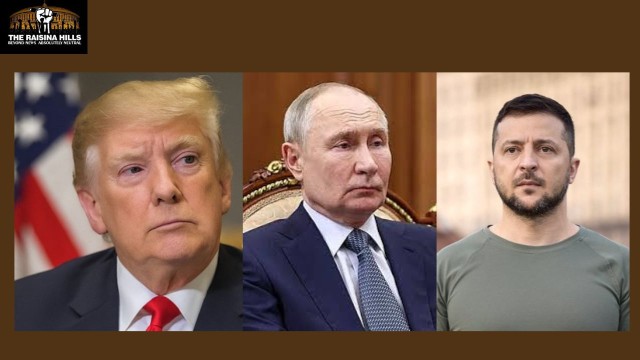
Presidents of US, Russia and Ukraine! (Images Wikipedia)
As European arms stocks slide sharply, markets appear to be betting on diplomacy over escalation—well before politicians say it aloud.
By S JHA
Mumbai, December 19, 2025 — “Follow the money.” The Wall Street maxim may now be the clearest geopolitical signal of all. According to Djoomart Otorbaev, former Prime Minister of the Kyrgyz Republic, markets are quietly but decisively pricing in the end of the Ukraine war—even as political rhetoric remains combative.
Writing on LinkedIn, Otorbaev points to a striking divergence between political messaging and financial behaviour. The inflection point, he argues, came when Donald Trump’s widely reported 28-point peace plan hit the headlines. Within days, European defence stocks—whose revenues are closely tied to the Ukraine conflict—went into a steep decline.
The numbers are unambiguous. Between October 6 and December 3, the STOXX Europe Aerospace & Defence index fell 13 per cent. Individual firms fared far worse. Germany’s RENK Group collapsed 43 per cent, Hensoldt fell 39 per cent, and Rheinmetall—once the poster child of Europe’s war-driven boom—lost 22 per cent. Sweden’s Saab dropped 15 per cent, France’s Thales slid 16 per cent, Italy’s Leonardo fell 17 per cent, and Britain’s BAE Systems plunged 20 per cent.
These are not routine corrections. They reflect a rapid erasure of what investors had priced in as a permanent “war premium”. Since 2022, European defence firms had surged on the assumption that Ukraine would remain an open-ended battlefield. Rheinmetall alone had risen over 400 per cent. When the news cycle shifted towards diplomacy, that assumption collapsed.
The contrast with the United States is telling. American defence giants registered softer declines—Lockheed Martin down 13 per cent, Northrop Grumman 12 per cent, General Dynamics just 3 per cent, while RTX remained steady. The reason is structural: Ukraine accounts for under 10 per cent of US defence revenues, while Europe’s arms makers are far more exposed. Rheinmetall draws about 15 per cent of its revenue from Ukraine-related supplies; others depend on it for between 5 and 10 per cent.
What comes next, Otorbaev warns, is political pressure. European defence lobbying budgets have surged nearly 40 per cent since 2023 as firms seek to lock in long-term spending. The contradiction is stark: politicians speak of escalation, while markets are pricing peace.
History suggests markets are rarely sentimental. When defence stocks fall this fast, they are not guessing—they are anticipating.
One Code to Rule the Market? SEBI Wades into Reform and Power
Follow The Raisina Hills on WhatsApp, Instagram, YouTube, Facebook, and LinkedIn




About The Author