Mark Carney’s Beijing Pivot Signals a Geopolitical Earthquake
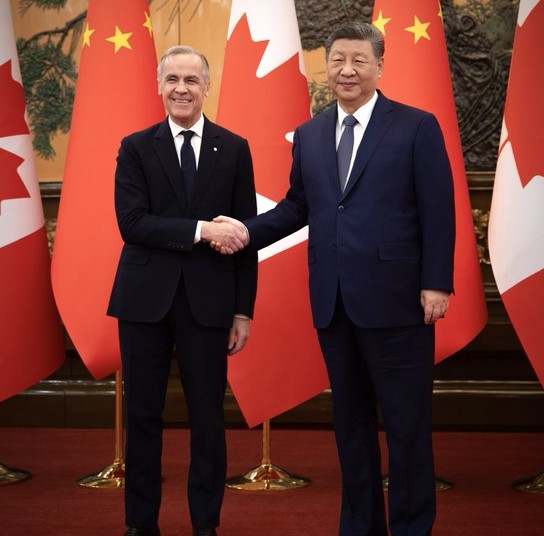
Canada's Prime Minister Mark Carney meets Chinese President Xi Jinping in Beijing. (Image Carney on X)
Canada’s China reset redraws global alignments—with deep consequences for India, BRICS, and the Western order.
By Manish Anand
New Delhi, January 18, 2026 — Canadian Prime Minister Mark Carney’s visit to China is not diplomacy as usual—it is a geopolitical tremor. After nearly a decade of bitterness between Ottawa and Beijing, Carney’s China outreach has abruptly reset relations, sending a sharp, unmistakable message to Washington: Canada no longer sees Trump’s America as a reliable anchor of the global order.
What Carney has done—without openly saying it—is reject America’s disruptive, coercive geopolitics and embrace China as a pragmatic economic and strategic partner. In geopolitical terms, this is a choice between systems, not merely states.
The symbolism is striking. Canada, a G7 nation and longtime US ally, has dramatically reduced tariffs on Chinese electric vehicles—from over 60 percent to just 6.2 percent—opening its markets to the world’s EV superpower. This move dismantles the economic walls erected during Justin Trudeau’s tenure, when relations with both India and China deteriorated sharply.
Carney has quietly buried Trudeau’s confrontational legacy. After restoring ties with India—discarding unsubstantiated allegations that poisoned bilateral relations—he has now turned decisively toward Beijing, the world’s second-largest economy. The message is unmistakable: Canada is hedging against American unpredictability.
At the heart of this shift lies Donald Trump’s tariff-driven foreign policy. With Canada facing punitive US tariffs and Washington weaponising trade against allies and rivals alike, Ottawa has concluded that strategic diversification is no longer optional. China, despite ideological differences, offers scale, stability, and leverage.
Chinese strategists interpret Carney’s visit as validation of Beijing’s long-standing demand for “correct perception”—acceptance of China’s core interests without moral lectures on human rights, Hong Kong, Xinjiang, or Taiwan. Whether Canada fully subscribes to this framework remains debatable, but the optics alone matter.
For India, the implications are profound. With New Delhi hosting the BRICS Summit in 2026, speculation is already swirling: could China attempt to draw Canada closer to the Global South’s institutional orbit? A developed G7 nation engaging BRICS would mark a historic rupture in global alignments.
One thing is clear. This is the most consequential diplomatic visit of January. Mark Carney has showed that the age of automatic Atlantic loyalty is ending—and a multipolar world is no longer theoretical, but operational.
Why Modi May Actually Thank Trump for India and Canada Reset
Follow The Raisina Hills on WhatsApp, Instagram, YouTube, Facebook, and LinkedIn




About The Author