Madras High Court FCRA Ruling Resets ‘Religious’ Label
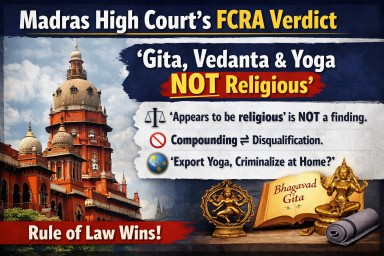
Madras High Court FCRA Ruling Resets ‘Religious’ Label: Gita, Vedanta and Yoga Can’t Be Grounds for Denial (Image TRH)
When “Religious” Becomes a Lazy Label: Madras High Court’s Gita–Vedanta–Yoga Reset for Foreign Contribution Regulation Act (FCRA)
By P. SESH KUMAR
New Delhi, December 28, 2025 — In Arsha Vidya Parampara Trust v Union of India, the Madurai Bench of the Madras High Court confronted a familiar administrative reflex under the Foreign Contribution (Regulation) Act, 2010: if an institution teaches the Bhagavad Gita, Vedanta, or Yoga, brand it “religious” and shut the FCRA gate. Justice G.R. Swaminathan’s judgment (19 December 2025) does something sharper than merely quash an order—it exposes how vague suspicion, compounded allegations, and a bureaucratic fear of “religion” can corrode statutory decision-making.
The Court held that “appears to be religious” is not a finding; that compounding cannot be used as a backdoor disqualification without fair warning; and that the Gita, Vedanta and Yoga-especially when taught as moral philosophy and universal practice-cannot be mechanically boxed into “religion” for FCRA purposes. The ruling resets the evidentiary threshold for denial, while also raising hard questions about how the State should regulate genuinely religious activity without criminalising India’s civilisational knowledge systems.
Skilling the Numbers: A Critical Reading of CAG’s PMKVY Audit
The story begins like many FCRA stories do-slowly, and then suddenly. The Arsha Vidya Parampara Trust, formed in 2017 by disciples of Swami Dayananda Saraswati, describes its work in the language of learning: teaching Vedanta with Sanskrit, teaching Hatha Yoga and yoga philosophy, and digitising/preserving ancient manuscripts. It applied for FCRA registration; the application languished for years; and when the file finally moved, it moved with the anxious twitch of a regime that treats foreign funding as both necessity and threat.
The Ministry’s eventual rejection (8 September 2025) rested-by the Court’s account-on two broad planks. First, alleged contravention relating to receipt of foreign contribution without prior permission and an allegation of transfer to another organisation. Second, the claim that the Trust’s nature “appears to be religious.” This is where the judgment’s tone turns from judicial restraint to judicial impatience.
On the contravention plank, the Court performs a basic but devastating audit of fairness. The Trust admitted an improper receipt; the authorities offered compounding; the Trust compounded by paying the specified sum; and the Ministry formally passed a compounding order on 1 August 2025. Having invited compounding and accepted the fee, the administration then tried to use the very contravention-now legally compounded-as a reason to deny registration. The Court calls out the bait-and-switch logic: if the State wanted compounding to operate as a continuing disqualification under Section 12(4)(a)(vii), it should have said so plainly at the time it offered the option, not after pocketing the compounding amount.
Worse, the “transfer to another organisation” allegation arrived like a ghost paragraph-materialising in the final rejection order without prior notice, without naming the recipient organisation, without dates, without particulars. The Court treats this as a textbook violation of natural justice and as an order infected with vagueness. The message is unmistakable: national security concerns do not license procedural sloppiness; discretion does not excuse opacity.
Then comes the second plank-“appears to be religious”—and here the Court tightens the legal screws. Under Section 11, any person with a “definite cultural, economic, educational, religious or social programme” must obtain registration before accepting foreign contribution. But if the statute is willing to recognise multiple legitimate programme-heads, the State cannot treat “religious” as a contaminant word that automatically disqualifies, nor can it rely on a tentative hunch.
SEBI Sparks Rally: Are India’s Markets Quietly Inflating Bubble?
The judgment insists that if the authority wants to reject on the ground that an organisation is religious, it must be categorical and must base that conclusion on relevant materials—not on vibes, not on discomfort, and certainly not on the mere presence of the words “Gita”, “Upanishads” or “Yoga” in a trust deed.
This is where Justice Swaminathan’s civilisational argument enters—not as a sermon, but as a classification tool. The Court records that the authorities effectively treated the Trust as “religious” because it teaches the message of the Bhagavad Gita. The response is blunt: the Gita is “not a religious book” but “a moral science”; it cannot be confined within a given religion; it is part of Bharatiya civilisation. The Court then extends the same reasoning to Vedanta, describing it as a philosophical stream— “pure philosophy evolved by our ancestors”—and delivers its most quotable line on Yoga: it would be “atrocious” to view Yoga through the prism of religion because it is universal.
The doctrinal significance is not the Court’s praise of these traditions—it is the Court’s insistence that the State must classify activities correctly, because classification drives rights. Under the FCRA regime, classification can decide whether an institution can survive, expand, collaborate internationally, or simply wither under compliance starvation. When classification becomes lazy, governance becomes arbitrary.
The Court also flags something the FCRA bureaucracy often pretends not to notice: legal systems are not silos. The Trust had a live charitable registration under the Income Tax Act (Section 12A), backed by an ITAT order; and the Court held that this was a relevant material that the FCRA authority failed to consider, showing non-application of mind. It draws strength from Section 52 of the FCRA Act-FCRA is “in addition to” and not “in derogation of” other laws—meaning the State cannot casually treat an organisation as charitable for one statutory regime and deny it basic consideration under another without coherent reasoning.
One Code to Rule the Market? SEBI Wades into Reform and Power
So the Court sets aside the rejection order and remits the matter for fresh consideration-within a time-bound frame-rather than granting registration outright. That remedy is important: it signals that the Court is not trying to run the FCRA office from the Bench, but it is also warning the office that it must now write a lawful order-one that meets standards of notice, evidence, proportionality, and categorical findings.
A critical reading, however, must hold two truths at once. First, the judgment is a win for administrative legality. It restores the idea that “national security angle” is not a magic phrase that dissolves due process; that vague reasoning is not “discretion”; and that compounding cannot be used as a procedural trapdoor. If FCRA is an exceptional statute with sweeping consequences, the discipline of reasoning must be exceptional too.
Second, the judgment also exposes the elephant the law still refuses to name clearly: what, exactly, is a “religious organisation” for FCRA decision-making? The Act speaks of “religious programme” but does not provide a crisp operational test for “religious” character, leaving the field open for inconsistent, mood-driven classification across cases.
In that vacuum, officials often reach for crude proxies-scriptural terms, saffron optics, spiritual vocabulary—because proxies are easier than analysis. The Court has now raised the bar against that habit. But unless the executive issues principled, transparent guidelines (and applies them consistently), the same disputes will keep returning—just with better-drafted rejection orders.
There is also a deeper policy anxiety the sequel must confront: India wants to present Yoga as global soft power and civilisational export, yet domestically it sometimes treats Yoga pedagogy as religious contagion for regulatory purposes. The judgment calls that lens “atrocious,” but the governance contradiction remains.
A sequel is necessary-not to re-argue that the Gita is profound (everyone already knows that), but to build a workable constitutional and administrative framework for distinguishing (i) spiritual-philosophical education, (ii) religious propagation, and (iii) faith-based service delivery, without weaponising FCRA as a blunt instrument.
The Madras High Court’s ruling is, at heart, thus, a warning against a particular kind of bureaucratic cowardice: the kind that replaces reasoning with labels. By holding that teaching the Bhagavad Gita, Vedanta and Yoga does not automatically make an organisation “religious” under FCRA-and by insisting that denial must be categorical, evidence-based, procedurally fair, and proportionate-the Court has made it harder for the State to smuggle suspicion into administrative orders.
Yet the larger governance task remains unfinished: unless “religious” is given a clear, consistent, rights-respecting meaning within FCRA administration, India will keep oscillating between celebrating its civilisational knowledge abroad and criminalising its teaching at home through regulatory overreach. This judgment forces the system to choose coherence over convenience-and that, in today’s compliance culture, is a revolution in plain language.
(This is an opinion piece. Views are personal)
Why India Must Not Blur the Line Between Auditor and Executive
Follow The Raisina Hills on WhatsApp, Instagram, YouTube, Facebook, and LinkedIn




About The Author








As years under Hindutva regime has, willy-nilly, worn on one feels that miasma of religious bigotry has entered every sphere of life in India
Will the judicial officer concerned accord the same status to Granth Sahib, Bible & Quran which too teach only morals ?