Landsbergis Warns NATO Playing Into Putin and Xi’s Hands
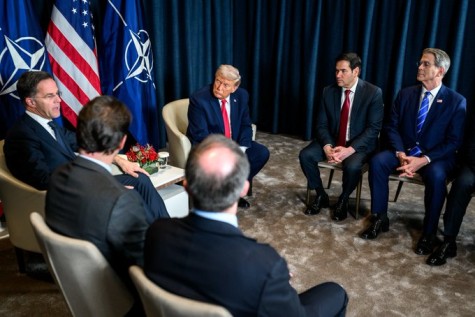
US President Donald Trump with NATO officials (Image The White House)
Former Lithuanian foreign minister Gabrielius Landsbergis argues why Europe must prepare for war—even without the United States
By TRH Op-Ed Desk
New Delhi, February 1, 2026 — When NATO Secretary General Mark Rutte publicly declared that Europe could not defend itself against Russia without US support, the message may have been intended as a warning to Europeans. But as former Lithuanian foreign minister Gabrielius Landsbergis cautions, such language risks doing the opposite of what deterrence demands.
“I presume that the NATO Secretary General’s messaging… was intended for Europeans as a warning against shutting the door on transatlantic cooperation,” Landsbergis writes in an article on his newsletter. “But it is nevertheless prudent to consider the possibility that a war with Russia… might have to be fought by Europeans alone.”
For Landsbergis, the problem is not realism—it is public defeatism. Referring to Rutte’s remark in the European Parliament that those who believe Europe could defend itself are “dreaming,” he warns: “Bullies aren’t deterred by loud declarations of vulnerability, they are emboldened and encouraged.”
This concern deepens when adversaries are taken into account. Landsbergis recalls that Rutte himself previously warned that a Chinese attack on Taiwan would likely be coordinated with Russian aggression in Europe. “I agree with the assessment,” he writes. “This does indeed seem to be their plan.”
That is precisely why Rutte’s words are so damaging. By stating unequivocally that Europe cannot defend itself, NATO’s top official is, in Landsbergis’s words, offering adversaries “loud confirmation… that their dual-theatre strategy can indeed work.” The implication is stark: the United States would face a forced choice—“either lose Europe to Russia, or Taiwan to China.”
Rather than strengthening the transatlantic bond, such messaging risks becoming “a self-fulfilling prophecy of success” for Beijing and Moscow. A stronger NATO strategy, Landsbergis argues, would signal readiness to fight in two theatres simultaneously—presenting Putin and Xi with dilemmas of their own.
Instead, what dominates is a misplaced appeal to pragmatism. Rutte’s approach, Landsbergis says, amounts to “declaring, and even exaggerating, weakness in order to justify the need for US support.” But that support, he notes, was never truly in doubt.
The question that remains unanswered is the most uncomfortable one: “What must be done to prepare Europe to fight… without our main ally?” Landsbergis concludes that the real pragmatism lies in confronting this possibility openly—before Europe is forced to do so by events.
Follow The Raisina Hills on WhatsApp, Instagram, YouTube, Facebook, and LinkedIn




About The Author