


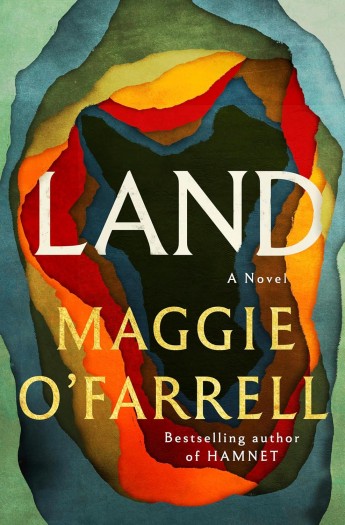
Land by Maggie O’Farrell Review: A Sweeping Irish Epic About Memory, Loss and Survival
Book Desk. June 2026. Land by Maggie O’Farrell.
Few contemporary writers combine historical research and emotional storytelling as effectively as Maggie O’Farrell. After the international success of Hamnet and The Marriage Portrait, expectations for her latest novel, Land, were understandably high. The result is an ambitious, sprawling work that seeks to map not merely the geography of nineteenth-century Ireland but also the scars left by famine, migration, colonialism, and grief.
Set largely in post-Famine Ireland in the 1860s, Land follows Tomás, an Irish mapmaker employed in the British Ordnance Survey, and his young son Liam. Their task appears straightforward: chart the physical landscape. Yet O’Farrell quickly turns surveying into a powerful metaphor. What happens when a nation attempts to measure territory while simultaneously trying to forget the suffering embedded in that land?
The novel was inspired in part by O’Farrell’s own family history. Her great-great-grandfather worked as a mapmaker, a connection that gives the narrative an unusual intimacy despite its epic scope. In interviews with NPR, O’Farrell described the book as emerging from a long fascination with Ireland’s landscape and the stories hidden beneath it.
The Land Remembers
The greatest achievement of Land is its ability to make geography feel alive. Villages emptied by famine, abandoned cottages, forgotten wells, and windswept coastlines become characters in their own right. O’Farrell suggests that landscapes carry memory long after official records have been erased.
American critics have largely praised this aspect of the novel. In The New Yorker, the book was described as another example of O’Farrell’s ability to blend meticulous historical research with imaginative storytelling while giving voice to people overlooked by conventional history. The review argued that her fiction functions as an alternative form of historical truth-telling, recovering emotional realities often absent from official accounts.
That ambition is evident throughout the novel. The Great Famine is not treated merely as a historical backdrop. It becomes a lingering presence that shapes every decision, every migration, and every family relationship. O’Farrell’s Ireland is a place haunted by absence.
Ambitious, Beautiful—and Occasionally Overextended
Yet Land is not without flaws.
At nearly 400 pages and spanning multiple generations and locations, the novel sometimes struggles to maintain narrative momentum. Readers who admired the tighter emotional focus of Hamnet may find themselves overwhelmed by the scale of O’Farrell’s project.
Some critics have questioned whether the novel’s mythic and spiritual dimensions occasionally overshadow its characters. Others have argued that the story’s emotional intensity can drift toward sentimentality. The mixed reactions suggest that Land may divide readers more sharply than O’Farrell’s earlier work.
Still, even when the narrative becomes unwieldy, O’Farrell’s prose remains luminous. Few writers can evoke weather, landscape, and human longing with such consistency.
Verdict
Land is not as immediately accessible as Hamnet, nor is it likely to achieve the same universal appeal. But it may be O’Farrell’s most ambitious novel. It asks readers to think about how nations remember, how history is recorded, and how ordinary people endure forces beyond their control.
At its best, Land transforms cartography into a moral act. Every map becomes a story. Every place name becomes an act of remembrance.
In an era when questions of identity, migration, and historical memory dominate political debate across much of the world, O’Farrell’s novel feels unexpectedly timely.
Rating: 4.5/5
(Land is a rich, lyrical, and deeply moving novel that rewards patient readers willing to follow O’Farrell into the tangled territory where history, myth, and memory meet.)
Regime Change: The Trump Book That Even Trump Was Waiting For — With Dread
Follow The Raisina Hills on WhatsApp, Instagram, YouTube, Facebook, and LinkedIn




