


Book Desk. June 2026.
Book Review: Communion: Finding My Way Back to Faith by J.D. Vance. Published: June 16, 2026 | Publisher: HarperCollins | Pages: 304 Author: J.D. Vance, 50th Vice President of the United States
A House Divided Against Itself
There is a cruel irony buried in the title of J.D. Vance’s second memoir. Communion — the Catholic sacrament of shared bread and cup, of union between the believer and the divine — implies wholeness, integration, a self brought together after fracture.
What the 304-page book published by HarperCollins on June 16, 2026, actually delivers is something closer to the opposite: a text visibly at war with itself, a man writing two entirely different books at once and succeeding, fitfully, at only one of them.
Vance, the 50th Vice President of the United States and the bestselling author of Hillbilly Elegy, frames Communion as an intimate spiritual account — a sequel to his 2016 breakout, picking up where that book left off to trace his journey from Protestant roots through collegiate atheism to his 2019 conversion to Catholicism.
The publisher describes it as “a spiritual exploration of what it means to be a Christian in all the seasons of life.” And for its first half, it very nearly is. What follows that first half is something considerably less inspiring.
The Book That Works
To be fair to Vance — and critics across the political spectrum agree on this more than the surface noise suggests — the early chapters of Communion contain some of the most candid and genuinely searching writing he has produced. Slate observed that the book’s opening section, through roughly page 177, is “a thoughtful read,” with Vance meditating on trauma and fatherhood, on periods of feeling spiritually adrift, and on “coming to love a ‘majestic’ faith tradition while remaining connected to the rowdy evangelicals of his childhood.”
His account of why Catholicism ultimately claimed him is the most intellectually interesting passage in the book. He writes that he values the Church for its structure — a balm, he explains, for someone raised in the chaos and instability of his Appalachian youth.
More provocatively, he describes feeling liberated by Catholicism’s theology of trauma, which he contrasts favourably with what he perceived as the deterministic fatalism of sociological accounts of poverty.
He had felt, he writes, “debilitated” by those frameworks, as though his destructive patterns were inescapable. Catholic thought, by contrast, gave him a sense of moral agency while acknowledging that social forces genuinely matter.
This is Vance at his best: a writer capable of genuine intellectual honesty about his own formation, willing to show his reasoning. The New Republic notes that the book’s redemption arc traces clearly how his wife Usha became a pivotal figure in his return to faith — after his therapy proved ineffective, she told him, simply, that church worked for him, and encouraged him to commit to it. It is a portrait of a marriage that, whatever else one thinks of Vance, reads as authentic.
Where the Book Falls Apart
And then, at roughly the midpoint, the machinery changes. Slate identified the pivot precisely: “After a section about his own adult baptism, the pinnacle of his faith journey, Vance launches, jarringly, into a chapter about his views of the international order.” The transition is so abrupt, so architecturally jarring, that it effectively announces: we are now in a different book.
From that point on, critics across publications — liberal, conservative, and centrist — largely agree that Communion becomes a conventional, and conventionally weak, political memoir. Writing in The Wall Street Journal, columnist Barton Swaim described the book as reading like a work that is “part religious memoir, part campaign book,” and accused it of “egregious sloppiness” — strong language from a conservative publication not disposed toward reflexive hostility to a Republican vice president.
Swaim’s specific objections are damaging because they are specific. He notes that in the book’s second chapter, Vance writes thoughtfully about the complexity of economic policies like minimum-wage laws, urging humility before difficult questions.
By chapter eleven, that nuance has evaporated: Vance attacks free-market economics using what Swaim characterizes as oversimplified caricatures, apparently having abandoned the epistemic modesty he praised earlier.
More pointedly, Swaim accuses Vance of drawing the entirely wrong conclusion from a paper by Vanessa Brown Calder of the Cato Institute on parental leave — a mistake the reviewer attributes to either “laziness or dishonesty or something else,” concluding that it “typifies the low regard he has for people who profess views he dislikes.”
The New Yorker’s Jessica Winter identified a different problem with the book’s theology — or rather, its studied avoidance of theology. Winter found that Vance espouses a peculiar aloofness toward Catholicism, hedging on Church doctrine and Vatican policy in ways that suggest the book’s religious ambiguity may have been intentional, likely to retain appeal among evangelical Protestants who remain the backbone of the MAGA coalition.
This is perhaps the most revealing observation about Communion: a book nominally celebrating a man’s conversion to one of the world’s most doctrinally specific religious traditions conspicuously avoids that doctrine at nearly every turn.
The Associated Press described the book as a “manifesto for the role of religion in public life” — which is a way of saying it is about religion as political instrument rather than religion as lived encounter with the transcendent.
Book Marks, aggregating critical opinion, noted that the book “communicates little of spiritual hunger, of crises of faith, of temptation or redemption or awe, or whatever else one might want or expect from a conversion tale,” and that the strongest emotion Vance seems able to express at several points is actually his distaste for the very tenets and rituals of the faith he has chosen to join.
Regime Change: The Book That Exposes How Trump Rewired the American Presidency
The Elephant(s) in the Room
The deepest problem with Communion, and the one no reviewer has been able to sidestep, is the problem of context — specifically, of reading the book in the world in which it was written and published.
The New Republic framed this with appropriate directness: reading Communion in 2026 “requires a strange leap of faith, a leap across a chasm into some alternate universe.” To accept the book’s premises, one must enter a world in which the Trump administration of the past several years somehow does not exist, in which Vance’s own public conduct — documented at length in the press — does not exist, and in which Vance himself is someone rather different from the man who appears in daily political news.
The tension between the book’s professed Christianity and Vance’s political record has been the dominant theme of critical reception. The New Republic asked pointedly what Christianity has actually done for Vance beyond shoring up his marriage and making him a father — whether it has, for instance, given him the capacity to forgive his enemies, or to temper the public aggression documented in contemporaneous reporting. These are not unfair questions for a man who has written 304 pages about the transformative power of his faith.
Pope Francis himself, before his death last April, had appeared to push back on Vance’s invocation of ordo amoris — a medieval Catholic concept about the hierarchy of moral duties — to defend the administration’s “America First” immigration stance. The late pontiff stressed in a February 2025 letter that the concept should not be used to rank some groups of people above others, adding that Christian love is not a “concentric expansion of interests” but an open fraternity “without exception.”
That the book largely elides this controversy speaks to its selective engagement with the faith it claims to celebrate.
Slate offered the sharpest summary of the book’s structural tragedy: the rupture between Vance’s first half and second half does not merely produce an uneven reading experience — it reveals how far he has travelled from the writer who once had something genuinely original to say.
“It’s not only that he squandered a decent beginning, but that he revealed how far he has fallen from the thoughtful young man who once had something original to say.”
Regime Change: The Trump Book That Even Trump Was Waiting For — With Dread
The Cover Problem and the 2028 Question
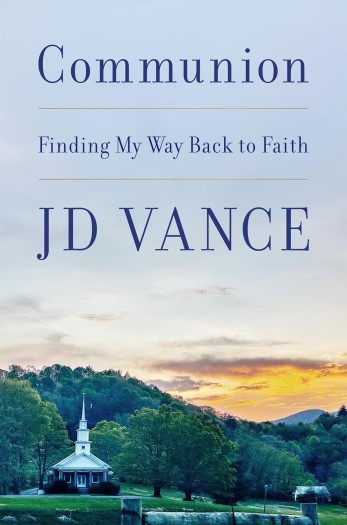
Before the book was even published, it attracted mockery for a revealing oversight: its cover photograph depicts Mt. Zion United Methodist Church in Elk Creek, Virginia — not a Catholic church, and one with no documented connection to Vance or his faith journey. The congregants of the rural church confirmed no relationship. For a book staking its credibility on the authenticity of one man’s conversion, it was a spectacular own goal.
The Wall Street Journal’s Swaim was blunt about what he believed the book’s true purpose to be: “Readers familiar with books by ambitious politicians will assume the author of this one has an eye on 2028.” The timing supports this reading. Most sitting vice presidents do not publish memoirs mid-term. That Vance launched a media blitz — including appearances on Fox News and, remarkably, The View, a show he once dismissed as “propaganda” — suggests he is reaching for audiences beyond the base. The policy positions in the book’s second half, which The New Republic described as suggesting a center-right repositioning, further underline the electoral calculus at work.
Writing from the sympathetic end of the spectrum, Princeton’s Robert P. George, in a review for The Free Press, argued that the book deserved to be read on its own terms rather than through the filter of political opinion. He maintained that Communion is “an interesting, and even valuable, book” for any reader trying to understand what Vance believes and why he makes the choices he makes.
It is a fair argument. The problem is that the book itself makes that charitable reading increasingly difficult to sustain as one progresses through it.
Verdict
Communion: Finding My Way Back to Faith is, genuinely, two books — and they do not belong in the same binding.
The first book is a flawed but sincere account of one man’s encounter with religious tradition: how structure and theology and love all conspired to pull a chaotic young man toward something larger than himself. It is worth reading on these terms, and Vance shows real literary capability when he is not performing for an imagined future electorate.
The second book is a campaign document — evasive where the first was candid, reductive where the first was nuanced, and populated (as Book Marks noted) with straw men, particularly on economic questions. It does not advance the spiritual argument; it evacuates it.
Whether Communion succeeds in its probable primary mission — positioning J.D. Vance as a serious, faith-rooted statesman for a potential 2028 run — remains to be seen. What it does not succeed in being, at least for its full length, is the honest spiritual reckoning it advertises. The sacrament of Communion requires, before anything else, an honest examination of conscience. On that count, this book comes up short.
Communion: Finding My Way Back to Faith by J.D. Vance. HarperCollins, 304 pp., 2026.
FAQs:
Q: What is JD Vance’s book Communion about?
A: Communion: Finding My Way Back to Faith (2026) is Vice President JD Vance’s second memoir, tracing his journey from a Protestant upbringing through atheism to his 2019 conversion to Catholicism. It also covers his marriage, rise to political prominence, and policy views.
Q: How has Communion been reviewed?
A: Critical reception has been largely negative across the political spectrum, with reviewers at The Wall Street Journal, The New Yorker, Slate, and The New Republic all raising significant concerns about factual sloppiness, internal contradictions, and the book’s dual identity as spiritual memoir and campaign document.
Q: Is Communion a sequel to Hillbilly Elegy?
A: Yes. Vance and his publisher HarperCollins describe it as picking up where Hillbilly Elegy (2016) left off, focusing on the period of his adult life from his drift toward atheism through his conversion to Catholicism and into his political career.
Q: Why does Communion’s cover show a Methodist church?
A: The cover photograph depicts Mt. Zion United Methodist Church in Elk Creek, Virginia — not a Catholic church. Congregants confirmed no connection to Vance. The oversight drew widespread coverage and criticism before the book’s publication.
Q: Is JD Vance running for president in 2028?
A: Vance has not formally announced a presidential run, but multiple reviewers, including The Wall Street Journal’s Barton Swaim, interpreted Communion as positioning him for a potential 2028 campaign.
Land Review: Maggie O’Farrell Maps Grief, Memory and a Nation’s Wounds
Follow The Raisina Hills on WhatsApp, Instagram, YouTube, Facebook, and LinkedIn




