Khaleda Zia and Sheikh Hasina Turned Power into a Personal War
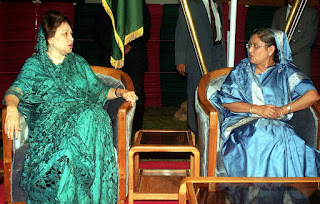
Khaleda Zia and Sheikh Hasina (Image X.com)
From shared detention to bitter domination, the rivalry between Khaleda Zia and Sheikh Hasina reveals how feminine strength, memory, and vengeance reshaped Bangladesh’s politics
By NIRENDRA DEV
New Delhi, December 31, 2025 —“Woman was God’s second mistake,” Friedrich Nietzsche once wrote—an assertion history has repeatedly disproved, nowhere more dramatically than in Bangladesh. Few political rivalries in South Asia were as enduring, personal, and unforgiving as that between Khaleda Zia and Sheikh Hasina—two women who rose from purdah to power, only to turn governance into a theatre of memory, grievance, and control.
Both became prime ministers. Both inherited political legacies soaked in blood. And both demonstrated what Chanakya described centuries earlier: a courage and passion that could overwhelm convention itself.
Their rivalry reached its most revealing moment not in parliament, but in detention. Around 2006, under a military-backed interim regime, both leaders were jailed—held in houses not far from each other. Reports surfaced that Hasina shared her food with her bitter rival Khaleda. Years later, Hasina would deny it, instead recalling a hierarchy even in captivity: Khaleda, she said, had better furniture, a newer house. Hers was old, broken.
These were not trivialities. In Bangladesh’s politics, symbolism is substance.
After 2009, once Sheikh Hasina returned to power, the rivalry hardened into domination. For the next 15 years, Khaleda Zia was relentlessly pursued through courts and cases. Among the most surreal was the charge that she had misrepresented her birthday—celebrating August 15, the day Hasina mourns the assassination of her father Sheikh Mujibur Rahman, as her own. Memory itself became criminalised.
When Khaleda failed to appear in court in 2016, an arrest warrant followed. Her lawyers insisted August 15 was her genuine birthday. It did not matter. Power had decided otherwise.
Cruelty peaked in illness. In 2021, when Khaleda contracted Covid-19 and later suffered multiple age-related ailments—arthritis, diabetes, liver disease—her pleas to seek treatment abroad were denied. BNP leaders claimed Sheikh Hasina rejected such requests 18 times. The state allowed doctors to come to Khaleda—but refused to let Khaleda leave.
Politics, here, was not content with victory. It demanded submission.
Only after Hasina was ousted on August 5, 2024, was Khaleda freed from house arrest and several cases dropped. By then, she was bedridden, frequently hospitalised, and nearing the end of life. Yet her party still nominated her to contest three seats in the 2026 elections—a final assertion of defiance.
From her hospital bed, Khaleda called Hasina’s fall “the end of tyranny.”
And when Khaleda died on December 30, it was Sheikh Hasina who issued the formal condolences—acknowledging her rival’s role in democracy, even as history remembers how merciless that rivalry was.
They shared food once, perhaps. But they fought over birthdays, furniture, memory—and ultimately, power itself.
(This is an opinion piece. Views are personal)
Follow The Raisina Hills on WhatsApp, Instagram, YouTube, Facebook, and LinkedIn




About The Author