Is Imran Khan Alive? Alarm as Pakistan Sits on a Powder Keg
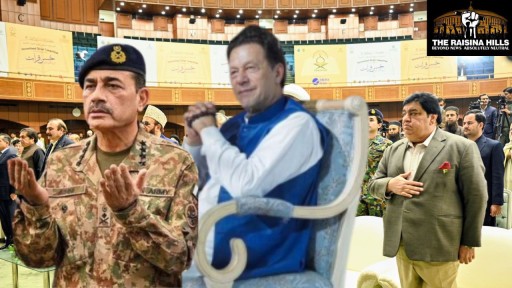
Pakistan Army Chief Asim Munir and ex-PM Imran Khan. (Images X.com)
On The Raisina Hills, analyst Manish Anand warns that the silence around Imran Khan’s health could push crisis-hit Pakistan toward a dangerous nationwide upheaval.
By TRH Foreign Affairs Desk
New Delhi, November 29, 2025 — Mounting global concern over the health and safety of jailed former Prime Minister Imran Khan is rapidly turning into a full-blown political crisis for Pakistan, with analysts warning that the country is now “sitting on a pile of gunpowder with a lit match nearby.”
In a detailed analysis on The Raisina Hills YouTube channel, Manish Anand, foreign affairs analyst, said Pakistan today resembles a tinderbox nation, where uncertainty over Khan’s condition, deep public anger against military rule, and extreme economic distress are converging into a dangerous flashpoint.
According to Anand, no family member has been allowed to meet Imran Khan for nearly 40 days. His sister and close relatives have repeatedly sought access, despite court permissions. Meanwhile, reports from Afghan media alleging Khan’s death in custody have triggered what Anand described as a “global firestorm of speculation and anxiety.”
Khan’s son, Kasim Khan, has written an open letter appealing to the United Nations and the international community to intervene and confirm his father’s safety. Anand said the continued silence of Pakistan’s authorities is only deepening public suspicion and outrage.
Military Under the Spotlight
Anand underlined that the era of ambiguity over who truly rules Pakistan is now over. “There is no longer any doubt—Pakistan’s real power centre is the military,” he said, pointing directly at Army Chief Asim Munir as the man who will bear ultimate responsibility for any national upheaval.
Pakistani Prime Minister Shehbaz Sharif, Anand argued, is widely seen by the public as a figurehead, while actual authority rests with the army leadership. “If confirmation emerges that Imran Khan has died in custody, the accountability will fall squarely on Asim Munir,” he said.
The PTI Factor and the Threat of Revolt
The analyst warned that the popular anger visible during earlier protests by Khan’s party, the Pakistan Tehreek-e-Insaf, was only a “trailer, not the full film.” When PTI protesters earlier attacked military installations and senior officers’ residences, the movement was crushed through military courts and mass arrests.
“But that anger never disappeared,” Anand cautioned. “If the worst fears about Imran Khan’s fate are confirmed, Pakistan could witness a far bigger and more uncontrollable uprising.”
He noted that Pakistan’s youth, already disillusioned by unemployment, inflation and political repression, view Imran Khan as a symbol of resistance against military dominance.
Economic Collapse and Public Fury
Anand further linked the political crisis to Pakistan’s deepening economic distress—food insecurity, power shortages, IMF dependence and the devastation caused by last year’s floods. According to him, Pakistan’s apparent financial stability is being artificially sustained through foreign bailouts, leaving it extremely vulnerable to sudden collapse.
“In such a fragile environment, even a single spark can ignite nationwide chaos,” he said.
Why the Silence Is So Dangerous
Anand concluded that Pakistan’s refusal to clearly confirm Imran Khan’s health status is not defusing tensions—it is accelerating toward disaster.
“If the military establishment does not immediately establish transparent proof of Imran Khan’s well-being, it may be inviting the very storm it fears,” he warned. “And once that barood (gunpowder) ignites, it will be impossible to predict who survives the fire.”
The unfolding silence, he said, is no longer just a domestic issue—it has become a global concern with serious regional security implications.
Follow The Raisina Hills on WhatsApp, Instagram, YouTube, Facebook, and LinkedIn




About The Author