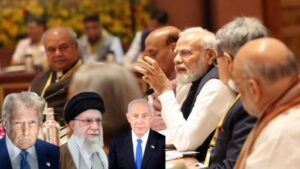
Iran War: A New World Order Takes Shape With Israel at Its Core
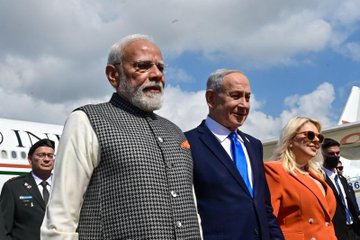
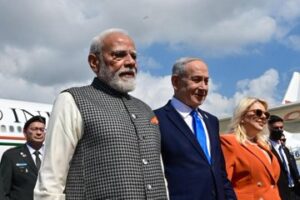
Prime Minister Narendra Modi with Israel PM Benjamin Netanyahu in Tel Aviv on Wednesday (Image Israel PM on X)
By targeting Gulf Arab states, Iran sought to raise the cost for Washington. Instead it is uniting its rivals, tightening US-Israel-Arab coordination, and isolating itself as never before.
By NIRENDRA DEV
New Delhi, March 1, 2026 — The Iranian Revolutionary Guard Corps believed that striking American and allied bases across six Gulf nations would coerce Washington into retreat. The opposite is happening. Rather than fracturing the US-Arab-Israel alignment, Tehran’s missiles are welding it together — and in doing so, Iran is deepening the most consequential rift in Islamic geopolitics: the historic divide between Shia Iran and the Sunni Arab world.
This is not merely a military story. It is the story of a new world order being born in real time.
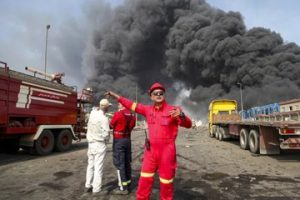
The IRGC struck Al-Udeid Air Base in Qatar — the largest US air base in the Middle East. It hit the US Fifth Fleet headquarters in Bahrain. It targeted UAE bases near Abu Dhabi, Kuwait’s Central Command sites, and installations across at least six nations. Iranian media framed each strike as retaliation against “legitimate military targets,” warning non-US sites to stand clear.
The results were strategically counterproductive. Qatar’s Defence Ministry stated it intercepted all incoming missiles before they entered its airspace. Kuwait engaged missiles in its airspace. Jordan downed two ballistic missiles. Bahrain labelled the strike on the Fifth Fleet base a “treacherous attack” and a sovereignty violation. The UAE reported one fatality from intercepted missile debris but confirmed its air defences neutralised the principal threats.
All these countries closed their airspace. None endorsed Iran’s actions. Each was pushed further into reliance on the American security umbrella.
“By targeting Arab states, Tehran believes it is raising the cost for Washington. Instead, it is uniting its rivals, tightening US-Israel-Arab coordination — and isolating itself,” as one assessment put it with precision.
The Abrahm Accords: From Economic Framework To Security Architecture
In the past, Tehran succeeded in driving wedges between Israel and its Arab neighbours. That era appears to be ending. The Abraham Accords — once dismissed by sceptics as a narrow economic normalisation — have evolved into a tightening strategic and security infrastructure.
As the Iranian threat has grown, so too has a shared understanding in Jerusalem and in Gulf capitals that they face a single regional challenge. Iran’s aggression in the Gulf is producing the opposite of its intended effect: the closer Tehran pushes, the closer Israel and the Arab states draw to each other.
Violations of Gulf state sovereignty are not intimidating these countries into neutrality. They are incentivising alignment.
Trump, Netanyahu And The ‘Israel First’ Charge
Iranian Foreign Minister Seyed Abbas Araghchi framed the strikes in stark terms on X: “Netanyahu and Trump’s war on Iran is wholly unprovoked, illegal, and illegitimate. Trump has turned ‘America First’ into ‘Israel First’ — which always means ‘America Last.’ Our powerful armed forces are prepared for this day and will teach the aggressors the lesson they deserve.”
Tehran also emphasised that the strikes occurred while it was “in the midst of a diplomatic process” with Washington — negotiations it said it had entered to demonstrate the legitimacy of the Iranian nation’s position, even as it remained sceptical of US and Israeli intentions.
The charge that Trump has subordinated American interests to Israeli ones has been made by figures across the political spectrum. Whether or not one accepts the framing, it reflects a real debate inside the United States about who is driving the current conflict.
Modi In Israel: Departure From Equidistance
Into this volatile landscape stepped Indian Prime Minister Narendra Modi, who made a significant visit to Israel — reportedly in the hours before the US-Israeli assault was launched. The visit and Modi’s rhetoric about India standing with Israel represented what many analysts read as a meaningful departure from India’s traditional posture of equidistance between Israel and Palestine.
Whether this departure reflected a broader strategic repositioning — remains a matter of debate. What is clear is that the optics placed India closer to the US-Israel axis at a moment of maximum regional tension.
The questions this raises are significant. Whose battle is this — Israel’s or America’s? And what are the implications for India’s relationships with the Gulf states, Iran, and the wider Islamic world?
The I2U2 Grouping And The New World Order
One framework for understanding India’s positioning is the I2U2 grouping — India, Israel, the United States, and the UAE. Conceived during the Biden administration, it has received less formal attention under Trump. But the current crisis may be precisely the moment when the grouping’s strategic logic asserts itself most forcefully.
The four members of I2U2 represent a significant node in the emerging new world order — linking South Asia, the Levant, the Gulf and North America in a security and economic framework that is directly relevant to the post-Iran crisis architecture.
The new world order being shaped is characterised by intense economic rivalry and rapidly increasing military friction. The main players are the United States and China. But the key secondary players — those with the capacity to shift the balance of power — include Israel, with its unmatched military technology, intelligence capability, and role as a global hub for defence tech, AI and drones; Russia; India; France; and a handful of others.
Israel in particular has been considered a leading laboratory for future warfare. Post-October 2023, it has been working deliberately to establish a new regional structure in the Middle East — one built around strengthened ties with moderate Sunni states and aimed at containing Iranian influence. The Gulf, which Iran sought to turn into an arena of pressure under its influence, is becoming a focal point of international cooperation aimed at exactly that containment.
The Death Of The Old Order
The old world order — constructed after the end of the Cold War on the assumption of a flat, interconnected, rules-based world — is dead. The institutions and frameworks built on that assumption no longer command the authority they once did.
In the world that is replacing it, sovereignty and nation-state power matter more than multilateral rules. Military and economic might — not international legitimacy — determine outcomes. The concept of Might is Right, long dismissed as a relic of an earlier era, is reasserting itself with uncomfortable clarity.
The threat of Mullah-influenced radical Islam has already been a painful lived experience across Europe. A Middle East restructured around a US-Israel-Arab axis — with Iran isolated, economically damaged and led by hardliners — may reduce one dimension of that threat. But it will generate new instabilities whose contours are not yet visible.
(This is an opinion piece. Views expressed are author’s own.)
Follow The Raisina Hills on WhatsApp, Instagram, YouTube, Facebook, and LinkedIn




About The Author