Iran-US War: Tehran Signals 60-90 Day Endurance Strategy

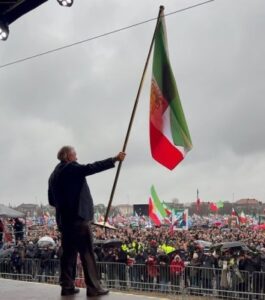
Iran war protests in Tehran after killing of Ayatollah Khamenei (Image video grab)
Hamidreza Azizi, visiting fellow at SWP Berlin, analyses Iran’s strategic narrative on Day 3 of the conflict
By TRH World Desk
New Delhi, March 3, 2026 — The third day of the US-Iran-Israel war has revealed a conflict rapidly expanding across military, economic, psychological, and regional dimensions. Tehran has shown a deliberate long-war strategy designed. Iran aims to erode American resolve rather than seek an early exit, according to Hamidreza Azizi, visiting fellow at SWP Berlin.
Multiple mediation attempts have been rejected by Tehran, Azizi wrote on X. He quoted Iranian sources indicating the leadership believes it can sustain high-intensity conflict for 60 to 90 days — making early ceasefire acceptance strategically counterproductive.
Senior Iranian official Ali Larijani explicitly framed the confrontation as a contest of endurance. Iran, he stated, unlike the United States, is prepared for prolonged conflict — with the objective of gradually altering Washington’s cost-benefit calculations over time.
US President Donald Trump has also stated that ground action is the next course of actions. This is despite the fact that the US has used B1 bombers against Iran.
‘War Without Rules’: Iran Signals Deliberate Unpredictability
Iranian strategic discourse has increasingly described the conflict as a “war without rules” or a “game without red lines,” according to Azizi’s analysis. The framing signals deliberate unpredictability intended to reshape deterrence dynamics — particularly after leadership decapitation strikes failed to halt Iran’s military response.
A related concept emerging in Iranian messaging is operating “one level above” adversary actions — delivering escalatory responses even to indirect threats in order to permanently redefine escalation thresholds.
This logic appears directly reflected in Iranian strikes against British facilities in Cyprus, interpreted domestically as retaliation for London allowing US access to Diego Garcia, despite the UK not formally joining offensive operations.
US Loses Three F-15 Aircraft; Coalition Congestion Grows
One of the most consequential battlefield developments on Day 3 was the loss of three US F-15 aircraft. While Iran initially claimed the shootdowns, the losses were subsequently attributed to friendly fire from Kuwaiti air defences — highlighting the dangerous and growing risks of coalition battlefield congestion.
CENTCOM confirmed that US strikes on Iranian missile bases employed B-1 bombers, as Washington intensifies efforts to dismantle Iran’s fortified underground missile facilities.
Iran’s Layered Missile Strategy: Attrition Over Immediate Damage
Analysts close to Iranian security circles describe a sophisticated layered missile strategy: first targeting radar systems, then launching low-cost drones and missiles to exhaust air-defence interceptors, before deploying advanced weapons in later phases.
Iran’s continuous missile launches therefore appear designed less for immediate battlefield damage and more for the attritional depletion of US and Israeli defensive systems over time. This explains the intensified American and Israeli strikes against underground facilities and missile infrastructure amid uncertainty over the size and dispersal of Iran’s advanced stockpiles.
Strait of Hormuz De Facto Closure; Gulf Energy Infrastructure Hit
In a major escalation targeting global energy flows, the IRGC has reportedly begun enforcing a de facto closure of the Strait of Hormuz, warning commercial vessels against transit and threatening missile strikes.
Simultaneous attacks on Gulf energy infrastructure — including an Aramco facility near Ras Tanura and gas infrastructure in Qatar — signal a deliberate effort to drive up global energy prices and increase economic pressure on Washington.
Beyond Hormuz: Can Iran Destroy the Gulf’s Oil Infrastructure?
Proxy Forces Activated; Hezbollah Enters Conflict
Iran-aligned Iraqi resistance factions — including Kataib Hezbollah, Harakat al-Nujaba, and Kataib Sayyid al-Shuhada — continue operations on a limited scale. They have opened an additional attritional front against US forces. Hezbollah formally confirmed its participation, firing rockets toward Haifa, though involvement remains constrained by degraded capabilities and domestic political pressures in Lebanon.
Iranian sources, Azizi stated, claim prewar coordination between the Quds Force and regional partners defined phased entry into the conflict, suggesting activation of the broader axis of resistance is proceeding gradually rather than simultaneously.
Israel Targets Regime Coercive Capacity; Border Fears Mount
Israel’s targeting pattern has sharpened considerably, with strikes now heavily focused on intelligence ministries, police headquarters, IRGC district bases, and internal security institutions — suggesting a systematic effort to erode the regime’s coercive capacity from within.
Parallel strikes against western border regions and Kurdistan province have fuelled Iranian fears that external actors may seek to enable insurgent infiltration as an alternative to direct ground invasion. Iran has responded by striking areas in Iraqi Kurdistan while intensifying pressure along its borders.
Internal Repression Tightens; Negotiation Signals Contradictory
Iranian President Pezeshkian expanded emergency authorities across ministries and provincial administrations to ensure continuity of governance, deepening wartime decentralization initiated before the conflict began, wrote Azizi. “IRGC intelligence simultaneously warned that any actions undermining internal stability would be treated as collaboration with the enemy,” he added.
Negotiation signals remain deeply contradictory. While Trump suggested a potential deal was possible, Larijani publicly rejected talks — reinforcing Tehran’s stated position that negotiations can only occur after strategic calculations on both sides have fundamentally shifted.
The Critical Question Ahead
“The key question now,” Azizi notes, “is whether expanding proxy involvement and energy warfare will force external powers into deeper participation — or instead accelerate pressure for negotiated containment.”
Day 3 makes clear that this conflict has evolved well beyond a bilateral confrontation into a simultaneously military, economic, psychological, and regional escalation with consequences for the entire global order.
Books That Explain Iran: Essential Reading on the US-Iran Conflict
Follow The Raisina Hills on WhatsApp, Instagram, YouTube, Facebook, and LinkedIn




About The Author