Iran to Greenland: New Grammar of Empire with Silent Control
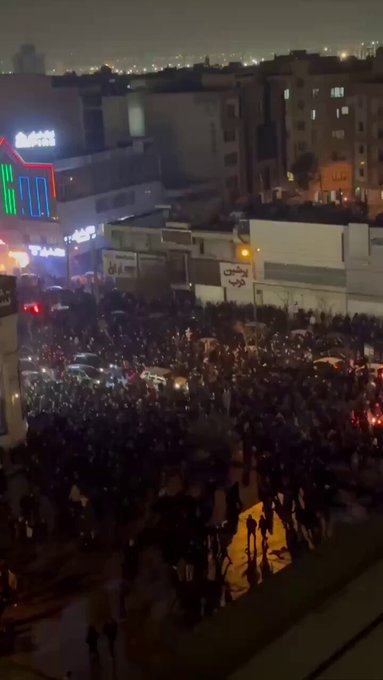
Protestors in Iran raise slogans against Supreme Leader Ayatollah Khamanei (Image video grab)
The new geopolitics of control reveals why airstrikes on Iran and legal capture of Greenland reflect the same imperial logic—domination without invasion.
By P. SESH KUMAR
New Delhi, January 14, 2026 — Contemporary geopolitics is undergoing a quiet but profound transformation. The age of regime-change wars—defined by invasion, occupation, and overt political reconstruction—is giving way to a subtler but no less coercive strategy: the calibrated degradation of state capacity.
Power today is exercised not by seizing capitals, but by selectively dismantling a state’s ability to function—through the targeted elimination of leadership, surgical destruction of strategic assets, coercive extraction of political actors bordering on abduction, and the legal-institutional capture of geography itself.
Using Iran as a primary case study, this narrative examines the strategic logic behind recent air and drone strikes on Iranian nuclear and military infrastructure, the feasibility—and limits—of leadership decapitation as a tool of coercion, and why such operations rarely produce durable political transition. The analysis then shifts to Greenland, which represents the inverse model of contemporary power projection: slow, contractual, legally binding, and alliance-compatible acquisition of strategic space without formal annexation.
Together, Iran and Greenland illuminate the emerging grammar of empire in a world fatigued by invasion yet increasingly addicted to control—where domination is no longer declared but quietly engineered.
From Regime Change to Regime Degradation
The last 25 years have taught the United States—and the world—an expensive lesson. Regime change through invasion works tactically, fails strategically, and poisons legitimacy permanently. Iraq collapsed quickly but never stabilised. Libya was liberated but never governed. Afghanistan was occupied, rebuilt, abandoned, and reclaimed by the very forces it was meant to erase. These outcomes did not merely drain American power; they delegitimised the very idea that political order can be engineered externally at scale.
What has replaced regime change is something subtler and more dangerous: regime degradation. Instead of overthrowing governments, external powers may now aim to progressively hollow out a state’s strategic capabilities-its nuclear programme, its senior military leadership, its command-and-control nodes-while leaving the political shell intact. The hope is not immediate transition, but cumulative exhaustion.
Iran sits squarely at the centre of this new doctrine.
Iran’s Strategic Position: Too Big to Invade, Too Dangerous to Ignore
Iran today occupies an uncomfortable geopolitical space. It is too large, too populous, and too internally coherent to be invaded without catastrophic escalation. The United States knows this too well. At the same time, its nuclear ambitions, regional proxy networks, and ideological hostility make it unacceptable as a “normal” adversary.
Unlike Iraq in 2003, Iran possesses layered air defences, hardened underground facilities, dispersed command structures, and the ability to retaliate asymmetrically across the Middle East. Any conventional war would immediately spill into the Strait of Hormuz, Iraq, Syria, Lebanon, and the Red Sea-raising oil prices, destabilising allies, and dragging global markets into turmoil.
This reality explains why recent actions against Iran have taken a very specific form: targeted, deniable, precision strikes, rather than open war.
Targeted Strikes on Iran’s Nuclear and Military Core
Over the past few years, Iran has experienced a series of carefully calibrated blows to its strategic infrastructure. Nuclear enrichment facilities have suffered unexplained explosions, power disruptions, and structural damage. Missile production sites, drone assembly units, and air defence systems have been struck with remarkable accuracy. Senior military figures-particularly within the Islamic Revolutionary Guard Corps-have been eliminated through airstrikes and drone operations, often outside Iran’s borders but increasingly close to its core command ecosystem.
These operations are not designed to stop Iran outright. They are designed to slow, fragment, and intimidate. Each strike sends a layered message: your facilities are penetrable, your leaders are trackable, and your escalation options are constrained.
Yet these strikes also reveal the limits of precision power. Iran adapts. Facilities are rebuilt deeper underground. Command structures are decentralised. Public outrage is channelled into nationalist defiance rather than elite revolt. The regime absorbs losses as proof of resistance, not weakness.
The Decapitation Question: Can Iran’s Leadership Be Removed?
The most provocative-and repeatedly resurfacing-question is whether the United States or its allies (Trump does not believe in Allies anymore) could simply eliminate Iran’s top leadership and trigger a political transition. Technically, the answer is uncomfortable but clear: yes, it is feasible.
Modern intelligence, surveillance, and strike capabilities make no individual truly unreachable. Ali Khamenei lives under extraordinary security, but not invisibility. Iran’s president, senior clerics, and top commanders are known, tracked, and analysed continuously. We have only recently witnessed the capture and ‘smooth’ extraction of Nicolas Maduro from Caracas by the US with no involvement of its Allies.
The real question is not feasibility but consequence.
Iran’s system is not leader-centric in the way Saddam Hussein’s Iraq or Muammar Gaddafi’s Libya or Nicolas Maduro’s Venezuela was. Authority is distributed across institutions: the clerical establishment, the Revolutionary Guards, the judiciary, and economic conglomerates. Removing the apex figure would not dissolve the pyramid; it would likely harden it.
Decapitation would almost certainly trigger emergency consolidation by the IRGC, suspension of residual civilian politics, and a surge of nationalist legitimacy for the most hardliner factions. Any successor regime emerging under such circumstances would be more militarised, less accountable, and more hostile to the USA/West.
The lesson from history is blunt: killing leaders does not create legitimacy; it reallocates coercion.
The United States Today: Power Without Illusions
President Donald Trump, governing in the present, confronts an Iran that has already survived maximum economic pressure and calibrated military attrition. Sanctions have reached diminishing returns. Open war is strategically irrational. Decapitation is politically incendiary.
What remains is a narrow corridor: deterrence reinforced by selective degradation, coupled with the implicit signal that regime survival is not incompatible with restraint. This is not diplomacy in the classical sense, nor war in the traditional sense. It is managed hostility-a posture designed to prevent the worst outcomes rather than engineer the best ones.
Russia and China: Spectators With Interests, Not Saviours
Russia views Iran as a strategic irritant it can monetise. Higher oil prices, Western distraction, and bargaining leverage elsewhere suit Moscow. But Russia will not fight for Iran. Its opposition to actions of the United States will be rhetorical and tactical, not existential.
China has deeper economic exposure-energy security, long-term supply contracts, and Belt and Road corridors. Yet China’s approach remains conservative. It prefers endurance over upheaval, contracts over crusades. Beijing will hedge, condemn, adapt, and wait.
Neither power sees Iran as a cause worth dying for. Both see it as a board on which the United States can be made to spend time, money, and credibility.
Why Iran Chaos Not Soaring Oil to $100: 160-Million-Barrel Worry
From Iran to Greenland: Two Models of Power
If Iran represents the limits of coercive precision, Greenland represents its opposite: the triumph of legal-institutional acquisition.
Greenland has been strategically valuable to the United States since World War II. During the Cold War, it anchored early-warning radar systems against Soviet missiles. Today, its importance has multiplied as Arctic ice retreats, opening shipping routes and exposing vast reserves of rare earths, uranium, and critical minerals essential for modern technology and defence systems.
Formally, Greenland remains within Denmark, but it enjoys extensive self-rule and controls most domestic resources. Its population is small, its economy narrow, and its strategic value enormous.
The United States does not need annexation. That would provoke NATO discord, legal challenges, and unnecessary resistance. What Washington needs is guaranteed access: minerals, basing rights, surveillance infrastructure, and denial of rival powers.
This can be achieved through long-term, legally binding agreements involving Denmark, Greenland’s autonomous government, and the United States. Such agreements could include security guarantees, infrastructure investment, revenue-sharing from mineral extraction, and formalised United States’ defence responsibilities-short of sovereignty transfer.
This model is not hypothetical. It mirrors United States’ arrangements elsewhere: extended basing rights in Japan, security compacts with Pacific Island states, and defence agreements that blur the line between independence and dependency.
Greenland illustrates how modern empire expands not through conquest, but through consent shaped by asymmetry. The only problem could be President Trump’s declared intent of making Greenland the 51st of the United States, unless it is hyperbole and deliberate negotiation tactic.
Two Futures, One Logic
Iran and Greenland appear unrelated. They are not.
Iran shows where coercion cannot manufacture legitimacy. Greenland shows where legitimacy can be quietly structured through law, economics, and security dependence. One is contested, volatile, and resistant. The other is consensual, gradual, and durable.
Together, they reveal the emerging logic of global power: precision where resistance is unavoidable, contracts where consent is possible.
Way Forward: The End of Theatrical Power
The age of dramatic regime change may have been over (Nicolas Maduro being an exception) not because power has declined, but because its costs have become visible. What replaces it is neither peace nor restraint, but a colder, more transactional world where states are weakened selectively, territories are absorbed legally, and instability is managed rather than resolved.
Iran will change, but not on an external timetable. Greenland will integrate deeper into United States’ strategic architecture without a single flag being raised.
History will judge not the boldness of interventions, but the discipline of restraint. Donald Trump would not agree- next on his bucket list of adventure could be Cuba, Mexico, Colombia and even Argentina.
Follow The Raisina Hills on WhatsApp, Instagram, YouTube, Facebook, and LinkedIn




About The Author