Indore–Gandhinagar Water Contamination Tanks Double Engine
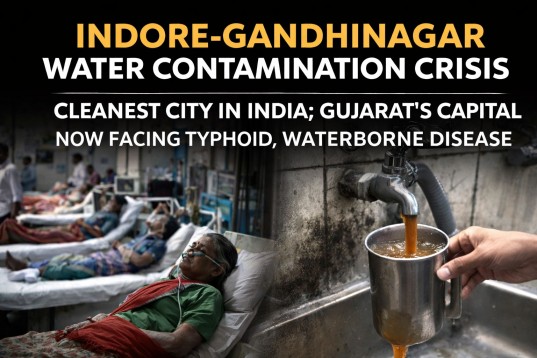
A representative image of typhoid outbreak. (Image TRH)
From India’s cleanest city to Gujarat’s capital, contaminated water exposes the gap between slogans, governance, and ground reality.
By NIRENDRA DEV
New Delhi, January 5, 2026 — The Indore–Gandhinagar water contamination crisis is not just a health emergency. It is a mirror held up to India’s urban governance—and the reflection is deeply unsettling.
Indore, celebrated repeatedly as India’s cleanest city, and Gandhinagar, the capital of Gujarat and parliamentary constituency of Union Home Minister Amit Shah, are now grappling with outbreaks linked to contaminated drinking water. In Gandhinagar, Civil Hospital Superintendent Dr Mitaben Parikh has confirmed a 50 percent surge in positive cases, with typhoid bacteria detected in Widal and blood culture tests. Adults and children alike are affected. In Indore, over 1,100 residents reportedly fell ill, with three confirmed deaths attributed to waterborne disease.
These are not isolated failures. They reveal a systemic contradiction.
Indore’s transformation under the Swachh Bharat Abhiyan was once real and measurable. In 2018–19, this writer reported how disease indicators had fallen sharply, respiratory illnesses reduced by nearly 50 percent, and civic pride replaced cynicism. From rank 150 in 2014 to No.1 by 2017, Indore became proof that governance could deliver.
Yet today, sewage mixing with drinking water in Bhagirathpura tells a harsher story. Residents complained of foul-smelling, discoloured water. Supplies continued. People drank it because they had no alternative. The result was predictable—and preventable.
Gandhinagar’s case is equally embarrassing. This is not just Gujarat’s capital; it is the flagship of the “model state” narrative. When contaminated pipelines trigger typhoid outbreaks here, questions inevitably travel upward—to policy, oversight, and accountability.
As columnist Tavleen Singh bluntly put it, the failure of “double-engine governments” is no longer anecdotal. It is visible on roads, in taps, and now in hospital wards. India may speak of becoming viksit by 2047, but unsafe water belongs to the 19th century, not a developed future.
Union Home Minister Amit Shah’s directive to act on a war footing is necessary—but it is also reactive. Governance that arrives after deaths is not governance; it is damage control.
The World Health Organization has long warned that unsafe water fuels typhoid, cholera, and dysentery—diseases that thrive not because solutions are unknown, but because maintenance, monitoring, and political urgency are absent.
Indore has indeed come full circle—from clean-city triumph to public health alarm. The lesson is stark: cleanliness campaigns without infrastructure integrity are cosmetic. Pipes matter more than posters. Water safety matters more than rankings.
(This is an opinion piece. Views expressed are author’s own)
Follow The Raisina Hills on WhatsApp, Instagram, YouTube, Facebook, and LinkedIn




About The Author