IndiGo Meltdown Exposes A Broken System amid Crashing Airlines
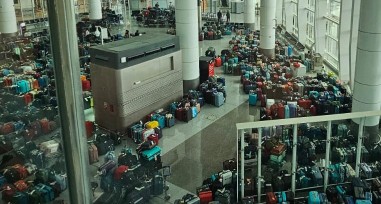
IndiGo crisis hits baggage handling at New Delhi airport (Image TRH)
Why India’s Airlines Keep Crash-Landing Financially – And What the IndiGo FDTL Crisis Really Tells Us
By P. SESH KUMAR
New Delhi, December 7, 2025 — Indian Government likes to boast that it is one of the world’s fastest-growing aviation markets, with shiny new airports, packed holiday flights and a “Ude Desh ka Aam Naagrik” (UDAN) slogan promising that even the common citizen can fly. Yet behind the glossy ads and celebratory ribbon cuttings lies an uncomfortable truth: India is also a graveyard for airlines.
Jet Airways, Kingfisher, Air Deccan, Air Sahara, Go First—all promised to rewrite the rules of the game, and all ended up grounded, insolvent or sold for scraps. At the same time, aviation experts say that the global airline industry itself runs on razor-thin margins of around three per cent, with high fixed costs, volatile fuel prices and brutal fare wars that make even “profitable” years feel like walking on a tightrope.
India’s aviation dream, chronic turbulence reality
On the surface, the India aviation story looks irresistible. Low-cost carriers now account for roughly seventy per cent of capacity, traffic is near or above pre-Covid highs, and IndiGo alone carries well over sixty per cent of domestic passengers. Tata’s consolidation of Air India, Vistara and Air India Express is creating a giant full-service rival. There is the UDAN regional connectivity scheme, new terminals in Tier-2 and Tier-3 cities, and an aspirational middle class that increasingly treats flying as a basic utility, not a luxury.
If we scratch the surface, the picture darkens. Sector-wide, Indian airlines are expected to lose between ₹9,500 and ₹10,500 crore in FY 2026, a deterioration from the already large losses estimated for FY 2025. Global jet fuel prices, rupee depreciation, engine issues on new-generation aircraft, and rising capital costs all bite simultaneously. Even as load factors remain healthy and airports look crowded, balance sheets bleed. In one sense, India may have managed to combine the worst of both worlds: global airline fragility plus local distortions that make survival even harder.
Why airlines are fragile everywhere – the global economics of a bad business
To understand our aviation industry, one must first accept a counter-intuitive truth: airlines are bad businesses almost everywhere. IATA itself projects that global net profit margins are in the range of 2.7 to 3.6 per cent – roughly three rupees of net profit on every hundred rupees of revenue – with return on capital routinely below the cost of capital. High fixed costs for aircraft, crew training, maintenance and slots, combined with low marginal costs for an additional passenger, push airlines into perpetual price wars. If a seat takes off empty, its revenue is gone forever; this makes aggressive discounting almost irresistible, even when it destroys profitability.
Over decades, the United States has seen scores of airlines file for Chapter 11 bankruptcy, some of them more than once. A famous case-study dryly remarked that the cumulative net profit of the US airline industry since Kitty Hawk was essentially zero. Europe has its own list of casualties, from Alitalia to smaller low-cost upstarts that vanished in downturns or after fuel spikes. High fixed costs, volatile jet fuel prices, labour disputes, engine recalls, air-traffic-control disruptions and geopolitical shocks create a perfect storm where even well-run carriers can be pushed to restructuring or closure.
So airline failure is not an Indian eccentricity. What is distinct about India is how the dice are loaded against carriers even in good times, and how regulation has struggled to keep pace with this structural fragility.
The Indian twist: expensive fuel, cheap fares and weak cushions
Let us start with aviation turbine fuel (ATF). Official parliamentary data and sector analyses show that ATF typically makes up around forty to forty-five per cent of Indian airlines’ operating costs, far higher than in many global markets. While many states have recently cut VAT on ATF to the one-five per cent band, laggard states still levy up to twenty-nine or thirty per cent, and ATF remains outside GST, denying airlines input tax credit. Sector studies estimate that Indian carriers pay roughly sixty-five per cent more for ATF than some foreign competitors, thanks to this tax structure and import-parity pricing.
Layered on top of this fuel handicap is a political obsession with keeping fares low. Governments bristle at visible fare spikes, even when fuel or currency shocks justify them, and have not hesitated to impose temporary fare bands or moral suasion. Airlines therefore live in a strange world where their largest cost is structurally high, but their main revenue lever is politically constrained. It is like running a restaurant where cooking gas is taxed as a luxury item, but the government expects you to keep thali prices flat “for the people”.
Airport charges, navigation fees and the cost of maintenance, repair and overhaul (MRO) are also higher than they need to be. Taxation of imported spares and limited hangar capacity at key airports make Indian MRO more expensive and limit scale, even though shifting work into India could theoretically save airlines money. Financially, this all translates into thin cash buffers. When a shock comes – an engine recall, a rupee slump, or a regulatory change like new pilot-fatigue rules – the average Indian airline has much less shock-absorbing capacity than its global peers.
The roll-call of failed carriers: Jet, Kingfisher, Air Deccan, Sahara – and then Go First
Kingfisher Airlines is the cautionary tale that refuses to fade. In the mid-2000s it branded itself as a “good times” carrier and doubled down by acquiring low-cost pioneer Air Deccan in 2007. Instead of giving Kingfisher a balanced portfolio, the merger created an unwieldy hybrid with clashing cultures, confused pricing and an over-leveraged balance sheet. High fuel costs, aggressive under-pricing, unpaid taxes and mounting debt eventually left Kingfisher with billions of rupees in dues to banks, airports, staff and the taxman. Academic and industry studies have catalogued how the combination of reckless expansion, weak financial controls and a hostile cost environment pushed it into collapse by 2012.
Air Deccan itself symbolised a different problem. It genuinely democratised flying with rock-bottom fares and bare-bones service, but in a market with high fuel costs and poor yield management it simply did not earn enough to survive. Extreme financial stress led to its sale to Kingfisher. The dream of “Rs 1 tickets” was politically popular but economically suicidal in a country where ATF cost up to forty per cent of operating expenses and where taxation denied carriers basic input credits.
Jet Airways represented the more traditional full-service carrier that lost its way. It once enjoyed over forty per cent market share, but as low-cost rivals multiplied it found itself squeezed between price-sensitive domestic economy fliers and global network carriers on international routes. A mix of heavy debt, a complex web of subsidiaries, misjudged overseas expansion and unviable fare wars steadily eroded its finances. When oil prices rose and creditors lost patience, even fuel supply was briefly cut off for non-payment, and by 2019 Jet had ceased operations and entered insolvency proceedings.
Air Sahara and its acquisition by Jet illustrated another recurring Indian problem: messy mergers. The Jet–Sahara and Kingfisher–Deccan integrations both struggled with different corporate cultures, systems and labour contracts, which turned supposed synergies into chronic friction and distraction at exactly the time when aggressive low-cost competition required managerial laser focus.
Go First’s latest 2023 collapse adds a more modern dimension. Here was a low-cost carrier undone not only by the familiar trio of high fuel, competition and debt, but also by technical and supply-chain shocks: Pratt & Whitney engine issues that grounded around half its A320neo fleet, triggering revenue loss and cash-flow stress that it claimed could not be survived without enforcement of arbitral orders against the engine maker. Whatever the merits of that dispute, the bankruptcy filing revealed, again, how thinly capitalised Indian airlines are and how a single technical bottleneck can push them over the edge.
Seen together, these cases tell a consistent story. Indian airlines do not die only because promoters are incompetent or greedy, though that happens. They also die because they are trying to run a global-standard, capital-intensive business on local-politics economics: expensive inputs, artificially cheap outputs, and limited regulatory capacity to enforce discipline on either side.
The IndiGo FDTL meltdown: a safety reform turned operational crisis
The current IndiGo crisis is not just a scheduling snafu; it is a warning about what happens when a dominant carrier, thin margins and weak regulation collide.
In January 2024, the DGCA notified revised Flight Duty Time Limitations (FDTL) to manage pilot fatigue better, aligning India more closely with ICAO-influenced norms and practices in the USA and Europe. Weekly rest was increased from thirty-six to forty-eight hours, the definition of “night” was extended, and stricter caps were placed on night landings and duty hours with the explicit aim of reducing fatigue-related safety risks. Airlines had nearly two years to adjust their rosters, hiring and training pipelines before full implementation.
When the final phase kicked in during the 2025 winter schedule, IndiGo-which controls around sixty-plus per cent of the domestic market – was caught badly short of pilots relative to the new rules and its own ambitious schedule. Over a December week it cancelled hundreds of flights a day; on a single day the count crossed a thousand, with airports like Delhi, Mumbai, Bengaluru and Hyderabad thrown into chaos. Passengers were stranded for hours with poor information, connecting itineraries collapsed, and fares on other airlines shot through the roof.
Regulators initially held the line: the DGCA and the Civil Aviation Ministry criticised IndiGo’s planning and demanded a restoration plan. But within days, facing public anger and a real risk that the de facto national workhorse would keep choking the system, the government temporarily suspended parts of the new FDTL rules or granted IndiGo-specific exemptions, particularly on the contentious “no leave shall be substituted for weekly rest” clause and night-duty constraints.
IndiGo has been asked to fix its crew gaps and submit a roadmap, but the immediate signal was stark: a safety rule that took years of consultations and court battles to finalise could be diluted in days when one airline stumbled operationally.
Pilot associations and fatigue experts have unsurprisingly cried foul, arguing that this amounts to trading away safety under pressure and even suggesting that poor planning may have been allowed to fester to force such a relaxation. The regulator now finds itself on the back foot, having to prove that safety will not be compromised even as it tries to keep India’s overwhelmingly IndiGo-dependent domestic aviation market functioning.
The episode exposes three long-standing structural weaknesses. First, concentration risk: when one airline becomes “too big to fail operationally”, every internal misstep becomes a systemic crisis. Second, regulatory weakness: rules exist on paper, but the capacity to stress-test, simulate and enforce them without backtracking is limited.
Third, consumer vulnerability: unlike in the EU or under emerging US practice, Indian passengers have relatively weak ex-ante rights to compensation, rebooking or care, and depend heavily on the goodwill of the very airlines that just ruined their travel plans.
Regulation and consumer protection: how India compares internationally
In Europe, Regulation EC 261/2004 creates a tough passenger-rights regime: for delays of over three hours or cancellations within certain windows, passengers can claim between €250 and €600 in cash compensation, plus meals, accommodation and rerouting, unless the airline can show truly extraordinary circumstances. Airlines hate it, but it has fundamentally changed how they plan for and respond to disruptions. The ongoing debate in Europe is about tweaking thresholds, not about whether such rights should exist at all.
In the United States, the approach is more market-driven but has been moving, at least until very recently, towards stronger enforcement. The Department of Transportation maintains a public Airline Customer Service Dashboard that lists what each airline promises in the event of controllable delays and cancellations, and has imposed billions of dollars in refunds and penalties on carriers – including a record settlement with Southwest after its 2022 holiday meltdown.
A proposed rule to mandate cash compensation for long delays has now been withdrawn in the name of deregulation, but even without it, airlines face real reputational and financial consequences if they mishandle mass disruptions.
India has taken steps – such as Civil Aviation Requirements on denied boarding, cancellation and delays, and advisories on fare gouging – but enforcement is patchy and compensation levels are modest.
There is no equivalent of EC 261’s strong, automatic cash-compensation architecture, nor of a transparent public dashboard that lets passengers compare airlines’ service commitments at a glance. In practice, passengers often have to fight individually for refunds, vouchers and rerouting, exactly when they are most stressed and least equipped to do so.
On the safety-regulation side, India has moved towards global practice by revising FDTL norms and strengthening oversight, but the IndiGo episode shows how quickly a big operator’s problems can bend the system.
By contrast, when US carriers or European majors mishandle mass disruptions, regulators investigate, fine and mandate remedial measures; they do not typically rewrite safety standards tailored to one airline’s staffing plan.
So what really ails Indian airline operations and viability?
At this point, the pattern is clear. What ails Indian airlines is not one villain but a full cast of characters.
There is an inherently fragile global business model, with high fixed costs and low margins, into which India has inserted some uniquely punishing twists: high and distorted ATF taxation, costly infrastructure, complex taxes on maintenance and spares, and political sensitivity to fares and route choices.
There is intense fare competition in a demand-rich market, but with weak capital buffers and limited risk-sharing mechanisms. Airlines chase market share with ultra-low fares, but cannot easily pass through shocks. When something gives – fuel spikes, engine recalls, rupee depreciation, a pandemic – the weakest carriers fold, and even strong ones wobble.
There are governance and strategy missteps: over-ambitious fleet orders, poorly structured mergers, mispriced acquisitions, weak risk management, and in some cases cavalier treatment of statutory dues and employee obligations. The collapse stories of Kingfisher, Jet and Go First all contain variations on these themes.
And there is regulation that is simultaneously heavy and soft. Airlines must navigate complex approvals, route dispersal guidelines and cross-subsidy schemes such as UDAN, but until recently many of them did so without robust safety—and fatigue-risk management systems. When DGCA finally tightened FDTL, its own enforcement resolve melted at the first sign of a crisis involving the dominant airline.
Add to this a rapidly consolidating market where IndiGo and a Tata-group combine are projected to control three-quarters or more of domestic traffic, and the risk of a cosy duopoly—or a “too big to fail” mentality—becomes real. The IndiGo FDTL story is an early taste of how costly such concentration can be for passengers and regulators alike.
Lessons and way forward – from crisis management to durable reform
The headline lesson from the IndiGo FDTL meltdown is brutally simple: you cannot run a twenty-first-century aviation system on twenty-cent contingencies. If a single regulatory tweak on pilot rest can trigger over a thousand cancellations in a day, something is fundamentally wrong with how capacity, crew and schedules are being planned and overseen.
First, safety rules around fatigue must be non-negotiable. India has already moved towards global practice with longer weekly rest, extended night windows and stricter caps on night flying. These rules should not be relaxed ad hoc for individual airlines, however inconvenient the transition. Instead, DGCA should insist that carriers demonstrate – through data-backed crew-planning models – that they have the pilots and reserves needed under the stricter FDTL regime before being allowed to file ambitious schedules. That is exactly how banking regulators stress-test capital; aviation regulators can do the same for crew sufficiency.
Second, cost distortions must be attacked at source. Bringing ATF under GST with a moderate, uniform rate and input tax credit would do more for airline viability than any band-aid subsidy. The recent wave of VAT cuts by states shows this is politically feasible, and the central government itself acknowledges that ATF is around forty per cent of operating costs. Rationalising MRO taxation and airport charges, and ensuring competitive fuel pricing rather than oligopolistic mark-ups, would further ease structural pressure.
Third, India needs a real passenger-rights regime. One does not have to copy-paste EU 261, but the basic idea that airlines should automatically compensate passengers with cash, rebooking, meals and accommodation for controllable delays and cancellations is hardly radical. Once airlines know they will bleed cash for operational meltdowns, the business case for serious contingency planning writes itself. A transparent, public dashboard of each airline’s commitments – as the US DOT has created – would also empower consumers and allow regulators to name and shame laggards.
Fourth, competition policy and slot allocation must consciously guard against excessive concentration. A duopoly of one giant low-cost carrier and one full-service conglomerate need not be evil, but it requires vigilant oversight of pricing, capacity withdrawal, slot hoarding and treatment of smaller rivals. The fate of niche carriers in such a market will determine whether passengers truly have choice, or whether they merely hop between two giants.
Finally, corporate governance and promoter discipline in airlines must be treated as a systemic issue, not a gossip column. Banks, markets and regulators should reward conservative treasury management, realistic growth plans and transparent related-party dealings—and penalise the “good times” model of thin equity, ballooning debt and political brinkmanship. Kingfisher and Jet should have been cautionary tales; instead, much of the sector still behaves as if boom times will last forever and someone else will pay the bill.
IndiGo Faces Public Fury: Flyers Seek Lawsuits and Govt Action
From glamour business to boring, reliable utility
The airline sector has always sold glamour—smiling cabin crew, exotic destinations, loyalty cards and airport lounges. But if India wants its aviation system to stop producing financial wreckage and traumatic passenger experiences, it must move in exactly the opposite direction: treat airlines as boring, tightly regulated utilities that move people safely and predictably, at fares that reflect true costs, in markets where no single player can imperil the system.
Globally, airlines are learning—through Covid, fuel shocks and engine recalls—that resilience and reliability now matter as much as, if not more than, raw growth. IATA’s own forecasts of trillion-dollar revenues with three-per-cent margins underline that this will never be a get-rich-quick industry; it is a grind-it-out, manage-every-risk business.
For India, the winding up of Jet, Kingfisher, Air Deccan, Sahara and Go First should not be seen as isolated failures but as chapters in a long-running structural story. The IndiGo FDTL crisis has merely dragged that story onto the front pages again, reminding us that when safety rules are diluted, costs are distorted and regulation is reactive, the people who ultimately pay are the passengers and taxpayers.
The way forward is not mysterious. Make fuel and maintenance taxation rational. Lock in fatigue-management rules as non-negotiable. Build a real passenger-rights regime. Stress-test airlines before they load schedules into global distribution systems. And treat dominance in the skies with the same suspicion we now reserve for dominance in digital markets and telecom. If India can do that, its aviation story may finally move from drama to durable success – less “good times” and more “gets you there, safely and on time, year after year.”
(This is an opinion piece, and views expressed are those of the author only)
Follow The Raisina Hills on WhatsApp, Instagram, YouTube, Facebook, and LinkedIn




About The Author