IndiGo Meltdown Exposes a Broken Indian Aviation System
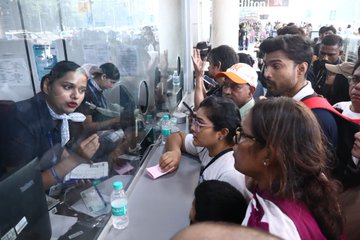
Indigo chaos at airports (Image Prof. Varsha Eknath Gaikwad on X)
IndiGo’s Great Meltdown: Fatigue, FDTL and the Fragility of a Duopoly in Indian Skies
By P. SESH KUMAR
New Delhi, December 6, 2025 — The first week of December 2025 will be remembered as the moment when India discovered that the country’s aviation system had quietly become a one-airline economy. IndiGo, which normally carries nearly two-thirds of all domestic flyers, ‘misjudged’ (some say, mischievously) the transition to the DGCA’s strengthened Flight Duty Time Limitations (FDTL) norms and unleashed a chain reaction of cancellations that crippled airports, stranded thousands of passengers and exposed how regulatory dependence on a single airline can compromise public interest.
What ought to have been a technical exercise in fatigue-management turned into a national crisis, raising questions about whether the airline had ignored transition warnings, whether the DGCA diluted its own safety reforms under pressure and whether India’s emerging duopoly—IndiGo and the Tata-owned Air India group—has made the entire sector more brittle.
Drawing from international experience, this narrative argues that India needs a more competitive, resilient and passenger-centric aviation ecosystem, backed by strong fatigue-management norms, transparent regulatory oversight and a deliberate strategy to break the structural duopoly before the next shock paralyses the system.
The Week India’s Skies Shrivelled to One Airline
On a grey December morning in 2025, India woke up to an aviation collapse that felt eerily similar to the failure of a financial system “too big to fail” yet perfectly capable of failing anyway. IndiGo, the dominant workhorse of Indian aviation, cancelled hundreds of flights day after day after gravely underestimating the impact of the DGCA’s new pilot rest requirements. By December 5, its operations in Delhi had simply imploded.
Terminal floors turned into make-shift dormitories. Queues spilled outside security gates. Airport displays quietly switched from “on time” to “cancelled” almost as an act of surrender.
The testimonies that came from stranded passengers were chilling in their ordinariness. One traveller remarked that the app kept showing “on time” for three days, only for the cancellation to be revealed at the boarding gate.
Was this an airline-specific inconvenience or a systemic seizure? When a carrier that handles sixty to sixty-five per cent of the domestic market goes dark, the entire network stumbles into chaos.
The Spark That Lit the Crisis: FDTL and a Failure to Prepare
The crisis began with what should have been a matter of routine compliance. On 1 November 2025, DGCA implemented tougher FDTL norms designed to reduce pilot fatigue, improve alertness and align India with global safety standards. The regulator had issued drafts, consulted stakeholders and signalled its intent well in advance.
Other airlines, smaller in size but more disciplined in planning, rejigged rosters, tweaked night-landing schedules and hired temporary crew in anticipation. IndiGo, however, appeared to assume that the storm would pass, or that the rules would be softened at the eleventh hour-as they sometimes have been in the past.
When the new norms kicked in, the airline realised it simply did not have enough pilots in the right cities or sufficient buffers in its rostering system to maintain its dense flight schedule. The daily cancellations crossed 400; on one day the figure soared past a thousand.
The DGCA, facing unprecedented public fury, took an extraordinary step: it quietly paused or watered down parts of the FDTL implementation specifically for IndiGo, while insisting publicly that action would follow.
Pilots’ unions were not amused. Fatigue rules are not a luxury; they are the thin line between safety and catastrophe. A union leader summed it up bluntly: “You cannot trade pilot sleep for corporate mis-planning.”
The broader public was left wondering whether safety had become negotiable when the airline in question was simply too large to discipline.
Did IndiGo Engineer the Crisis? The Unasked but Unavoidable Question
A darker suspicion began circulating almost immediately. Was this chaos merely incompetence, or was it a sophisticated pressure tactic? If the public fury reached boiling point, the DGCA and the government would be forced to dilute the new rest norms-thereby saving the airline millions in operational adjustments.
The optics certainly fed this suspicion. When the regulator rolled back parts of a carefully designed safety reform within weeks of implementing it, and only for one airline, it confirmed what many feared: India’s aviation oversight had become structurally dependent on its largest carrier.
Whether or not there was deliberate orchestration, IndiGo’s management undeniably allowed the situation to deteriorate. The warnings were visible months in advance; the consequences were foreseeable; and the crisis was not triggered by an unforeseeable shock like weather or war, but by predictable regulatory compliance.
The Governance Earthquake: When Regulators Become Hostages
The crisis exposed a worrying truth: India’s skies have drifted into an implicit duopoly. IndiGo commands over sixty per cent of the market; the Tata-owned Air India group controls over twenty-seven per cent. Nine out of ten domestic passengers now fly with these two conglomerates. Smaller players-Akasa, SpiceJet, and a scattering of regional carriers-operate on thin margins and thinner buffers.
This market structure turns every operational hiccup at IndiGo into a national event. Regulatory philosophy becomes distorted: every enforcement decision must first pass through an informal filter, the unspoken question, “Can the system survive if IndiGo reacts badly?”
This is not classical regulatory capture born of malice; it is capture rooted in dependence. In such an environment, the consumer is the first victim and safety is the first compromise.
International regulators, from the FAA in the United States to EASA in Europe, have faced pushback when tightening fatigue rules. Yet they have rarely diluted reforms under airline pressure once implemented. The contrast with India’s softening of FDTL norms for one airline is stark and disquieting.
Economic Shockwaves: When a Duopoly Trips, the Country Stumbles
What made the IndiGo meltdown uniquely dangerous was not the number of cancelled flights, but the absence of fallback capacity. Other airlines simply did not have spare aircraft or crew to absorb the shock because IndiGo’s dominance had squeezed redundancy out of the system.
Airfares shot to ₹20,000–23,000 on trunk routes. Passengers described being stranded in metros for days. Small businesses bled money. Tourism circuits choked. Even state governments struggled to move officials and patients on emergency routes.
This is the silent price of a duopoly. With fewer competitors, fares rise more easily, discounts shrink, and innovation stagnates because loyalty matters more than delight. New entrants, facing slot scarcity and high leasing costs, simply cannot scale quickly enough to offer meaningful competition. A crisis at one airline can turn into a national paralysis almost overnight.
Labour Fatigue, Pilot Stress and the Invisible Cost of Concentration
The FDTL debate also revealed how concentrated markets distort labour relations. When only two employers dominate an industry, pilots and crew have limited bargaining power and even less mobility. Fear of being labelled “difficult” can silence fatigue-related complaints, making the aviation system brittle and unsafe. IndiGo’s meltdown proved this.
Pilots had warned repeatedly about unrealistic rosters, but fatigue concerns were often dismissed as excuses for absenteeism. When the new rest rules exposed years of under-investment in crew planning, management blamed “lazy pilots,” deepening mistrust between cockpit and corporation.
Airlines Regulators Run at Half Strength amid Air Safety Concerns
Regional India: The Forgotten Victim
While metro passengers dominated the headlines, the real losers were Tier-2 and Tier-3 cities. Routes made viable only through IndiGo’s thickness of schedules suddenly collapsed. Under India’s UDAN scheme, regional sectors often survive only if major carriers operate them as part of a hub-and-spoke network.
When IndiGo faltered, entire regions were orphaned overnight. Local airports slid from three daily flights to zero; communities that depended on air connectivity to access jobs, healthcare and trade were stranded with no alternatives.
A Wake-Up Call, Not a One-Week Story0
IndiGo apologised. The ministry promised reviews. The DGCA tweaked the rules. Airports began emptying out. But if India treats this episode as just another aviation inconvenience, the deeper warning will be lost.
Aviation is not a luxury anymore; it is critical infrastructure for a services-driven, fast-growing economy. A fragile aviation system is as dangerous as a fragile banking system-its failure spreads far beyond corporate boundaries.
A stranded passenger captured this vulnerability perfectly: “We always thought IndiGo is the reliable one. Now we realise we had no Plan B.”
Way Forward: Lessons We Must Not Ignore
The IndiGo crisis is not a cautionary tale about one airline; it is an indictment of a system that allowed market concentration, regulatory softening and operational over-optimism to coalesce into a national breakdown.
The first lesson is that safety reforms must never be rolled back under pressure. Fatigue-management is non-negotiable; international experience shows that once norms are tightened, they must be enforced with iron discipline.
Regulators must impose transition readiness checks months in advance, and penalties for mis-planning must fall squarely on management, not on pilots or passengers.
The second lesson is that resilience must become a licensing condition. Airlines that control large market shares must demonstrate the capacity to absorb shocks-be it crew shortages, weather disruptions or IT failures. Just as banks undergo stress-tests, airlines should face network-stress evaluations: what happens if ten per cent of your pilots become unavailable overnight? What percentage of your schedule collapses? What is your recovery timeline? These answers should decide licensing, slot allocation and penalties.
The third lesson concerns passengers. India needs a strong, enforceable Passenger Rights Charter modelled on the EU’s EC-261, with guaranteed compensation, automatic refunds and real-time communication. In a duopoly, passengers lose the power of choice; strong rights are their only shield.
The fourth lesson is about competition policy. Breaking a duopoly is not about fragmenting existing players but about keeping the ladder of entry open. Transparent slot allocation at metro airports, incentives for new entrants, oversight of mergers and code-shares, and partial risk-sharing on regional routes can prevent further entrenchment of the big two.
Finally, the aviation sector needs transparent regulatory accountability. An independent inquiry must answer three questions: Did DGCA assess IndiGo’s readiness properly? Were internal warnings ignored? And did network stability take precedence over pilot safety in an unspoken compromise? Only an independent public report will restore trust.
The IndiGo meltdown was not an accident but a symptom of deeper structural vulnerabilities. Two corporate families now carry nine out of ten Indian passengers. This concentration may deliver scale, but without competition and strong oversight, it also breeds fragility. Government must treat aviation like a critical national utility, not a private enterprise dancing on the edge of operational overstretch.
The crisis of December 2025 should become the turning point-when India decided that resilience, safety and consumer interest were non-negotiable, and that the sky belongs not to two companies but to a billion citizens who depend on it.
(This is an opinion piece, and views expressed are solely those of the author)
‘IndiGo in Meltdown’: Velvet-Glove Regulation Finally Crumbles
Follow The Raisina Hills on WhatsApp, Instagram, YouTube, Facebook, and LinkedIn




About The Author