India’s Trade Push: EFTA FTA from Oct 1, UK CETA Boosts Exports
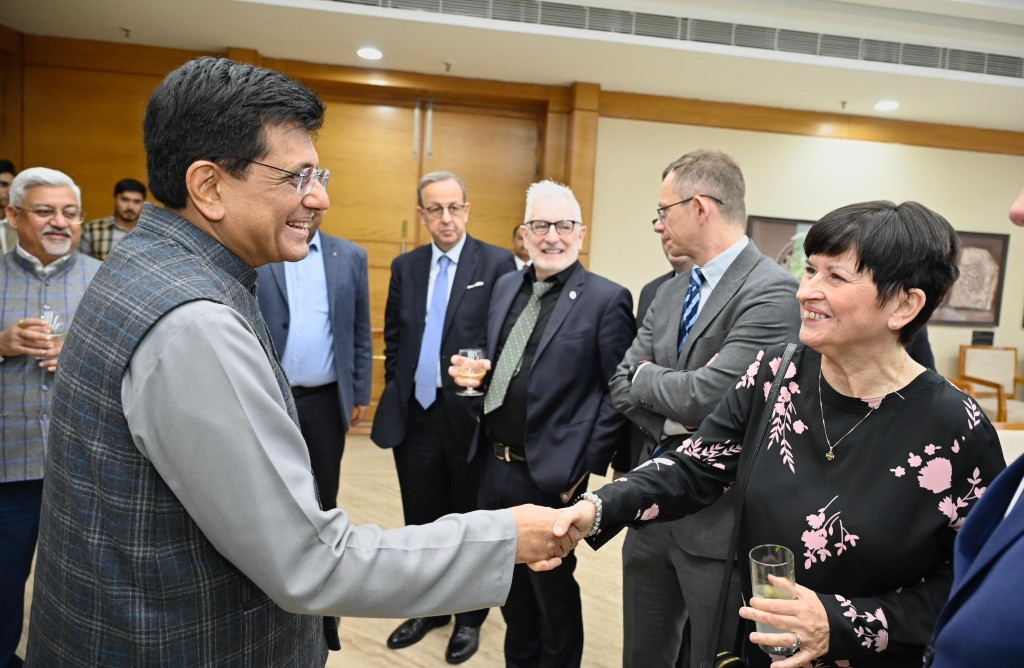
Union Minister for Commerce Piyush Goyal with EU delegation. Image credit X.com @PiyushGoyal
Piyush Goyal announces India–EFTA trade pact’s rollout as DGFT highlights India–UK CETA’s transformative potential for exporters, signalling a new era of economic diplomacy and market access.
By S JHA
MUMBAI, September 29, 2025 — India is fast making efforts to emerge as a central pillar of global trade diplomacy. At the UP International Trade Show, Union Commerce & Industry Minister Piyush Goyal announced that the India–EFTA Free Trade Agreement—finalised in March 2024 with Iceland, Liechtenstein, Norway, and Switzerland—will formally come into effect from October 1, 2025.
Calling the development a watershed moment for India’s trade policy, Goyal highlighted that global interest in partnering with India is accelerating. Having already signed FTAs with the UAE, Australia, and the UK, India is now in advanced discussions with the US, EU, New Zealand, Oman, Peru, and Chile. Even Qatar and Bahrain have signalled intent, while the Eurasian bloc has finalised its terms of reference with India.
The Minister framed this surge of negotiations as a reflection of India’s economic resilience. “From being described as fragile in 2014, the country is today the world’s fourth-largest economy with a $700 billion forex reserve, 2% inflation—the lowest in a decade—and a 7.8% GDP growth rate last quarter,” said Goyal.
He reaffirmed that India is on track to becoming a $5 trillion economy and the world’s third-largest within the next two years.
But Goyal also grounded his speech in the domestic narrative—championing the GST reforms announced during Navaratri as the most transformative step since Independence and urging citizens to embrace swadeshi products. Uttar Pradesh, he noted, has pioneered structural reforms with a dedicated Export Promotion Ministry and the One District, One Product (ODOP) initiative, now replicated in more than 750 districts across India.
Plans for Unity Malls in every state, including three in Lucknow, Agra, and Varanasi, are meant to ensure artisans and entrepreneurs find a national and global platform.
If Goyal provided the big-picture vision, the DGFT’s outreach programme on the India–UK Comprehensive Economic and Trade Agreement (CETA) held in New Delhi translated it into operational clarity for exporters.
Framed under the theme “Gateway to Growth: Harnessing Opportunities under India–UK CETA”, the programme featured senior officials, diplomats, EPC leaders, and UK representatives. DGFT Chief Ajay Bhadoo underscored how tariff concessions and simplified market access could boost Indian MSMEs’ integration into global value chains. UK’s Deputy Trade Commissioner Anna Shotbolt called CETA a “milestone” in bilateral ties and urged Indian firms to align with sustainability and quality standards to tap premium UK markets.
Sectoral leaders offered a roadmap for exporters:
- APEDA emphasised agri and processed foods, including organics and ethnic categories.
- FIEO urged exporters to embrace digital outreach and look beyond traditional buyers.
- ESC and SEPC pointed to new opportunities in IT, education, and creative services.
- GJEPC, EPCH, EEPC, and AEPC highlighted gems & jewellery, handicrafts, engineering goods, and apparel as sectors poised to benefit from UK demand.
Buyers and industry associations added a pragmatic note: supply chain transparency, compliance, and timely delivery remain non-negotiables for UK partners.
Together, these developments sketch a narrative of India’s twin-track strategy: pursuing bold global trade deals while building domestic capacity to seize opportunities. The India–EFTA FTA, coupled with India–UK CETA, marks not just the signing of agreements but the rewriting of India’s place in the global trading system.
As Goyal reminded in his closing note, every export is not just an economic statistic but also the “blood and toil of Indian workers.” India’s challenge now is to ensure that the benefits of these historic agreements cascade down to its MSMEs, farmers, artisans, and entrepreneurs—so that “local goes global” becomes a lived reality.
Follow The Raisina Hills on WhatsApp, Instagram, YouTube, Facebook, and LinkedIn




About The Author