India’s Export Surge: Diversification, Deals, and Declining Deficits
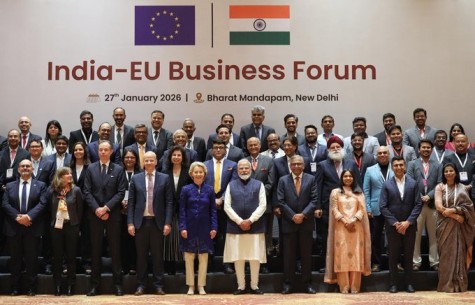
India EU Business Forum meeting in New Delhi on Tuesday (Image MEA India)
With exports up 15.5% and the trade deficit sharply narrowed, India’s trade strategy is quietly reshaping its global economic footprint
By S JHA
Mumbai, January 27, 2026 — Between November 2024 and November 2025, India’s export story quietly crossed an inflection point. Total exports rose from US$ 64.05 billion to US$ 73.99 billion, registering a robust 15.52% year-on-year growth, even as imports remained broadly stable at US$ 80.63 billion. The result was striking: the trade deficit narrowed by over 61%, from US$ 17.06 billion to US$ 6.64 billion.
In a world marked by geopolitical friction, supply-chain realignments, and uneven global demand, this is not a routine data point—it is a signal of strategic recalibration.
India’s export momentum is being driven by diversification across products, markets, and value chains. Merchandise exports surged 19.38%, reaching US$ 38.13 billion, while services exports grew 11.67% to US$ 35.86 billion, reflecting a near-balanced contribution between goods and services. Labour-intensive sectors such as readymade garments continued to perform, while high-value segments—pharmaceuticals (+20.19%), chemicals (+18.49%), gems and jewellery (+27.8%), and petroleum products (+11.65%)—anchored growth.
Geographically, export expansion was equally telling. Traditional partners like the UAE, Japan, Germany, France, and the UK recorded steady gains, while emerging markets such as Egypt, Saudi Arabia, and Hong Kong posted sharp spikes. This widening footprint reduces dependence on a narrow set of destinations and cushions India against demand shocks.
Policy choices are reinforcing this shift. A steady cadence of Free Trade Agreements, most recently the India–Oman Comprehensive Economic Partnership Agreement (CEPA), reflects a deliberate effort to lock in market access while protecting core domestic interests. Export-enabling schemes such as Zero Duty EPCG and the Market Access Initiative are further supporting competitiveness.
Perhaps most symbolic is electronics. Mobile phone exports, once negligible, have grown 127 times in a decade, positioning India as a serious global manufacturing hub.
At 21.2% of GDP, exports now play a critical role in macroeconomic stability. What distinguishes this phase is not just growth—but resilience. India’s exports are no longer riding a single wave. They are spreading risk, absorbing shocks, and steadily rewriting the terms of India’s engagement with global trade.
Snow, Suits, and Self-Congratulation: India at Davos Explained
Follow The Raisina Hills on WhatsApp, Instagram, YouTube, Facebook, and LinkedIn




About The Author