India’s Economy in 2025: Fragile Base and Cost Beneath Numbers
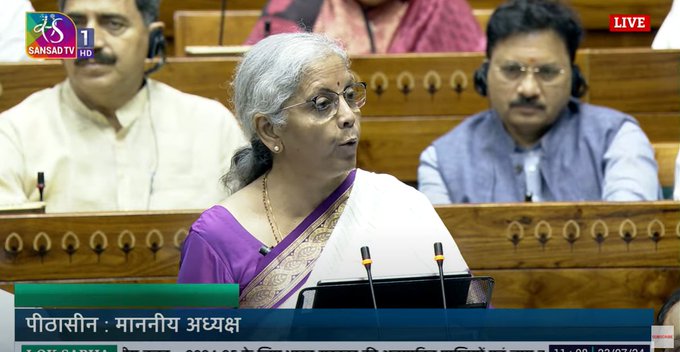
Image credit X.com Sansad TV
An 8.2% GDP headline masks job stress, weak private investment, rupee shocks, and rising doubts over data credibility.
By Pradeep Kumar Panda
Bhubaneswar, December 29, 2025 — India closed 2025 as one of the world’s fastest-growing economies—but not without visible scars beneath the headline numbers. Growth remained the dominant narrative, yet a closer look reveals an economy wrestling with structural stress, data credibility concerns, and global turbulence.
On paper, India posted 8.2% GDP growth, but the credibility of the data itself came under scrutiny after the IMF raised serious concerns over measurement and consistency. If growth was the headline, inflation was the surprise—with the GDP deflator unusually low at around 0.5%, raising questions about price dynamics and real income trends.
Monetary policy turned accommodative as the Reserve Bank of India cut the repo rate, supported by inflation staying largely within target bands. This provided policy space for growth, but also reflected concerns over slowing momentum.
GST 2.0 emerged as a mixed story. Collections touched a record ₹1.96 lakh crore, underscoring compliance gains, yet the promised revival in household savings failed to materialise. Budget 2025, billed as a major relief for the middle class, offered sentiment support but limited structural impact.
Financial markets mirrored this contradiction. The stock market scaled impressive highs—touching 86,159—before ending the year weakly, with lows around 71,425, amid global risk aversion.
Foreign Institutional Investor (FII) outflows hit record levels, while the rupee came under sustained pressure, emerging as Asia’s weakest currency in 2025.
External headwinds compounded domestic challenges. The US tariff war, rising protectionism, and trade uncertainty disrupted exports and capital flows. Immigration unexpectedly surfaced as a new trade flashpoint. In response, India accelerated trade diplomacy, placing Free Trade Agreements with New Zealand, Oman, the UK, the EU, and Russia at the centre of its external strategy.
Beneath these macro signals lay deeper concerns.
Despite headline growth, unemployment remained high and real wages stagnated. Quality job creation lagged, with a growing share of employment shifting towards short-term and informal work, intensifying economic insecurity.
Private investment—critical for sustaining long-term growth—remained uneven and weak. While select sectors showed promise, manufacturing ambitions were constrained by risk aversion, balance-sheet caution, and global uncertainty.
Questions around data quality and reliability persisted, particularly relating to GDP and industrial output figures. While upcoming base-year revisions for GDP and CPI may improve accuracy, doubts lingered through the year.
Income inequality remained another fault line. Although some data pointed to marginal improvements in the Gini index, the gap between those benefiting from growth and those bearing the costs of inflation and joblessness widened.
On the fiscal front, sovereign debt and fiscal consolidation progressed slowly, posing long-term risks. Declining household financial savings further limited domestic resources for productive investment, increasing dependence on foreign capital at a volatile time.
Still, there were stabilising anchors. Domestic consumption, accounting for nearly 70% of GDP, remained resilient and acted as a growth buffer. Policy reforms—ranging from GST tweaks and labour law adjustments to nuclear sector amendments—signalled intent to improve the investment climate, even if outcomes remain uneven.
In essence, 2025 was a year of economic duality. India combined strong headline growth with persistent weaknesses in job quality, private investment, and fiscal depth, all while navigating a fragmented global economy. Inflation management and trade outreach provided stability, but sustaining growth will demand deeper structural reform, credible data, and inclusive job creation.
(This is an opinion piece. Views expressed are personal.)
Follow The Raisina Hills on WhatsApp, Instagram, YouTube, Facebook, and LinkedIn




About The Author