India-US Trade Stalemate May Persist with Stress on Economy
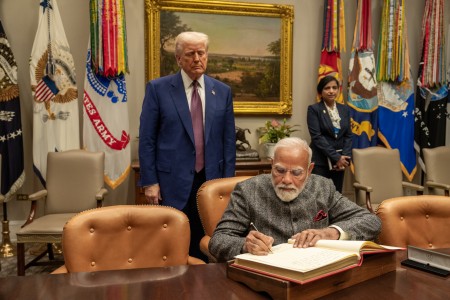
PM Narendra Modi with US President Donald Trump. Image credit White House
A prolonged stalemate could hurt India’s economy, given the signs of a US slowdown and global stock market sell-offs.
By TRH Foreign Affairs Desk
New Delhi, November 8, 2025 — In his analysis, journalist Manish Anand said that US President Donald Trump will not visit India this year, confirming growing signs that the 2025 QUAD Summit—which India was set to host—may now be postponed to 2026.
Speaking in his analysis to The Raisina Hills, Anand explained that Trump recently told reporters in the Oval Office that he “speaks regularly” with Indian Prime Minister Narendra Modi and could visit India “next year,” implying no summit-level engagement in 2025.
The QUAD—comprising India, the United States, Japan, and Australia—holds an annual leadership summit, with last year’s meeting hosted by the US under President Joe Biden. However, Anand noted that “strained ties between India and the US” have cast uncertainty over the next meeting.
“The QUAD’s identity is anchored in the Indo-Pacific, both strategically and economically,” he said. “But with the Trump administration taking a softer approach to the region following the US–China thaw after the Busan Summit, Washington’s interest in the Indo-Pacific appears to be cooling.”
According to Anand, diminishing American engagement could weaken the QUAD’s momentum. Yet, he emphasized India’s continuing importance to the grouping: “India’s role is central because of its maritime position near the Andaman and Nicobar Islands and its growing naval strength in the Indian Ocean.”
On the economic front, Anand warned that the absence of a Modi–Trump meeting means “no new trade agreements” are likely in 2025. “Without a summit, there is little chance of resolving the 50% US tariffs on Indian goods,” he said, adding that “direct negotiations in other countries, like South Korea and Japan, have only followed leaders’ meetings.”
He also cautioned that a prolonged stalemate could hurt India’s economy, given the signs of a US slowdown and global stock market sell-offs. “If the US economy contracts further, India’s exports—especially in textiles and IT—will face pressure,” Anand said, noting that the US remains India’s largest export destination.
“With US demand weakening, stress is already visible in textile hubs like Tirupur and Surat, and IT companies may also feel the impact,” he added.
Anand warned that if growth remains near 6–6.5%, India could see “jobless growth”, where expansion sustains output but fails to create new employment. “When economic stress persists, populist welfare politics—what we call ‘revdi’ politics—tends to rise,” he said, referring to states offering cash and subsidies ahead of elections.
“This discourages private and corporate investment, further shrinking the space for economic expansion,” he added.
Finally, Anand drew parallels with the UK, where rising living costs have prompted large-scale entrepreneur migration, warning that India could face similar trends. “Around two million Indians migrated in 2023, many of them entrepreneurs and job creators,” he said.
“The next two years,” Anand concluded, “are likely to be a period of significant economic challenge for India.”
Follow The Raisina Hills on WhatsApp, Instagram, YouTube, Facebook, and LinkedIn




About The Author