India–UAE Ties: Why Outcomes Matter More Than Optics
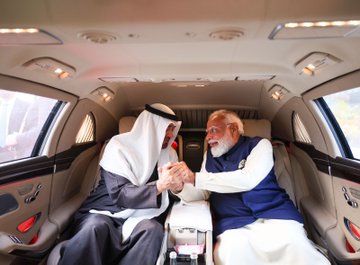
Prime Minister Narendra Modi Went Sheikh Mohamed bin Zayed Al Nahyan, President of the UAE, received at the airport (Image Modi on X)
A three-hour visit delivers strategic depth across trade, defence, energy and West Asia geopolitics
By TRH Foreign Affairs Desk
New Delhi, January 20, 2026 — In diplomacy, duration is overrated. Outcomes are not. The brief but outcome-heavy visit that reinforced India–UAE ties on Monday proved precisely that, underscoring how a mature strategic partnership operates without theatrics.
Former Foreign Secretary Sanjay Bhattacharya, speaking to DD News, offered a revealing assessment: India–UAE relations are no longer transactional—they are structural, diversified and future-facing. From trade and defence to nuclear energy, space and regional stability, the partnership is expanding in both scale and ambition.
Trade has already crossed $100 billion since the 2022 Comprehensive Economic Partnership Agreement (CEPA). The new target—$200 billion by 2032—is not aspirational rhetoric. It is anchored in concrete enablers: local currency settlements, investment treaties, DP World’s expansion into GIFT City, and UAE-backed infrastructure and renewable energy projects across India.
Crucially, the relationship is now entering the third-country cooperation phase, positioning India and the UAE as joint economic and strategic anchors across West Asia, Africa and Eurasia. As global trade fragments and US-led markets slow, diversification through the UAE emerges as India’s most reliable hedge.
On defence and security, the framework agreement reflects shared anxieties over West Asia’s fragility—from Gaza and Syria to Iran and Yemen. As Bhattacharya noted, India’s principled yet pragmatic diplomacy gives it credibility with all sides—an asset the UAE values deeply.
Beyond geopolitics lies the human foundation: 4.3 million Indians in the UAE, cultural integration, faith pluralism, temples, youth exchanges and the proposed “House of India.” These are not soft add-ons; they are strategic stabilisers.
This partnership is no longer about alignment. It is about co-ownership of regional order.
India–UAE Trade Push: Modi, MBZ Make Big Digital Corridors Push
Follow The Raisina Hills on WhatsApp, Instagram, YouTube, Facebook, and LinkedIn




About The Author