India Sold Control Cheap: The Hindustan Zinc Story
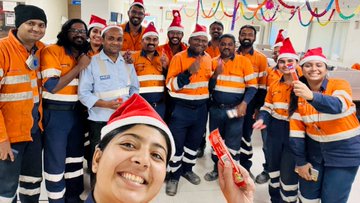
Hindustan Zinc employees celebrate Christmas. (Image company on X)
India’s most dramatic privatisation story is also its most uncomfortable—mixing staggering wealth creation, Supreme Court scrutiny, and hard lessons on minority protection.
By P. SESH KUMAR
New Delhi, January 25, 2026 — Hindustan Zinc’s journey after the Vedanta (then Sterlite) takeover is one of India’s most dramatic “market-value metamorphoses”: a strategic-sale price that now looks astonishingly small against a market capitalisation that has recently hovered around (and even crossed) ₹3 lakh crore.
But this is not a simple fairy-tale of turnaround and shareholder riches. It is also a case study in the uncomfortable triangle of (i) privatisation-era valuation anxieties, (ii) a powerful promoter with incentives to use a cash-rich listed subsidiary for group-level goals, and (iii) a large minority shareholder-the Government of India-forced to fight for governance safeguards long after “disinvestment” supposedly ended the state’s control. The result is a rich mix of spectacular wealth creation, recurring controversy, regulatory and boardroom friction, court-ordered investigation, and a set of sharp lessons for future strategic sales and minority protection in India.
The viral social-media claim that Hindustan Zinc was “bought for ₹500 crore” (or “₹3,500 crore”) and is now worth “₹3 lakh crore” is directionally trying to capture a truth—extraordinary value creation—but it often garbles the original transaction. What actually happened is more precise, and far more consequential for the governance story that followed.
In March-April 2002, Sterlite acquired 26% in Hindustan Zinc for about ₹445 crore, winning management control in what was then a marquee strategic disinvestment. Later, Sterlite/Vedanta increased its holding further (including through market purchases and another government tranche), taking promoter ownership to about 64.9%—a figure that still frames today’s promoter–minority dynamics.
Fast-forward to January 2026 and the scale looks almost surreal: Hindustan Zinc’s market capitalisation has been reported around ₹3 lakh crore (and in some sessions, above it), propelled recently by a powerful rally in silver and strong earnings. In other words, the “wealth creation” headline is real—yet the deeper question is: what exactly created that value, and who controlled the levers while it was being created?
A large part of the answer is operational and strategic. Under Vedanta’s stewardship, Hindustan Zinc became a machine built around scale, cost discipline, and integration of mining-to-metal operations-exactly the kind of industrial story that markets reward when commodity cycles turn favourable. The recent surge is also brutally cyclical: as silver prices jumped, Hindustan Zinc’s profits and valuation got a turbo-boost, with news reports explicitly tying the m-cap leap to the silver rally and quarterly profit surge. The market, in short, began to price Hindustan Zinc not merely as a zinc-lead producer but as a serious silver play, and the rerating followed.
But in India, big privatisation stories rarely remain purely about operations. They become moral theatre: “Was the family silver sold too cheap?”; “Did the buyer get a rigged runway?”; “Is the promoter now siphoning value from the listed company?”
In Hindustan Zinc, these questions didn’t remain cocktail debate-they entered the courtroom. In November 2021, while allowing the government to proceed with disinvestment of its residual stake, the Supreme Court also directed a CBI probe into alleged irregularities relating to the 2002 disinvestment.
That single judicial move captures the paradox perfectly: the state is told, “You may sell what you have left,” but also, “We are not done examining how you sold control in the first place.”
On the one hand, the Court cleared the Union government to go ahead and disinvest its residual stake in the company, signalling that policy paralysis or endless litigation should not freeze legitimate economic decisions. On the other, it simultaneously directed the Central Bureau of Investigation to inquire into alleged irregularities surrounding the original 2002 strategic sale through which Sterlite acquired control.
In plain language, the Court told the government: you are free to sell what you still own—but the story of how control was transferred two decades ago is not closed. The CBI enquiry, as ordered, is confined to examining whether the disinvestment process-valuation, bidding, decision-making and approvals-suffered from procedural lapses or illegality; it is not a verdict on guilt, nor a reversal of privatisation.
Crucially, the Supreme Court did not stay the company’s operations, disturb the existing shareholding structure, or question the legitimacy of Hindustan Zinc as a listed entity; instead, it drew a careful constitutional line between economic continuity and accountability for past state action. The message was unmistakable and sobering: economic reforms may move forward, markets may rally, and valuations may soar-but when public assets are sold, the state’s conduct remains answerable to law long after the ink on the disinvestment cheque has dried.
This is where the Hindustan Zinc saga quietly turns into a textbook on how privatisation design can make or break public trust. The ₹445-crore price paid in 2002 was never the whole story; it was merely the entry ticket. What truly mattered—and what continues to cast a long shadow—was the architecture of the deal: how valuation was done, how bidders were shortlisted, how competition was fostered (or constrained), what information asymmetries existed between the seller and buyer, and what guardrails were put in place once control changed hands.
The Comptroller and Auditor General (CAG) of India captured this dilemma with clinical clarity in its performance audit of the disinvestment programme of that era, showing how fragile process design can return decades later as litigation, political controversy, and shareholder distrust. The difference is as stark as selling a fruit tree versus selling its timber: if the state treats disinvestment as a one-time cash harvest, it celebrates the cheque received and moves on; if it recognises that it is transferring a living asset that will generate dividends, cash flows, and strategic value for decades, then valuation is not just arithmetic-it is destiny.
A competitive auction with multiple serious bidders, transparent assumptions on metal prices and reserves, and strong post-sale governance norms is like building a house on rock; a hurried or weakly designed sale is building on sand-fine on day one, disastrous when the tide turns.
Hindustan Zinc’s later explosion in market value, the Supreme Court-ordered probe into the original sale, and the recurring battles over related-party transactions all illustrate the same uncomfortable truth: one can under-engineer a privatisation only once, but one pays for it forever. The lesson is brutal but simple—when a national resource is handed over to private control, safeguards, valuation discipline, information symmetry, and minority-shareholder protection are not procedural niceties; they are existential choices that determine whether privatisation is remembered as reform or as regret.
Tax Tightens, Capital Pauses: Tiger Global Case and Startups
Yet, even if one assumes the takeover was legally executed, the next governance problem arrives in a different form: the listed subsidiary becomes a financial engine. Hindustan Zinc has long been viewed as cash-rich, and in a promoter group with high leverage pressures elsewhere, the temptation is obvious: dividends, intra-group arrangements, and related-party transactions can become the quiet pipelines through which value shifts. That is why Hindustan Zinc’s post-takeover controversies have repeatedly clustered around related-party proposals and the government’s role as a vigilant minority shareholder.
Consider the attempted transaction where Hindustan Zinc planned to buy Vedanta’s international zinc assets-reported around $2.98 billion—which the government opposed, explicitly flagging concerns tied to related-party nature and the use of Hindustan Zinc’s cash. Reports later indicated the bid lapsed, but the episode left a lasting message: India’s largest minority shareholder was effectively saying, “Don’t use this company’s balance sheet to solve the promoter’s problems.” That is not merely a commercial disagreement-it is a fundamental clash of fiduciary philosophy.
Then came the demerger idea. Hindustan Zinc proposed splitting operations into separate units (zinc, lead, silver, recycling), a move the company argued could unlock value. But Reuters reported that the government rejected the plan, saying it was not convinced the split would enhance shareholder value-and notably, objecting that the company had not consulted it. This matters because it reveals the unusual corporate constitution of Hindustan Zinc even today: a promoter-run listed company where a very large minority shareholder is not passive capital—it is a politically accountable stakeholder with a long memory of how control changed hands.
And most recently, the brand-fee / strategic services fee controversy injected fresh heat. A short-seller (Viceroy Research) alleged that Hindustan Zinc’s brand-fee arrangements with Vedanta raised serious governance and approval questions, while company leadership publicly contested the allegation and defended process compliance. Whatever one’s view of the merits, this episode again underlines the same structural risk: when promoter and listed subsidiary transact with each other, the minority shareholder’s only true shield is transparent process, disinterested approvals where required, and rigorous disclosure.
So where does that leave the “phenomenal market-cap surge” narrative? It remains impressive, but it should be read with two lenses simultaneously.
With the first lens, Hindustan Zinc is a case of how private control, professional management, scale economics, and commodity-cycle tailwinds can create staggering shareholder value. A company that the state once controlled, and then sold for a relatively modest cash receipt, became a market darling whose valuation now rivals-or even surpasses-other marquee metals players in India during certain rallies. If one were writing a pure capital-markets story, this would be framed as “patient capital plus operational excellence plus cycle equals wealth.”
With the second lens, Hindustan Zinc is a cautionary tale about what happens when privatisation is treated as an exit but the state remains a large minority owner for decades. Every major promoter action is then interpreted through suspicion: “Is this value creation-or value extraction?” The Supreme Court’s direction for a CBI probe into the 2002 disinvestment (status not in public domain) and the continuing government pushback on related-party and restructuring proposals, keep the company in a permanent governance spotlight. That spotlight is not always comfortable for the promoter, but it is also not entirely bad for the market: it can act as a deterrent against the more adventurous forms of tunnelling that minority shareholders in India have historically suffered.
The lessons are therefore blunt, and very usable for future strategic sales. First, valuation is not a spreadsheet event; it is a legitimacy event. Even if a deal is technically compliant, if competition, information symmetry, and pricing logic do not look robust in hindsight, the transaction can remain politically and legally radioactive for decades. Second, residual government stakes create a hybrid governance regime: the company is private-led, but politically scrutinised; commercial decisions become quasi-public disputes; and board processes must be unusually clean to survive the glare. Third, related-party discipline is not optional in promoter-controlled groups; it is the core of minority trust. If a listed subsidiary is cash-rich, the promoter must behave as though every rupee is being watched-because it is. Finally, the state itself must learn a hard truth: if it sells control, it must either exit cleanly within a defined horizon or design a credible long-term minority framework; drifting as a perpetual 29.5% shareholder practically guarantees recurring conflict.
Hindustan Zinc, in the end, is both a trophy and a warning. A trophy for what industrial scale and a favourable cycle can do to market value. A warning that India’s privatisation legacy is not just about what the state earned on day one, but about how the deal’s ethics and governance play out over twenty years-under courts, auditors, regulators, markets, and an unforgiving public memory.
(This is an opinion piece. Views expressed are author’s own)
Follow The Raisina Hills on WhatsApp, Instagram, YouTube, Facebook, and LinkedIn




About The Author