India–Oman CEPA: A Pact That Marries Access with Mobility
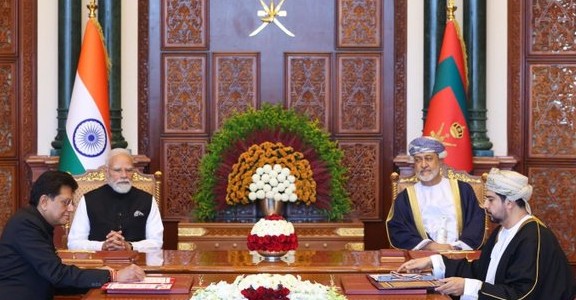
Prime Minister Narendra Modi during signing of India-Oman CEPA on Thursday. (Image Modi on X)
With sweeping tariff elimination, services liberalisation and unprecedented labour mobility, the India–Oman CEPA signals New Delhi’s Gulf strategy entering a decisive new phase
By S JHA
Mumbai, December 18, 2025 — The signing of the India–Oman Comprehensive Economic Partnership Agreement (CEPA) marks a decisive moment in India’s evolving engagement with the Gulf—one that goes far beyond symbolism to deliver tangible economic and strategic outcomes.
External Affairs Minister S. Jaishankar aptly described the agreement as “a landmark moment,” noting that the CEPA will unlock market access for India’s labour-intensive sectors and MSMEs while ensuring enhanced welfare and mobility for Indian professionals. Prime Minister Narendra Modi went further, calling it a historic step whose positive impact will be felt for decades, energising bilateral ties for the 21st century.
The numbers justify the optimism. Oman has offered zero-duty access on over 98 per cent of its tariff lines, covering nearly all Indian exports. Sectors ranging from textiles, gems and jewellery, leather, footwear and engineering goods to pharmaceuticals, medical devices and automobiles stand to gain immediately. For Indian exporters long constrained by tariff and non-tariff barriers in the Gulf, this is a structural breakthrough.
Equally significant is the services package. With Oman’s global services imports exceeding USD 12.5 billion and India’s share still modest, the CEPA opens vast untapped potential. Commitments across IT, professional services, R&D, education and healthcare position Indian firms to move up the value chain in the Gulf economy.
The agreement’s most transformative dimension, however, lies in labour mobility. For the first time, Oman has made wide-ranging Mode-4 commitments—doubling intra-corporate transferee quotas, extending contract durations up to four years, and liberalising entry for skilled professionals in critical sectors. For nearly seven lakh Indians living and working in Oman, this signals greater security, dignity and opportunity.
Strategically, the CEPA reinforces India’s calibrated trade diplomacy. It is the second major FTA in six months, following the UK deal, reflecting a clear preference for partnerships with economies that complement—rather than threaten—India’s labour-intensive strengths.
Oman, a key gateway to the Middle East and Africa, has not signed a bilateral trade agreement since 2006. That it chose India now speaks volumes. This CEPA is not merely about tariffs—it is about trust, long-term integration, and India’s emergence as a credible economic partner in the Gulf.
Follow The Raisina Hills on WhatsApp, Instagram, YouTube, Facebook, and LinkedIn




About The Author