India Faces Direct Economic Shock From Middle East Crisis
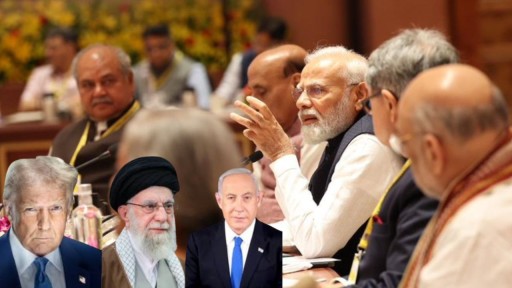
India challenge amid Middle East crisis. (Image X.com)
With 85 per cent of India’s oil needs met by imports — and the Gulf its single largest source — the West Asia crisis is no longer a distant geopolitical event.
By TRH World Desk
New Delhi, March 1, 2026 — India’s exposure to the rapidly deepening Middle East crisis is not primarily military — it is economic, and it is direct. That is the central warning from geopolitics analyst Manish Anand, speaking on The Raisina Hills channel.
“This is not about military censure,” Anand said, adding: “It is about economics hitting us in the veins. Brent crude oil has already crossed $80. India imports 85 per cent of its oil requirement, and the Gulf is a major source of those oil imports.”
Before the Iran war, crude oil was trading at approximately $60 a barrel. If the conflict escalates to the point where Gulf oil infrastructure is damaged — or the Strait of Hormuz is disrupted for a sustained period — Anand warns that crude could cross $100 a barrel. That would represent a near-80 per cent increase.
“If you imagine crude oil at $100 per barrel, which was $60 before this Iran war, that is roughly an 80 per cent increase. The inflationary blow that will hit India’s economy could be deeply painful — inflation will rise, our economic growth rate will be impacted, and the cost of living for the ordinary citizen will go up,” he said.
Iran has already targeted a tanker attempting to cross the Strait of Hormuz, Anand noted, destroying it — a signal that Tehran retains both the will and the capability to disrupt the world’s most critical oil chokepoint.
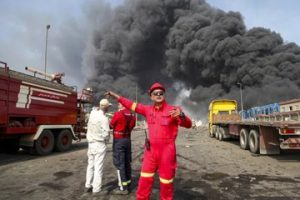
“Iran has the capacity to damage the oil reserves, oil wells, and oil infrastructure in the Gulf. We saw what happened when Iraqi forces retreated from Kuwait — they set the oil wells on fire and it took years to extinguish them. A similar disruption scenario is now being feared,” he said.
Beyond oil, Anand identified remittances as a second major vulnerability that has received insufficient attention. Millions of Indian workers are employed across the Middle East. Any sustained disruption to the Gulf economies — whether from direct conflict, capital flight, or economic contraction — would hit the flow of remittances back to India.
“It is not just oil. The remittances we receive because our workers work in the Middle East — if that is disrupted, India’s foreign currency reserves could also be impacted,” he warned.
India’s trade relationship with the UAE alone ranks as the third largest bilateral trade partnership in the world. If the UAE is drawn into the conflict — and Iranian strikes on Dubai hotels and the airport have already demonstrated that it is not beyond reach — the consequences for Indian commerce would be severe.
“A time when India had deepened its economic footprint in the Middle East economy significantly — UAE-India trade was enormous. If that country gets caught in this crisis, there is a direct impact on our economy,” Anand said.
Hardliners In Ascent: A New Wave Of Radicalism
Anand raised a concern that goes beyond the immediate military and economic calculus. With Khamenei assassinated, the leadership vacuum in Tehran is being filled — and the early signals are troubling.
“The news coming out is that hardliners are now moving into leadership positions inside Iran. They have a stockpile of hypersonic missiles and drone capability, with which they have already targeted American bases in the Middle East,” he said.
More alarming still, Anand suggested that Khamenei’s death — framed by Iran’s new leadership as martyrdom — could generate a new wave of hardline Islamist sentiment extending far beyond Iran’s borders.
“After Khamenei’s killing, his new leadership has given him the title of martyr — which carries enormous weight in the Islamic world. This could trigger a new wave of hardline Islam and even terrorism emanating from Iran, which could disrupt the entire Middle East,” he warned.
India’s Strategic Dilemma: American Dependence
Perhaps the most strategically significant point Anand raised is about the long-term direction of India’s oil import policy. India has historically sought to diversify its sources of crude — reducing dependence on any single supplier or geopolitical bloc. The purchase of discounted Russian crude after the Ukraine war was part of that strategy. But Washington’s pressure has now nearly halted Indian imports of Russian oil.
“We had diversified our oil import capability across multiple sources. But now it seems as though moving into American influence is becoming a compulsion — because the route we opened with Russia has also reached a new turning point,” Anand said.
If Iran is eventually destabilised and American interests take control of Iranian oil, India’s energy dependence on the United States would increase sharply — a strategic vulnerability New Delhi has spent years trying to avoid.
“If there is regime change in Iran and American dominance over Iranian oil is established, India’s dependence on America will increase — and that is a matter of strategic concern, because we have always tried to diversify,” he said.
Follow The Raisina Hills on WhatsApp, Instagram, YouTube, Facebook, and LinkedIn




About The Author