India–EU FTA Marks a Strategic Trade Reset Between Two Giants
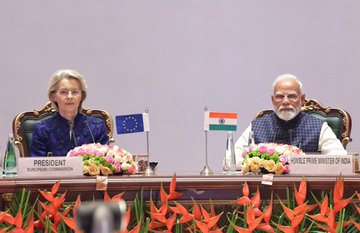
Prime Minister Narendra Modi and EU Commission President Ursula Von der Leyen in New Delhi on Tuesday (Image MEA India)
With near-total market access, services mobility, and rules-based integration, the India–EU FTA reshapes global trade alignments beyond China-centric supply chains
By S JHA
Mumbai, January 27, 2026 — The conclusion of negotiations on the India–EU Free Trade Agreement (FTA) marks a decisive moment in India’s external economic strategy. Far more than a tariff-cutting exercise, the agreement recasts India–EU ties into a modern, rules-based partnership suited to an era of fractured supply chains, geopolitical rivalry, and strategic de-risking from overdependence on China.
Together, India and the European Union represent a combined market of over USD 24 trillion, encompassing nearly two billion people. Yet bilateral trade has long underperformed its potential. That gap is now set to narrow sharply. The FTA delivers preferential market access across more than 99% of India’s exports by value, while preserving policy space for sensitive sectors and reinforcing India’s developmental priorities.
The trade numbers already point to momentum. In 2024–25, India–EU merchandise trade stood at USD 136.5 billion, with India exporting USD 75.8 billion worth of goods. Services trade added another USD 83 billion, underscoring the growing centrality of knowledge-led and digitally delivered services. The FTA locks in predictability across both goods and services, offering exporters and investors long-term certainty amid global volatility.
Labour-intensive sectors—textiles, apparel, leather, footwear, marine products, gems and jewellery—stand to gain immediately from duty elimination, enhancing competitiveness and employment generation. Engineering goods, chemicals, medical devices, and electronics gain access to one of the world’s most regulated yet lucrative markets. Crucially, balanced product-specific rules ensure genuine manufacturing and value addition while allowing flexibility within global value chains—an explicit nod to MSMEs and ‘Make in India’.
Services may prove the agreement’s most transformative pillar. Commitments across 144 services sub-sectors, alongside assured mobility for professionals, intra-corporate transferees, and independent service providers, position India as a global talent hub while giving EU firms predictable access to India’s expanding market.
Beyond commerce, the FTA carries strategic weight. It anchors India firmly within Europe’s long-term economic calculus, strengthens regulatory cooperation, protects intellectual property—including traditional knowledge—and deepens trust between two rule-shaping powers.
In a world drifting toward protectionism, the India–EU FTA is a clear statement: integration, not insulation, will shape the next phase of India’s global rise.
(This is an opinion piece. Views expressed are the author’s own.)
India’s Export Surge: Diversification, Deals, and Declining Deficits
Follow The Raisina Hills on WhatsApp, Instagram, YouTube, Facebook, and LinkedIn




About The Author