India–EU Free Trade Agreement Turns a Strategic Necessity
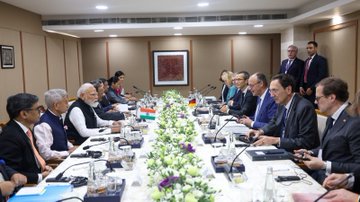
Prime Minister Narendra Modi holds bilateral meeting with German Chancellor Friedrich Merz in Ahmedabad (Image Modi on X)
With global markets under strain, New Delhi is fast-tracking the India–EU Free Trade Agreement to secure growth, resilience, and strategic autonomy.
By TRH Foreign Affairs Desk
New Delhi, January 12, 2026 — As global trade fragments under geopolitical pressure, India is recalibrating its economic diplomacy with urgency. The India–EU Free Trade Agreement (FTA), stalled for years by regulatory and political inertia, has now emerged as a strategic imperative. Foreign Secretary Vikram Misri’s remarks underline a clear shift: this is no longer a routine trade negotiation, but a response to a rapidly hardening global economic environment.
The turning point came in February last year, when the entire EU College of Commissioners visited India—an unprecedented diplomatic gesture. That visit triggered a political decision at the highest level to fast-track the agreement. Since then, negotiations have intensified. At least six physical rounds, complemented by numerous virtual sessions, have already taken place, showing seriousness on both sides.
Progress, Misri stressed, has been “considerable.” That matters. With markets elsewhere facing pressure from protectionism, wars, and supply-chain disruptions, India is actively seeking to expand and diversify its trade footprint. The European Union is already one of India’s largest trading partners, but the potential remains underexploited.
Germany offers a telling example. Bilateral trade with Berlin has crossed USD 50 billion—nearly a quarter of India’s total trade with the EU. Yet both Prime Minister Narendra Modi and German Chancellor Friedrich Merz agree that this figure falls far short of what is possible. The FTA, Indian officials believe, can unlock that latent capacity across sectors ranging from manufacturing and technology to green energy and advanced engineering.
Importantly, New Delhi is pursuing trade talks on multiple tracks. Negotiations with the United States are continuing, but Misri made it clear that these discussions are independent of the India–EU process. This parallelism reflects a broader Indian strategy: hedge against global volatility by building multiple, high-quality economic partnerships rather than relying on a single market.
The India–EU FTA also aligns with India’s green transition goals. Initiatives under the Green and Sustainable Development Partnership—including green hydrogen—are no longer peripheral add-ons but core economic drivers. Trade, climate finance, and technology transfer are converging into a single strategic framework.
In essence, the urgency surrounding the India–EU Free Trade Agreement reflects a new realism in Indian policy. As the global economy becomes more uncertain, India is betting on deeper, rules-based partnerships to secure growth, resilience, and strategic autonomy. Delay is no longer an option.
Modi–Merz Moment: India–Germany Ties Signal a Strategic Reset
Follow The Raisina Hills on WhatsApp, Instagram, YouTube, Facebook, and LinkedIn




About The Author