India–EU Deal Triggers a US Scramble Back to New Delhi
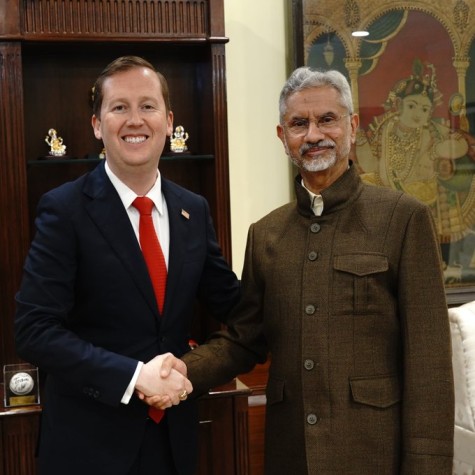
EAM S Jaishankar with US Amabassador in New Delhi Sergio Gor. (Gor on X)
From Trump’s trusted envoy in Delhi to soybean pressure tactics, America’s urgency reveals how badly it wants back into India’s trade calculus
By TRH Op-Ed Desk
New Delhi, January 31, 2026 — The ink is barely dry on the India–European Union trade agreement, and Washington already looks like a power that has missed a critical bus.
Across American television debates and policy circles, one message is becoming increasingly explicit: the India–EU deal changes the global trade balance—and not in America’s favour. The agreement opens the doors of 27 EU nations to Indian workers, services, and manufacturing at scale, while granting Europe privileged access to a 1.4-billion-consumer market where domestic consumption drives over half of India’s GDP.
That double dividend—for India and the EU—has set alarm bells ringing in Washington.
In response, the US has visibly shifted into action mode, seeking not just a reset but a rapid normalisation of ties with India. Nowhere is this more evident than in the hyper-activity of America’s ambassador in New Delhi, Sergio Gor, a figure of exceptional importance within Donald Trump’s political ecosystem.
Gor is not a routine diplomat. “A core member of Trump’s MAGA inner circle, his influence inside the Trump administration is such that no top appointment—from Secretary of State to senior national security roles—moved forward without his clearance,” said Manish Anand in his commentary on the YouTube channel of The Raisina Hills. His posting to Delhi is therefore being read in strategic circles as a clear signal: India matters, urgently.
The payoff for New Delhi is obvious. “Gor’s presence offers India a direct communication channel to Trump himself, bypassing the bureaucratic friction that often slows diplomacy,” added Anand. This matters at a time when India’s diplomats were reportedly struggling to secure meetings with top US officials.
Yet beneath the warmth lies pressure.
Trump has repeatedly promised an imminent India–US trade deal, but months have passed without a signature. “The reason appears to be hard negotiations, particularly Washington’s insistence that India open its markets to American agricultural exports—most notably soybean,” added Anand.
This is no coincidence.
The US is one of the world’s largest soybean producers. Until the US–China trade war erupted, China was its biggest buyer. “Beijing’s retaliatory strategy was surgical: it cut off American soybeans and shifted contracts to Brazil, deepening China–Brazil ties while leaving US farmers exposed,” stated Anand.
India, from Washington’s perspective, looks like a replacement market.
But for New Delhi, this is politically combustible. “India already produces soybeans in substantial quantities across Madhya Pradesh, Maharashtra, Gujarat, Bihar, and beyond. Large-scale US imports could devastate domestic farmers—something Prime Minister Narendra Modi has explicitly vowed to prevent,” added Anand.
A similar storm is brewing in horticulture. While the India–EU trade deal promises macroeconomic gains, apple growers in Himachal Pradesh and Jammu & Kashmir are bracing for impact. “Cheaper EU apples, combined with already-flooded Iranian imports and competition from US Washington apples, threaten to squeeze Indian growers further,” noted Anand.
This is where geopolitics collides with ground reality.
America may feel strategically sidelined by the India–EU pact, but India cannot afford trade concessions that destabilise its rural economy. And New Delhi knows that leverage is on its side.
“As Trump once again sharpens his rhetoric against China—threatening punitive tariffs and invoking Beijing across multiple fronts—the Quad (India, US, Japan, Australia) regains relevance as an anti-China alignment,” added Anand. That context makes a high-profile India–US summit in Delhi not just possible, but likely.
Washington wants back in. India, this time, gets to set the terms.
(Manish Anand hosts discussions on geopolitics for the YouTube channel of The Raisina Hills)
Europe at a Crossroads: Kaja Kallas on Shifting Transatlantic Order
Follow The Raisina Hills on WhatsApp, Instagram, YouTube, Facebook, and LinkedIn




About The Author