India–China Trade Deficit Explodes: Whither ‘Make in India’?
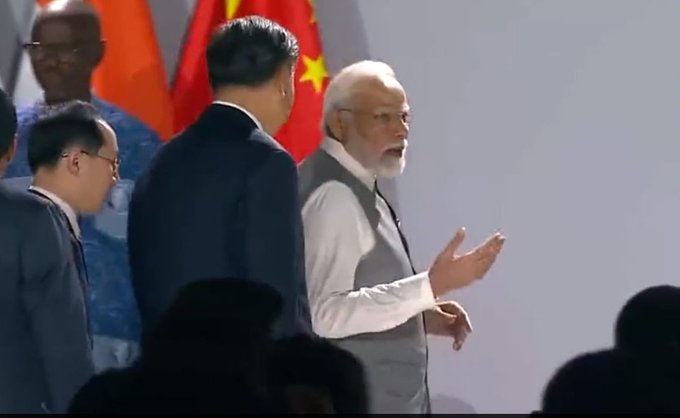
PM Narendra Modi with Chinese President Xi Jinping on the sidelines of BRICS Summit in Johannesburg.
As India’s trade deficit with China surges to alarming levels, Manish Anand argues that economic dependence is fast becoming a strategic vulnerability.
By TRH Foreign Affairs Desk
New Delhi, January 5, 2026 — India’s bilateral trade with China is no longer just an economic concern—it is a strategic alarm bell. Year after year, the numbers tell a story New Delhi can no longer ignore.
In the last financial year, India’s trade deficit with China climbed to nearly $128 billion, up sharply from around $101 billion the previous year and $95 billion before that. In effect, over the past decade, India–China trade has moved relentlessly in Beijing’s favour.
This raises an unavoidable question: What has happened to ‘Make in India’?
A Slogan Under Stress
“Had Make in India succeeded in reducing structural dependence on Chinese imports, the deficit would have narrowed. Instead, it has ballooned—by more than 25 per cent in just one year. Such acceleration is not normal; it is dangerous,” warned Manish Anand, a geopolitics analyst, in a YouTube video explainer for The Raisina Hills.
It confirms an uncomfortable reality: China’s footprint in India’s economy has deepened, not diminished. “From electronics and chemicals to fertilisers and critical minerals, India remains heavily dependent on Chinese supply chains,” he added.
This dependence demands introspection, stressed Anand.
“Have Indian industries failed to align with Make in India? Or have some businesses simply become import traders—bringing Chinese goods to Indian markets at scale, with little incentive to manufacture domestically,” asked Anand.
China’s Leverage Is Structural
To be fair, India is not alone. “China today occupies a commanding position in the global economy. Even advanced economies rely on Beijing for essential inputs. If China chooses, it can bring entire supply chains to a halt,” asserted Anand.
Consider critical minerals—the backbone of electric vehicles, fighter aircraft, advanced defence systems, and next-generation electronics. “China controls roughly 70 per cent of global production and close to 90 per cent of processing capacity. Mining elsewhere is meaningless without Chinese processing technology,” added Anand.
If Beijing tightens the tap, Indian automakers—from Tata Motors to Mahindra & Mahindra—would face immediate disruption.
Another example is fertiliser chemicals, vital for agriculture-dependent economies like India and much of Latin America. “Here too, China enjoys enormous leverage—and has not hesitated to use it globally,” added Anand.
This partially explains why the trade deficit continues to rise. “India has not yet succeeded in meaningfully reducing dependence in strategic sectors,” added Anand.
Trade Grows Despite Border Tensions
What makes the trend even more disturbing is its timing. “After the Galwan clash of 2020, India–China relations entered a deep freeze for over four years. Yet trade not only continued—it expanded, overwhelmingly in China’s favour,” Anand noted.
When ties began stabilising recently, the deficit widened further. “The message is clear: China has become the world’s manufacturing nerve centre. Europe, the United States, and India alike struggle to accelerate growth without Chinese inputs,” added Anand.
Why 2026 Is a Critical Year
This presents a serious challenge for the Modi government as it enters a decisive phase. “Eleven years after the launch of Make in India, a qualitative transformation should have been visible. It is not,” added Anand.
Some corrective steps are underway. “India is diversifying fertiliser supplies through agreements with Russia and Oman, and Indian firms are investing in overseas production. These are important moves—but they will take time,” added Anand. Meanwhile, the deficit continues to widen. In 2025 alone, China reportedly earned over $1 trillion in global trade surplus. To put that in perspective, India’s entire economy is roughly $3.75 trillion. China’s annual trade surplus is nearly one-fourth of India’s GDP.
Economic Dependence Is a Security Risk
This imbalance is not just economic—it is geopolitical. “India shares a long, disputed border with China, from Arunachal Pradesh to Ladakh. Every few years, Beijing raises tensions. If India’s economy remains deeply import-dependent on a strategic rival, its negotiating power weakens dramatically,” added Anand.
There is also a domestic cost. “India’s population is young—average age around 27—yet unemployment remains worryingly high. Heavy import dependence suppresses domestic manufacturing and job creation,” added Anand. This fuels joblessness, which in turn pushes politics towards short-term welfare populism instead of long-term economic reform.
The Unanswered Question
Make in India was meant to reduce vulnerability, create jobs, and strengthen national security. “After eleven years, the data suggests the opposite trend—at least in India’s economic engagement with China,” said Anand.
The question, he said, policymakers must now answer is stark: If China chooses to squeeze, how exposed is India’s economy?
Until that answer changes, the trade deficit is not just a statistic—it is a warning.
(Manish Anand hosts discussions on geopolitics for the YouTube channel of The Raisina Hills)
India–China Relations in 2025: Why Reset Stopped Short of Peace
Follow The Raisina Hills on WhatsApp, Instagram, YouTube, Facebook, and LinkedIn




About The Author